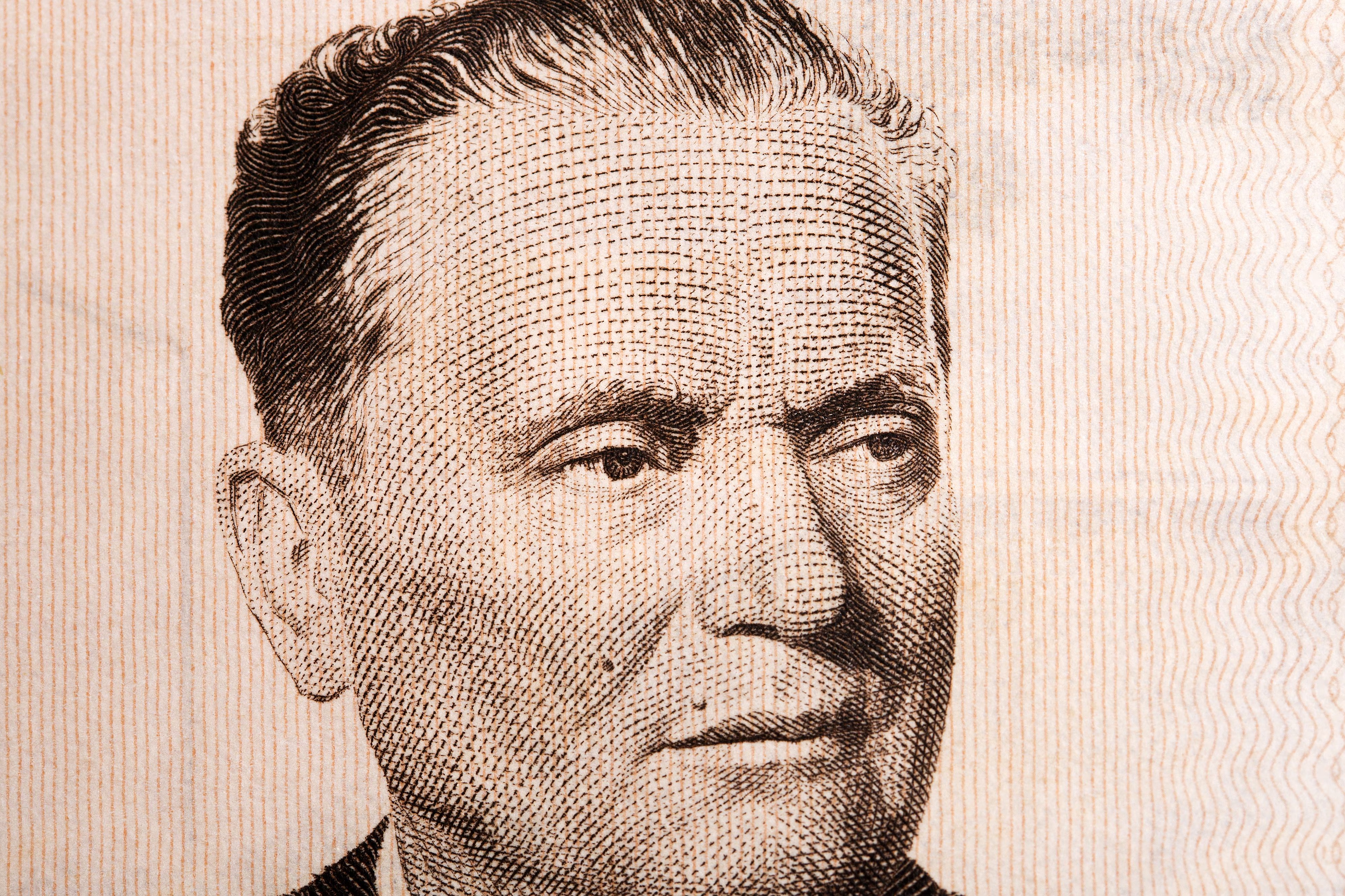
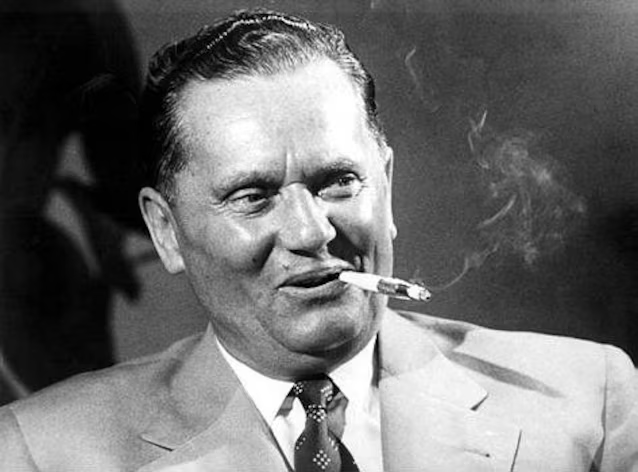
Josip Broz, known as Tito, was a Yugoslavian political leader and dictator. Born in 1892 in Croatian territory, in the 1920s he became leader of the clandestine communist party. During the Second World War he led the Resistance against the Nazi-fascist occupation and after the conflict he became prime minister of the country. He established a socialist republic and governed with authoritarian methods, although his Yugoslavia was a more liberal state than other Eastern European countries. He had no qualms about challenging Stalin’s authority, with whom he came to a public break in 1948. In the following years he became one of the leaders of the Non-Aligned Movement. He remained in power until his death on May 4, 1980, 46 years ago.
Birth and political education of Josip Broz Tito
Josip Broz, better known as Tito, was born on May 8, 1892 in Kumrovec, Croatia (at the time part of the Austro-Hungarian Empire). He belonged to an ethnic Croatian-Slovenian family. As a young man he worked as a laborer and in 1913 he was drafted into the army. He soon developed pacifist and communist political beliefs, to the point that in 1915, shortly after the start of the First World War, he was arrested for anti-war propaganda. In the same year he was sent to fight on the Russian front and taken prisoner together with his entire regiment. Brought to Russia, he was able to witness the fall of the Tsar and the October Revolution, consolidating his communist political beliefs.
He returned home after the war. The Austro-Hungarian Empire no longer existed and a new state was born, Yugoslavia (originally called the SHS Kingdom), which united some Slavic peoples under the Karageorgevic dynasty: Serbs, Croats, Slovenians, Bosnians, Macedonians and others. Josip Broz became leader of the newly formed Yugoslav Communist Party, which however was outlawed by the government and forced to operate clandestinely. To keep their identity hidden, many leaders chose to identify themselves with a nom de guerre. In 1934 Broz chose that of Tito, which became his official name during the resistance. The underground communist party maintained close contacts with the Soviet Union and stood out for its efficiency.
The Yugoslav resistance
In 1941, when Nazi Germany and fascist Italy occupied Yugoslavia, the Communist Party took a leading role in the Resistance. It was not the only group fighting against the occupation, because there were also Serbian nationalists (known as Chetniks) led by Draza Mihailovic. The communists, however, proved to be the strongest formation and organized a vast guerrilla war that put the occupying troops and their Yugoslav collaborators in difficulty, primarily the Ustaša movement, in power in Croatia. Tito gained recognition from the Allies and even from Yugoslav King Peter II, who had gone into exile in England. Thanks to the resistance of Tito’s troops, between 1944 and 1945 Yugoslavia, unlike most European countries, managed to free itself from Nazi occupation on its own, without the intervention of foreign powers.
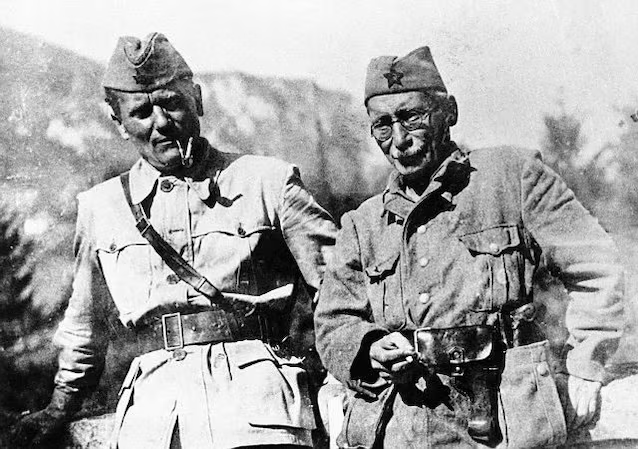
After the war, the Communist Party came to power. A new Constitution was introduced and the monarchy was abolished. Tito was elected prime minister and established a People’s Republic, in which six semi-autonomous republics were united: Slovenia, Croatia, Serbia, Montenegro, Macedonia, Bosnia-Herzegovina. Tito ruled with dictatorial methods, but enjoyed widespread support from the population.
Tito’s role in the expulsions and massacres suffered by non-Slavic ethnic groups (including the Italians in the so-called foibe massacres) is controversial: according to some interpretations he was responsible; according to others the massacres were perpetrated on the orders of local leaders.
The break with Stalin
Tito was linked to the international communist movement, led by the Soviet Union and Stalin, who after the Second World War was involved in the Cold War and demanded absolute loyalty from the satellite countries. Tito, however, was not willing to give up his independence, strong in the fact that his partisans had liberated Yugoslavia without external help. In 1948 the Soviet dictator «excommunicated» Tito, publicly announcing the breakdown of personal relations and cooperation of the communist world with Yugoslavia. Stalin expected the Yugoslav leader to be ousted from power, but Tito, who enjoyed great popularity, remained in office. The break with Stalin created difficulties in the international communist movement, but allowed Yugoslavia to improve relations with the West. In 1954, among other things, Tito and the Italian government reached an agreement on the thorny issue of Trieste.
Internally, a specific form of socialism was introduced in Yugoslavia, based on self-management and the division of the profits of state companies among workers.
Non-aligned Yugoslavia
After Stalin’s death in 1953, Tito reconciled with the Soviet leaders, but maintained his independence and became one of the leaders of the Movement of Non-Aligned Countries, i.e. not aligned with either the United States or the Soviet Union. Although Yugoslavia had some characteristics similar to those of the socialist republics of Eastern Europe, such as the presence of a supreme leader, it was in many ways more liberal. Furthermore, since the 1960s it has allowed its citizens to travel abroad and foreigners to visit the country without the need for a visa. Furthermore, Tito managed to keep the Yugoslav peoples together, avoiding the explosion of inter-ethnic tensions.
Tito’s last years and death
As the years passed, Tito took on the role of a sort of noble father, moving away from the concrete management of power. In 1974 he reformed the constitution and was appointed president for life, guaranteeing, at the same time, greater autonomy to the six constituent republics of Yugoslavia.
On May 4, 1980, following a heart attack, Tito died at the age of 87 in Ljubljana. No leaders endowed with his charisma emerged in Yugoslavia and at the beginning of the 1990s, as we know, inter-ethnic tensions caused the dissolution of the country.
Today Tito’s memory is controversial: in some states and political movements he is considered an enlightened leader capable of holding together a “difficult” country like Yugoslavia; in other contexts he is considered a dictator.