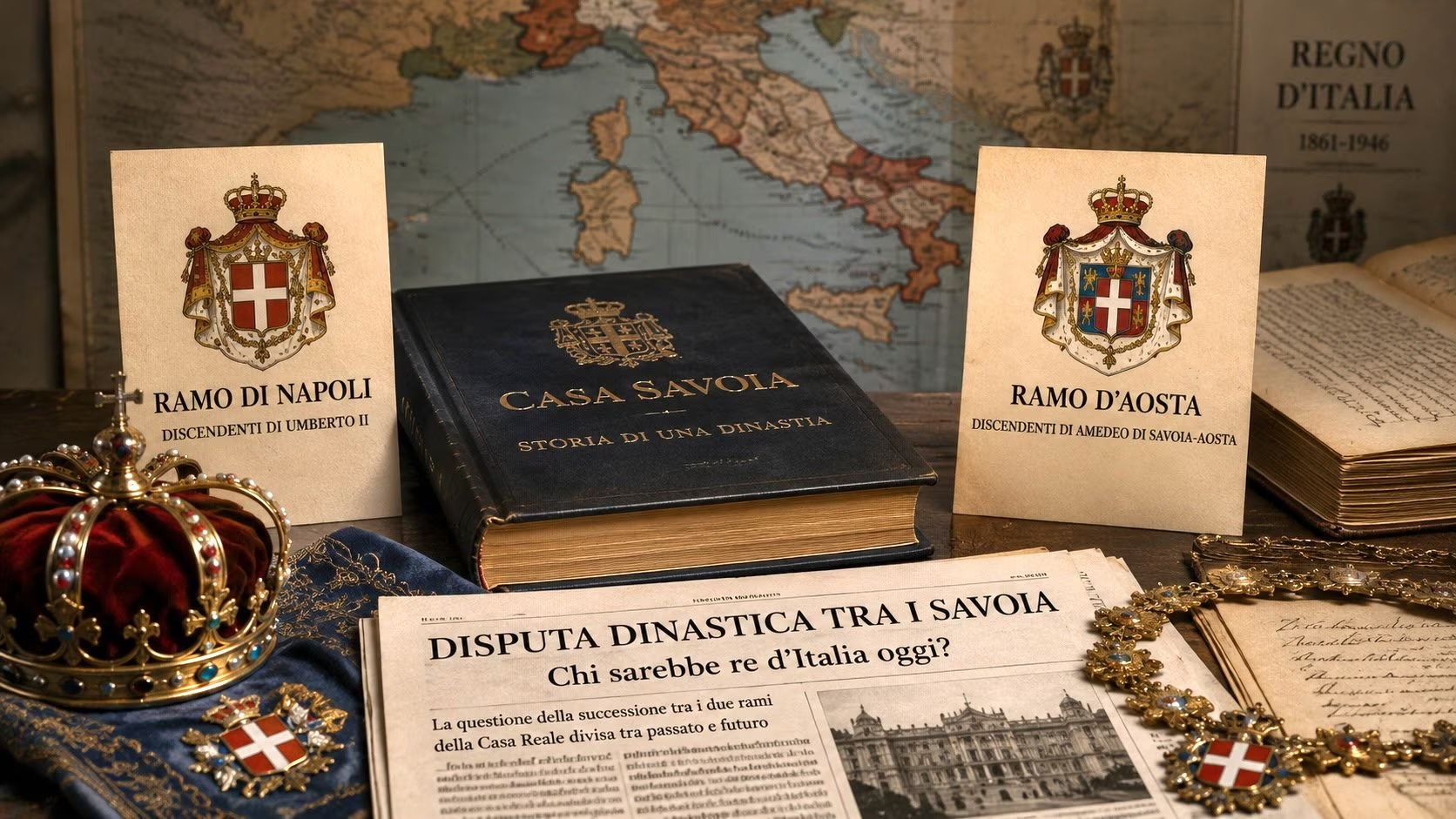
If there was a monarchy in Italy, the throne would, in theory, belong to the exponents of the House of Savoy, the dynasty that reigned over the country from the unification to the establishment of the Republic, i.e. from 1861 to 1946. It is not clear, however, who the king would be: the title of head of the house is disputed between two branches of the family: the Naples branch and the Aosta branch (sometimes defined as Savoy and Savoy-Aosta).
The dynasty has a very long history behind it, which began in the 11th century with Count Umberto Biancamano. In the nineteenth century, the Savoys, who were Kings of Sardinia, played a decisive role in the process of Italian unification. The history of the dynasty, however, was not always glorious. The penultimate king of Italy, Vittorio Emanuele III, collaborated with fascism for twenty years, endorsing its crimes, and for this earned the discredit of the Italians. In June 1946, Italian citizens chose to put an end to the monarchy and establish the Republic. The dynastic dispute, therefore, has no impact on the institutions.
The origins of the House of Savoy: the County and the Duchy of Savoy
House of Savoy is one of the oldest European noble houses. His birth takes place in the Savoy region, located between Italy, Switzerland and France. The first historical figure was Umberto Biancamano, who died in 1048, who obtained the title of Count of Savoy. The county included vast territories beyond Savoy proper and over the years it expanded further, until it gained access to the sea in 1388 by acquiring the territory of Nice.
The title of count was passed on to the male heirs of Umberto Biancamano. In 1416 the county underwent a sort of “upgrade”: Count Amedeo VIII obtained the elevation to duchy from the emperor, Sigismund of Luxembourg. The territory expanded further and the duchy, able to juggle the European powers, in particular between France and the Holy Roman Empire, enjoyed stability throughout the modern age.
From the Kingdom of Sardinia to the Kingdom of Italy
At the beginning of the eighteenth century the duchy took part in the War of the Spanish Succession, allying itself first with France and later with the Empire. The Treaty of Utrecht, signed between the European powers after the war, assigned the Kingdom of Sicily to the Duke of Savoy Vittorio Amedeo II. The Savoys thus obtained the title of king. Their control of Sicily, however, lasted a few years: in 1720, under diplomatic pressure, they exchanged Sicily for Sardinia, retaining the royal title. Thus was born the Kingdom of Sardinia, which included, in addition to the island, the territories previously controlled by the House of Savoy between Piedmont, Valle d’Aosta, Savoy proper and the county of Nice.
The Kingdom played an important role in European events between the eighteenth and nineteenth centuries, increasingly shifting its interests towards the Italian peninsula. In 1831, with the death of King Carlo Felice, the original lineage became extinct and the throne passed to Carlo Alberto, belonging to the cadet branch of the Carignano family.
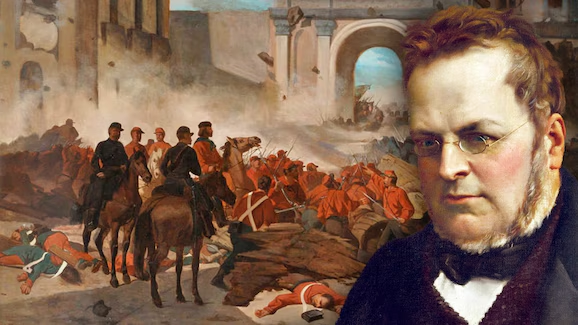
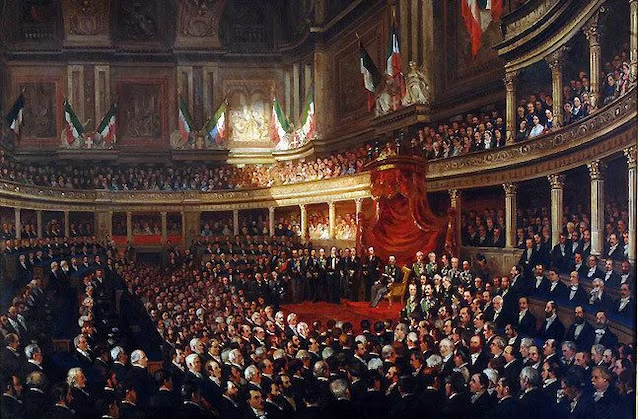
The new sovereign distinguished himself because he accepted, at least within certain limits, the principles of liberalism, and in 1848 he granted his subjects a constitution, the Albertine Statute. In 1848, Carlo Alberto declared war on the Austrian Empire, starting the First Italian War of Independence, but was defeated and forced to cede the throne to his son, Vittorio Emanuele II, in 1849. In the following years, the Kingdom of Sardinia led the process of Italian unification. In 1861, as we know, the birth of the Kingdom was proclaimed and Vittorio Emanuele II obtained for himself and his successors the title of King of Italy.
Monarchy until 1946: then fascism and abolition
The House of Savoy reigned over Italy until 1946: after Vittorio Emanuele II, who died in 1878, Umberto I took over until 1900, Vittorio Emanuele III until 1946 (although he had actually handed over the kingdom to his son in 1944) and Umberto II for just one month between May and June 1946.
For many years the Kingdom was governed under a liberal system. In 1922, however, Vittorio Emanuele III called Benito Mussolini to government, allowing the establishment of the fascist dictatorship. Throughout the twenty years, the king, despite mutual distrust, collaborated with Mussolini, from whom he received the title of Emperor of Ethiopia in 1936 and King of Albania in 1939. Other members of the House of Savoy also obtained prestigious positions from the dictatorship, such as that of viceroy of Ethiopia, awarded to Amedeo of Savoy-Aosta and that of king of Croatia assigned to Aimone of Savoy-Aosta.
The proximity to fascism discredited the monarchy in the eyes of Italians: during the Second World War, when it was clear that the dictatorship had led Italy to catastrophe and the citizens, the vast majority, took a stand against fascism, the monarchy also became an object of discredit. Attempts to save the Royal House in extremis they were not successful: in 1946 the Italians were called to choose between monarchy and republic and took a clear stand for the second option.
King Umberto II and his supporters refused to recognize the results, putting forward the theory that there had been fraud (today we know that the theory was completely unfounded and that the majority of citizens consciously chose the republic). The sovereign, however, was forced to relinquish power and go into exile. The Constitution of the Republic definitively sanctioned the abolition of the monarchy, establishing in art. 139 that “the republican form of the State cannot be the subject of constitutional revision”: it would not be possible in any case to return to monarchy. The Constitution also established that Umberto and his male heirs could not reside in the territory of the Republic (a rule repealed in 2002, when the heirs returned).
The dynastic dispute: who would be King of Italy today if there was a monarchy?
The House of Savoy continues to exist as a historical dynasty, devoid of real political power. The House awards noble titles, which however are not recognized by the State, and organizes cultural and commemorative activities.
“Control” of the House is contested by two branches. On one side are the direct descendants of Umberto II (sometimes called the Naples branch), who recognize Emanuele Filiberto, son of Vittorio Emanuele (in turn son of Umberto II) as their leader; on the other side are their cousins from the Savoy-Aosta branch, according to whom the fact that in 1970 Vittorio Emanuele had contracted an “unequal” marriage (i.e. with a woman not belonging to royal families) without his father’s consent would have automatically excluded him from the line of succession. The dispute began in the 2000s between Vittorio Emanuele and Amedeo d’Aosta and did not always develop with “elegant” means, to the point that, during a reception in Spain in 2004, Vittorio punched his cousin. Today the dispute, with the parents gone, continues through their children, Emanuele Filiberto and Aimone of Savoy-Aosta (grandson of the former king of Croatia), each of whom claims to be the legitimate head of the House of Savoy and, theoretically, king of Italy in the event of a monarchical restoration.

Both continue to assign noble titles and honors (without, as we have seen, legal value) and both boast the surname “Savoia”.
In any case, in Italy only small minorities of citizens are nostalgic for the monarchy and the risk of restoration is currently non-existent. Therefore, the dynastic dispute has no effect on the institutions of the Republic.