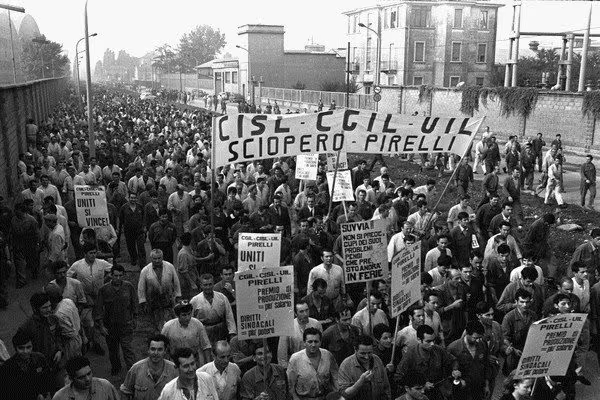
By Hot Autumn we mean the cycle of workers’ struggles that took place in Italy between the months of September and November 1969, with an extraordinary season of trade union struggles, workers’ strikes and social demands. The struggles, including strikes and occupations, developed in numerous regions, but were particularly intense in the large factories of the industrial triangle (Milan, Turin and Genoa). The cycle of protests was triggered by a series of reasons, including the radicalization of some sectors of the working class, which demanded equal wage increases for all and the reduction of working hours to 40 hours per week, the development of the 1968 movement and the atmosphere of protest that spread in some sectors of public opinion, the expiry of some important collective agreements. The Hot Autumn struggles ended with significant contractual improvements for the workers. Furthermore, the following year Parliament approved the Workers’ Statute, which recognizes numerous rights and is still in force today, although some articles have been modified in recent years.
What was the hot autumn of ’69
Hot Autumn is the name given to the season of intense workers’ and trade union struggles that took place in Italy in 1969, particularly from September to November. The hot autumn was characterized by mass strikes, demonstrations, factory occupations and mobilisations which involved millions of workers, particularly in the large industrial complexes of the Northern regions, in the demand for salary increases and fairer wages in general.
The origins of workers’ struggles: the new left and 1968
The struggles of the Hot Autumn originated from various factors, including the political radicalization of some sectors of society, especially young people, who in the 1960s had distanced themselves from the institutional left and had embraced more extremist ideas. Even in the working class, the younger component often followed radical ideas. Thus a new left was born, less willing to compromise.
At the end of the decade, as we know, the vast movement of ’68 developed, that is, a protest that mainly involved universities and schools, but also spread outside the world of education. Students and other young people rebelled against the political and cultural system, demanding more freedom and less authoritarianism.
1968, which spread on a global scale, significantly affected Italian universities and schools. In our country, the student protests were linked to the workers’ struggles of 1969, which in many cases were supported by students.
The hot autumn also arose from economic reasons: after the boom that had taken place in the 1950s, prosperity had spread across vast sectors of Italian society, but the expectations of the less well-off classes, particularly those of the workers, had not been fully satisfied and poverty continued to be widespread.
The main events and historical achievements
The cycle of struggles of 1969 began already in the spring months. Workers went on strike in many factories to demand wage improvements, reductions in working hours and recognition of greater rights. Furthermore, in 1969 important collective agreements expired and the renewal made tensions more acute.
Negotiations for the renewal of the metalworkers’ contract began in September, but the employers initially stiffened and refused to accept the requests of the non-unions. Thus began a cycle of strikes, which, although mainly involving the large factories of the industrial triangle (Fiat, Alfa Romeo, Pirelli, Italsider and others) spread to numerous regions. As time passed the fighting became more intense. On many occasions, in addition to ordinary strikes, internal strikes were called (workers entered the factory but did not work), meetings were called and, in some companies, works councils were established. The three largest unions, CGIL, CISL and UIL, acted in a substantially unanimous manner to support the workers’ demands, although they were not always able to direct the protests, which in some cases escaped their control.
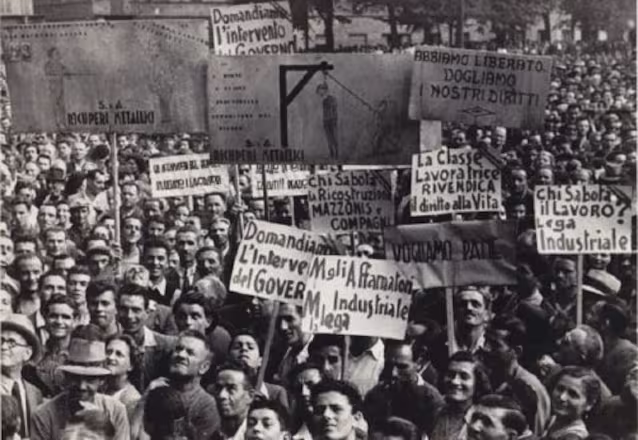
On several occasions the workers clashed with the police and on 19 November a tragic event took place in Milan: during the clashes an officer, Antonio Annarumma, died. His death made tensions more acute.
In December, however, the cycle of struggles weakened: many national contracts were signed which, acknowledging the workers’ requests, guaranteed numerous improvements in terms of working hours, wages and rights.
The Workers’ Statute becomes law to this day
In addition to contractual improvements, the struggles of the Hot Autumn had another important, more lasting consequence: the enactment of law no. 20 May 1970. 300, better known as the Workers’ Statute.
The Statute recognized numerous rights for workers, including freedom of association and opinion, the protection of dignity, the right to assembly, and the repression of anti-union conduct by employers. In article 18, the Statute also provided for protection from illegitimate dismissals in companies with more than 15 employees, obliging the employer to reinstate the unjustly dismissed employee. The law, however, has been modified in recent times with the Fornero law (2012) and with the Jobs Act of the Renzi government (2015), which have made the right to reinstatement of the unjustly dismissed worker more limited.
The other provisions of the 1970 Statute are largely still in force.
https://www.geopop.it/cose-stato-il-movimento-del-68-breve-storia-delle-contestazioni-in-italia-e-nel-mondo/