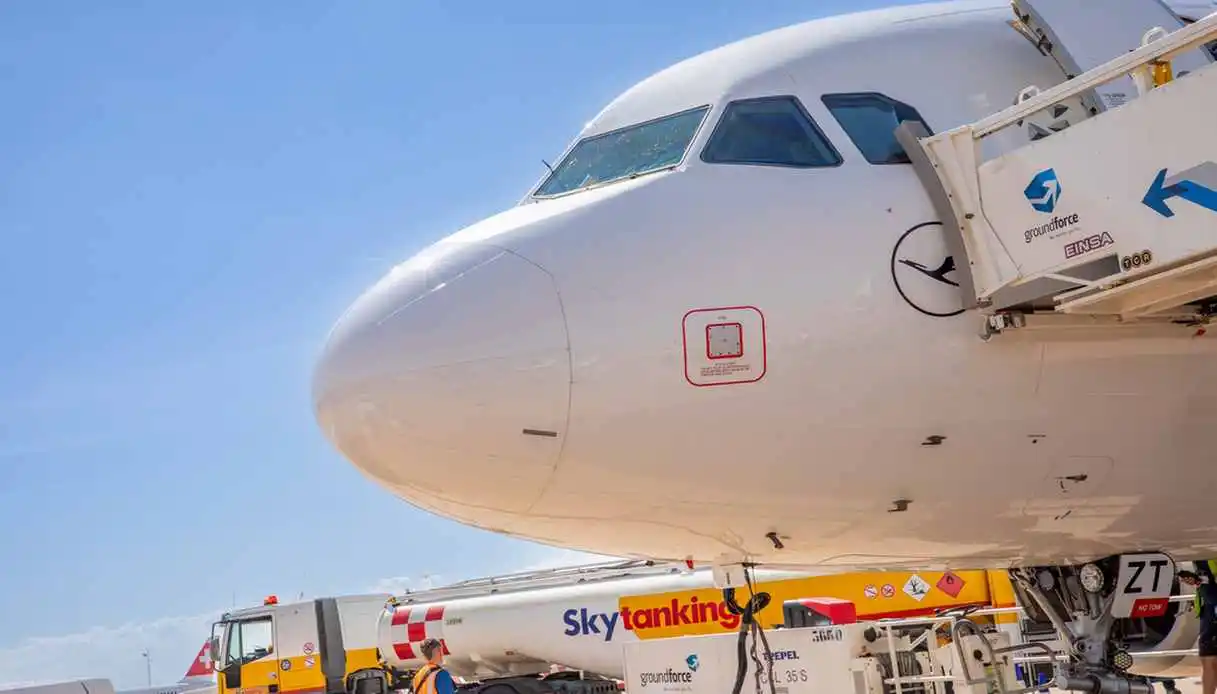
Europe enters the final quarter of the year with a new risk for airlines and travellers. The continent could see a jet fuel deficit of 510,000 barrels a day, Energy Aspects estimates. It does not mean that airports are destined to run out of kerosene: the difference can be made up by imports. However, purchasing jet fuel from increasingly distant suppliers exposes the sector to more expensive transportation, longer transport times and new disruptions.
Fuel now absorbs almost a third of companies’ operating costs and the same price increase can produce very different results. What will determine who will resist best will be the coverage already stipulated, the liquidity available, the profitability of the routes and the possibility of transferring the price increase to tickets without losing passengers.
Why Europe risks an aviation fuel deficit
The war in Iran has reduced Europe’s traditional jet fuel imports from the Middle East by about half. To replace them, Europe turned to the United States, Canada, Nigeria and South Korea. In September, South Korean deliveries reached around 129,000 barrels per day, the highest level since October 2022.
The problem does not only concern incoming flows. In the Amsterdam-Rotterdam-Antwerp hub, the European reference point for refining and storage, independent stocks fell to seven-year lows. France has therefore asked Brussels for immediate interventions and a temporary relaxation of some technical rules, which could allow European refineries to increase the production of diesel and aviation fuel by up to 20%.
Asia, on the other hand, has an expected surplus of 419 thousand barrels per day. The price differential makes it convenient to ship the product to Europe, but shifts the risk to shipping routes and logistics costs.
Fuel accounts for almost a third of budgets
IATA’s analysis of the impact of energy prices shows that jet fuel is expected to account for 31.4% of the sector’s operating costs in 2026, up from 25.4% the previous year. Overall spending could reach $350 billion.
An increase in prices does not immediately turn into a loss of the same size. Companies resort to hedging, the strategy used to reduce the risk of price fluctuations by purchasing part of their requirements in advance through derivative contracts.
Wizz Air, for example, has covered approximately 80% of its needs for the next twelve months at a value close to half of current market prices. The protection helps the accounts, but upon expiration the contracts must be replaced on the new terms. Hedging therefore makes costs more predictable, but does not always guarantee the best price.
Which companies are most exposed
It is not enough to distinguish between traditional and low-cost carriers. The latter depend on competitive rates, but often have extensive coverage. Large groups may have higher costs, but business customers sometimes allow them to defend their revenues better.
| Financial factor | Greater protection | Greater exposure |
|---|---|---|
| Fuel covers | High share at below market prices | Purchases concentrated on current prices |
| Liquidity | Abundant cash and sustainable debt | Fragile balance sheet and expensive refinancing |
| Pricing power | Routes with strong demand or few competitors | Passengers very sensitive to fares |
| Operational flexibility | Possibility to move aircraft | Rigid network and unprofitable routes |
| Fleet efficiency | New airplanes with reduced consumption | Older aircraft and higher consumption per seat |
The market will observe average cost per ton, percentage covered, contract expiry and scheduled capacity. Wizz Air has already reduced its winter offer by 5%; other carriers have scaled back flights or traffic targets on less profitable routes.
Reducing capacity protects margins, but can produce a second effect: fewer seats available on the most popular routes. It is this step, more than just the price of oil, that can support tariffs.
When the price increase hits the price of flights
There is no automatic relationship between jet fuel and tickets. Rates depend on demand, competition and available seats. According to Eurocontrol’s latest weekly overview, real prices between January and July were still around 1% lower than in 2025, despite the fact that fuel had already started to rise again.
The data shows the delay with which the shock passes through the system: first it is absorbed by the hedges or margins; then companies can reduce frequencies and routes; when supply shrinks it becomes easier to raise prices.
For Italy the risk mainly concerns connections with the islands, routes with few operators and periods of greatest demand. ITA Airways has indicated fuel among the factors that could impact 2027 rates, as explored by QuiFinanza on possible increases in airline tickets.
The three scenarios for companies and passengers
| Scenario | What should happen | Probable effect |
|---|---|---|
| Loosening | More European production and regular flows from Asia | Lower pressure on costs and tariffs |
| Deficit managed | Sufficient but expensive imports | Margins under pressure and selective price increases |
| New shock | More lockdowns, lower inventories and less capacity | Flight cuts and more widespread increases |
The central scenario is not that of airports without fuel, but of a Europe forced to pay more for it and import it from further away. For investors this means distinguishing between seemingly similar companies, checking financial protections and balance sheet strength.
For passengers, however, seat availability matters. Price increases will be more likely where frequencies decline, demand remains high and competition is limited.
Oil doesn’t tell the whole story. The economic price of the crisis will be decided by jet fuel logistics, coverage deadlines and capacity choices. It is there that it will be established who will absorb the final cost: the shareholders through lower profits or the travelers through more expensive tickets.