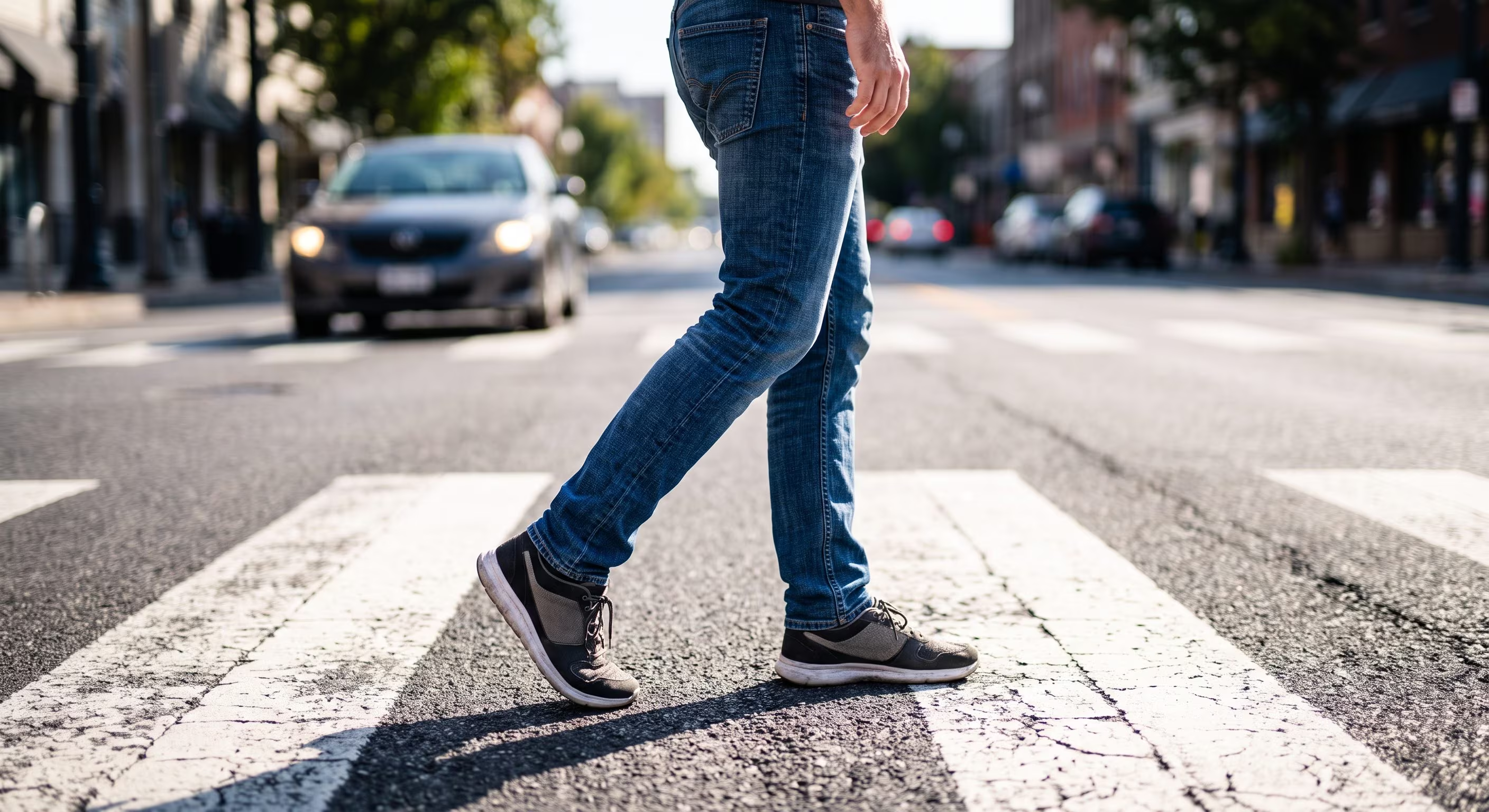
When it comes to the Highway Code, there is a very widespread belief which in some cases can prove to be incorrect: the pedestrian is the most protected subject (being also the most exposed and vulnerable) and, in the event of an accident, he is always right. In short, in the collective imagination it might seem that those who walk on foot have no obligations to respect.
In reality, things work differently and the Highway Code is very clear. The regulatory reference is article 190 of the Highway Code, which regulates the behavior of pedestrians as road users: the law establishes first of all that pedestrians must circulate on sidewalks, on platforms, on avenues and in other spaces provided for them. Only in cases where the latter are missing, cluttered, interrupted or insufficient, then it is allowed to walk on the edge of the road, but keeping to the side opposite to the direction of travel of the vehicles, so as to cause the least possible obstruction.
This first point already clarifies an important element: walking on the road when there is a passable sidewalk is, in all respects, a violation.
But the most delicate point concerns crossing and in this case the obligations for the pedestrian are expressly outlined. More specifically:
- If the pedestrian crossing is less than 100 meters away, the pedestrian has the obligation to use it by reaching it.
- Only if there are no pedestrian crossings, or when they are more than 100 meters apart, can the pedestrian cross the road, but only perpendicular to the road and with the necessary attention to avoid dangerous situations for himself or others. In this case, however, paragraph 5 of article 190 specifies that the right of way belongs to the drivers and not to the pedestrian. In other words, without crosswalks, priority goes to vehicles.
- In any case, pedestrians are prohibited from crossing intersections diagonally, crossing squares and outside the stripes (even if they are more than 100 meters away) and passing in front of buses or trams stopped at stops.
In addition to the dangers to their own safety, in the event of a violation, pedestrians also risk an administrative fine ranging from €26 to €102.
However, it should be clarified that the objective of article 190 is in no way to limit protections in favor of pedestrians: however, even if they do not drive a vehicle, those who travel on foot are still road users and must respect some fundamental rules to protect themselves and others.
The protections for pedestrians come immediately in the next article, article 191 of the Highway Code, which specifically requires drivers:
- The obligation to give precedence, gradually slowing down and stopping, to pedestrians who pass on pedestrian crossings or are in their immediate vicinity when traffic is not regulated by officers or traffic lights;
- In the case of roads without pedestrian crossings, the obligation to allow the pedestrian, who has already started crossing the roadway, to reach the opposite side of the roadway in safe conditions.
In summary, therefore, in the presence of pedestrian crossings, the right of way belongs to pedestrians (who have the obligation to use them if they are less than 100 meters away); outside the pedestrian crossing, the right of way belongs to the drivers, who still have the obligation to allow the pedestrian who has already started crossing to reach the opposite side of the road.