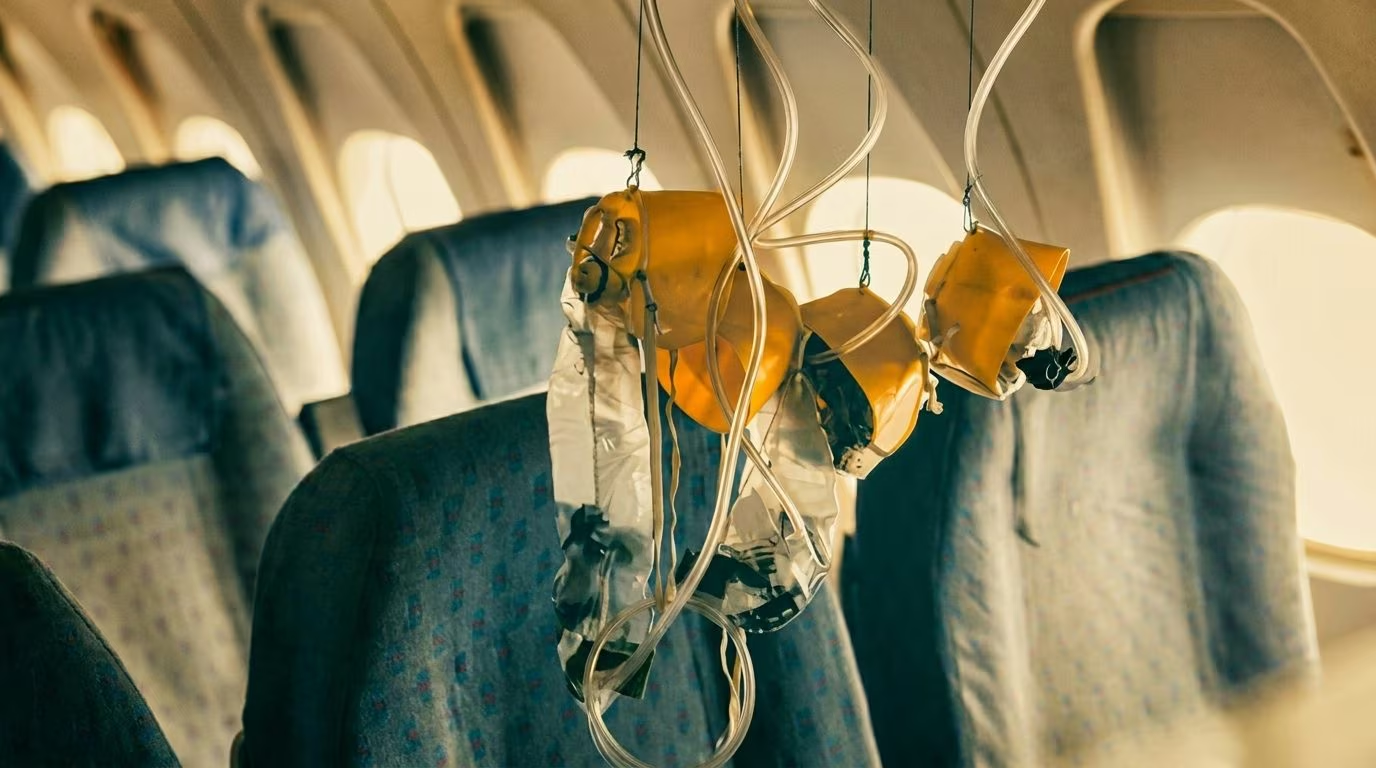
A British Airways Boeing 777-200ER headed from London Heathrow to Chicago O’Hare made a rapid emergency descent, dropping about 28,000 feet in a matter of minutes while flying over Ireland, going from about 37,000 feet to 9,000 feet. Oxygen masks came off in the cabin, the pilots declared an emergency by transmitting transponder code 7700, and the plane turned back towards London, landing safely at Heathrow after remaining aloft for a few hours to burn fuel and reduce weight before landing. Fortunately, no passengers were injured.
The causes have not yet been clarified but, according to experts, it could have been a cabin pressurization problem: but what physically happens to an airplane (and its occupants) when the cabin loses pressurization and what are the safety procedures in these cases?
What we know about British Airways flight BA295
British Airways Flight BA295, operated by a Boeing 777-200ER, took off from London Heathrow Airport on the morning of 5 October 2026 for Chicago O’Hare Airport. According to Flightradar24 tracking, the plane departed around 11:50 am (local time) and reached a cruising altitude of around 37,000 feet (about 11,300 meters).
About an hour after takeoff, while flying over Irish airspace, the Boeing 777 began a very rapid (but apparently controlled) descent, losing approximately 28,000 feet in altitude until reaching 9,000 feet in less than ten minutes. The pilots broadcast the code 7700, the universal signal to communicate a general emergency to air traffic controllers and signal that the aircraft needs priority attention.
In the cabin, the oxygen masks automatically detached from the overhead panels. After reaching the safe altitude, the plane reversed course and flew for a few hours over Ireland and the Irish Sea before landing. The reason for this wait is related to weight: long-haul flights carry large amounts of fuel and a plane that turns back shortly after departure may find itself above the maximum permitted weight for landing. The pilots then flew in circles to dump excess fuel before they could make a safe landing at Heathrow.
In any case, the exact technical cause of the emergency was not disclosed, but according to experts, a rapid descent towards 10,000 feet, accompanied by the emergency code 7700, could be associated with a cabin pressurization problem.
The safety procedure when the cabin loses pressurization
To understand why the pilots of flight BA295 decided to turn back to Heathrow airport, we need to take a step back: what is the pressurization for and what happens when it is missing?
Airliners routinely fly at altitudes between 30,000 and 40,000 feet (about 9,000-12,000 meters). At these altitudes, the outside air is too thin to allow normal breathing: the atmospheric pressure is so low that the human body cannot absorb enough oxygen. For this reason, commercial aircraft are generally equipped with a pressurization system, which keeps the interior of the cabin at a pressure equivalent to that which would be found at an altitude much lower than the actual flight altitude.
As reported by the FAA (Federal Aviation Administration), the operation of the system is rather outlined: the air is normally taken from the aircraft’s engines, compressed and conveyed into the cabin through the air conditioning system. A controlled outlet valve (called outflow valve) regulates the speed at which the air leaves the aircraft, thus maintaining the internal pressure at the desired level. It is a system designed with multiple levels of safety: if the air supply from one engine fails, the other engine can compensate. If both engines stop providing air, the APU (the auxiliary power unit) can take over.
But what happens if, due to a system failure or a leak, the cabin pressure can no longer be maintained? This is where the emergency descent procedure comes into play, the one that the pilots of flight BA295 most likely performed.
According to the guidelines published by SKYbrary (the aviation safety platform managed by EUROCONTROL in collaboration with ICAO and the Flight Safety Foundation), the first action of the crew is to put on oxygen masks. The reason is linked to what is called “useful consciousness time”, i.e. the time that passes between exposure to an oxygen-poor environment and the moment in which a person is no longer able to act lucidly. According to FAA aeromedical documentation, at 35,000 feet the useful consciousness time is only 30-60 seconds. In case of rapid decompression, the time is further halved, reaching 15-30 seconds. At 43,000 feet, the time drops to 9-12 seconds.
Once the mask is put on, the pilots begin the emergency descent. The goal is to get the plane to 10,000 feet (about 3,000 meters) or to the minimum safe altitude, whichever is higher due to the terrain. This is because at 10,000 feet, the atmospheric pressure is generally sufficient to breathe normally without supplemental oxygen.
At the same time as the descent, the pilots declare the emergency and inform the air traffic controllers who, as the FAA always explains, coordinate the air traffic below to allow the plane to descend safely, without risk of collision with other aircraft.
In the cabin, meanwhile, oxygen masks automatically detach from panels above the seats, which provide supplemental oxygen for a limited time, in most planes about 12 to 20 minutes. That may seem short, but it’s more than enough: a plane flying at 37,000 feet can reach 10,000 feet in about seven minutes.