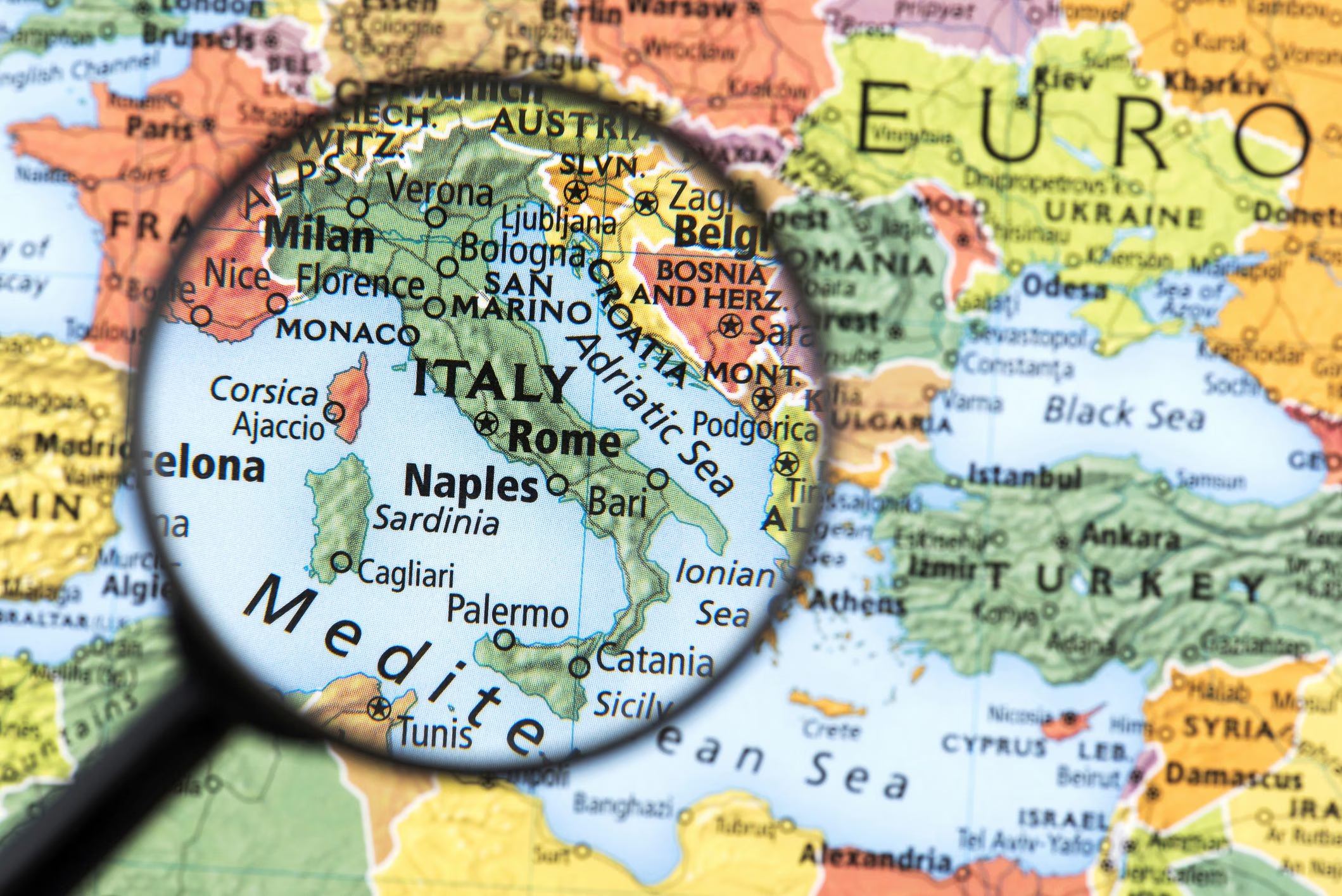
Europe is preparing for winter with the lowest gas stocks in the last 15 years, while Italy faces the appointment in a decidedly more solid position. According to the most recent data, European storage is around 72-73%, compared to 88% in our country, now one step away from the objective set by Arera.
A picture that intertwines prices, supplies from Russia and political choices that are also being played out in Washington. Here’s the general picture, why Rome is so far ahead, Trump’s role and above all some details on the age-old Russian issue.
Gas stocks in Europe
European depots are 72% full, compared to 83% a year ago, according to the winter report by Entsog, the network operators’ association. Data from Gas Infrastructure Europe, as of 6 October, indicate a level of just under 73%, equal to 826.3 TWh, compared to 945.86 TWh in the same period of 2025.
In particular, the most critical situation concerns the large markets in the North, with Germany and the Netherlands below 60% with Germany stuck at 146.68 TWh, compared to over 190 last year. The origin of everything is clearly the crisis in the Gulf, which has blocked the route through which about a fifth of the world’s liquefied natural gas passes, causing prices to rise and making it less convenient to fill the deposits during the summer.
Because Italy is better
The Italian picture is very different. According to Gas Infrastructure Europe, as of October 6, national storage exceeded 88%, with a total reserve of 179.45 TWh. A constant progress over the months, considering a level close to 80% in August and 84.8% in September.
Slight decline compared to 2025, when stocks on 6 October were at 188.85 TWh, which however does not affect the positive result. At the end of last October it reached 94.7% but now a clear approach to that threshold cannot be ruled out. Having said that, we still remain at one of the highest levels in Europe. Enough to cover a significant portion of winter demand.
An advantage that has several reasons. A decisive boost came from the inventory premium recognized to operators, which made it convenient to fill the warehouses even when the market did not allow it. Added to this is a diversified supply network, with gas pipelines from:
- Algeria;
- Azerbaijan;
- Libya.
Added to this are the regasifiers of:
- Panigaglia;
- Cavarzere;
- Piombino.
The last element to point out, then, is a high storage capacity compared to consumption. On the alliance front, Giorgia Meloni’s trip to Oslo was important. A key moment, because it was the first visit by an Italian Prime Minister in about 15 years. All with the theme of energy security at the centre.
Net of all this, we are one step away from the objective set by Arera: filling the warehouses to 90% by October 31st. With deposits above 88% as of October 6th, approximately two percentage points are missing. A goal that appears within reach by the end of the storage season.
Russian gas
With Europe having low inventories, every incoming cargo counts, including those from Russia. According to the German NGO Urgewald, in the first nine months of 2026 European ports received around 16 billion cubic meters of Russian liquefied gas.
We are talking about a record, with an estimated value of almost 8 billion euros. In practice, one load in seven is Russian, almost all of which comes from the Yamal Arctic facility. Inevitably all this sparks debate. It is true that Moscow’s gas helps fill the deposits, but the EU has decided to gradually close the tap.
Short-term contracts are already prohibited, while long-term ones will be prohibited from 1 January 2027. Replacing those volumes, however, clearly has a cost. According to the Ieefa institute, compensating for the lower stocks with new imports would cost around 3 billion euros, 12% more than a year ago, with the European reference price which has moved around 63-64 euros per megawatt hour on the markets.
Risks for the winter?
Answering doubts immediately, gas should not be missing in winter. The margins, however, are narrow. With few supplies, in fact, it will be more difficult to withstand a possible cold wave at the end of winter. Liquefied gas covers 40% of European supplies and, to reach spring with a safety reserve, almost 100 billion cubic meters would be needed in six months.
We cannot only look at the immediate, on the contrary. Adding the decline in inventories and the stop to Russian gas since January, according to Ieefa, Europe may have to reduce winter consumption by 7%, equal to 14 billion cubic meters. This explains the agitation of various governments:
- the Netherlands has allocated up to a billion to fill the deposits;
- Germany has asked the public company Sefe to buy more methane;
- Italy, with high stocks, starts from a calmer position with respect to expected consumption.
Addiction to Trump
In the background, however, there is a political element that is moving and can change the balance. In fact, in September the American Congress approved the Lindsey Graham Act. This forces the US president to evaluate a list of Russian entities to be sanctioned, including Novatek, the company that controls the Yamal plant. The first deadline expires on October 18th.
In fact, if Trump decided to attack Novatek, banks, insurers and shipowners would be forced to leave Yamal and Russian gas would stop arriving in Europe about 2 months early. However, the law also allows sanctions to be waived, justifying the choice to Congress. The hypothesis is currently described as “not unlikely”.
However, everything would be intertwined with business interests, according to some reconstructions. Readings yet to be verified, which however underline how part of European energy stability also depends on the choices of the White House.