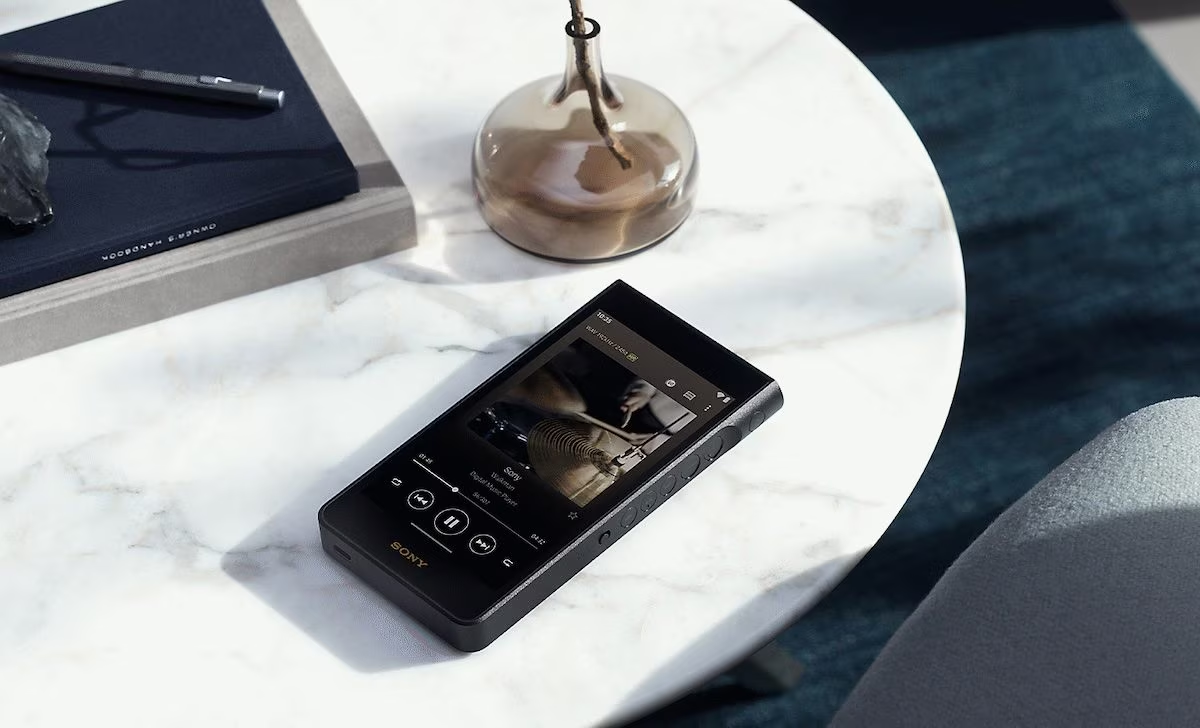
The Walkman, launched by Sony in 1979, changed the way we listened to music on the go. Forty-seven years later, that name identifies devices very different from the original cassette player. In fact, on 15 October 2026, the company announced two new models, the NW-WM1AM3 and the NW-WM1ZM3, arriving in November with prices of 2,499 and 4,999 euros. Figures that may be surprising, considering that today a smartphone allows you to access millions of songs without purchasing a separate device.
The new Walkmans, however, represent only a part of the market. Cheaper models continue to find space alongside devices designed for high-fidelity audio enthusiasts, while attention is growing for some players that are no longer in production. The available data helps to understand what space these devices still occupy today and what needs push some people to purchase them.
The music player market today: what the data says
The spread of digital platforms has profoundly changed listening habits. In Italy, according to the Italian Music Industry Federation (FIMI), in the first six months of 2026 streaming generated 179 million euros out of a total turnover of recorded music of around 225 million. These are figures that show the weight of streaming in the record market, but they do not indicate how many portable players are purchased or through which devices the songs are listened to.
To find device-specific statistics, it’s helpful to look to Japan, where analytics firm BCN collects actual sales data at numerous electronics stores and online retailers. One of his studies published in 2016 showed that in 2015 units sold had fallen to around a third of those recorded in 2010, with a drop of around 20% compared to 2014 alone. It is a historical comparison, not a 2026 measurement, but it allows us to understand the extent of the downsizing.
Music players, however, have not disappeared from the shelves. In the BCN ranking of July 2026, the first three places were occupied by Sony Walkman of the A and S series, different in features and prices from the newly announced models. Already in September, however, the ranking had changed: two MP3 players from Green House, a Japanese manufacturer of cheaper devices, had risen to first and second place, while the Sony NW-A306 and NW-A307 occupied third and fourth position respectively.
In the same month, Green House reached 44.3% of units sold monitored by BCN, compared to 28.5% for Sony. The latter had led the annual ranking of manufacturers for fifteen consecutive years, from 2011 to 2025.
These percentages, however, refer to the Japanese retailers included in the surveys and do not represent the global market. Furthermore, a higher share does not necessarily equate to an increase in total sales. The NCB itself describes a much smaller sector than in the past, in which Sony also recorded a decline in units sold. There is therefore a lack of sufficient data to quantify the phenomenon on a global scale or speak of a generalized recovery.
The return of used iPods amidst nostalgia and fewer distractions: who buys them
Apple’s iPods, whose line was definitively discontinued in 2022, are also attracting attention on the used and refurbished market. According to data communicated by eBay to Axios, between January and October 2025 searches on the platform grew by 25% for the iPod Classic and 20% for the iPod Nano compared to the same period in 2024. These are searches, not necessarily purchases.
Feedback on sales comes from Back Market, a platform specializing in refurbished products. iPod Shuffle unit sales increased 453% year over year, ITV News reported in August 2026. The percentage is high, but without knowing the initial volumes it is not possible to know how many units have been purchased nor to evaluate the weight of the phenomenon on the overall market.
Behind this interest there is first and foremost the nostalgia for the technology of the 2000s, from the circular bezel of the Classic to the small size of the Shuffle, which doesn’t even have a screen. However, the testimonies collected by Axios show that these devices also fascinate some young people from Generation Z.
One of the reasons is the ability to listen to music without constant distractions. On models like Classic, Nano and Shuffle no notifications from social networks, messages or calls to other applications arrive. It is a choice reminiscent of that of those who return to using i dumbphonemobile phones with essential features, to limit interruptions during the day.
Then there is the relationship with one’s music collection. An iPod Classic allows you to search and play stored songs using the dial, while the Shuffle is controlled with a few buttons. The songs can be listened to without an Internet connection, provided you have first transferred them to the player’s memory. Smartphones also allow you to play local files, and many platforms offer offline listening. The difference lies above all in the user experience, more concentrated on a single activity.
Why buy a high-end music player
For other buyers, however, the priority is audio quality. The so-called Digital Audio Player (DAP) can integrate amplifiers and connections designed for listening with particularly demanding wired headphones. The new Sony Walkman NW-WM1AM3 and NW-WM1ZM3, for example, use an S-Master HX digital amplifier and have both a traditional 3.5 mm output and a balanced 4.4 mm output, intended for compatible headphones.
The most expensive model employs an oxygen-free copper chassis with a claimed purity of 99.99%, coated in gold. According to the Japanese giant, the choice of materials and the design of the circuits help to reduce electrical interference. The less expensive version instead uses an aluminum alloy main frame.
Furthermore, these Walkmans do not give up modern features. They have Android 16, a 5.5-inch touch screen and Wi-Fi to access streaming applications. The internal memory is 128 GB for the NW-WM1AM3 and 256 GB for the NW-WM1ZM3, in both cases expandable via microSD. As for battery life, Sony claims up to 35 hours of MP3 playback using its music application, under specific conditions.
The two models also support audio formats such as FLAC and DSD. While MP3 compresses the sound by eliminating some of the information, FLAC uses lossless compression compared to the source audio file.
These features, however, do not automatically guarantee better listening than that offered by a smartphone. The result depends on the quality of the recording, the headphones used and the listening conditions. Many smartphones can already play lossless audio and connect to external converters or amplifiers. Spotify also offers lossless quality listening to Premium subscribers. For most users, therefore, the smartphone remains a more than sufficient solution.