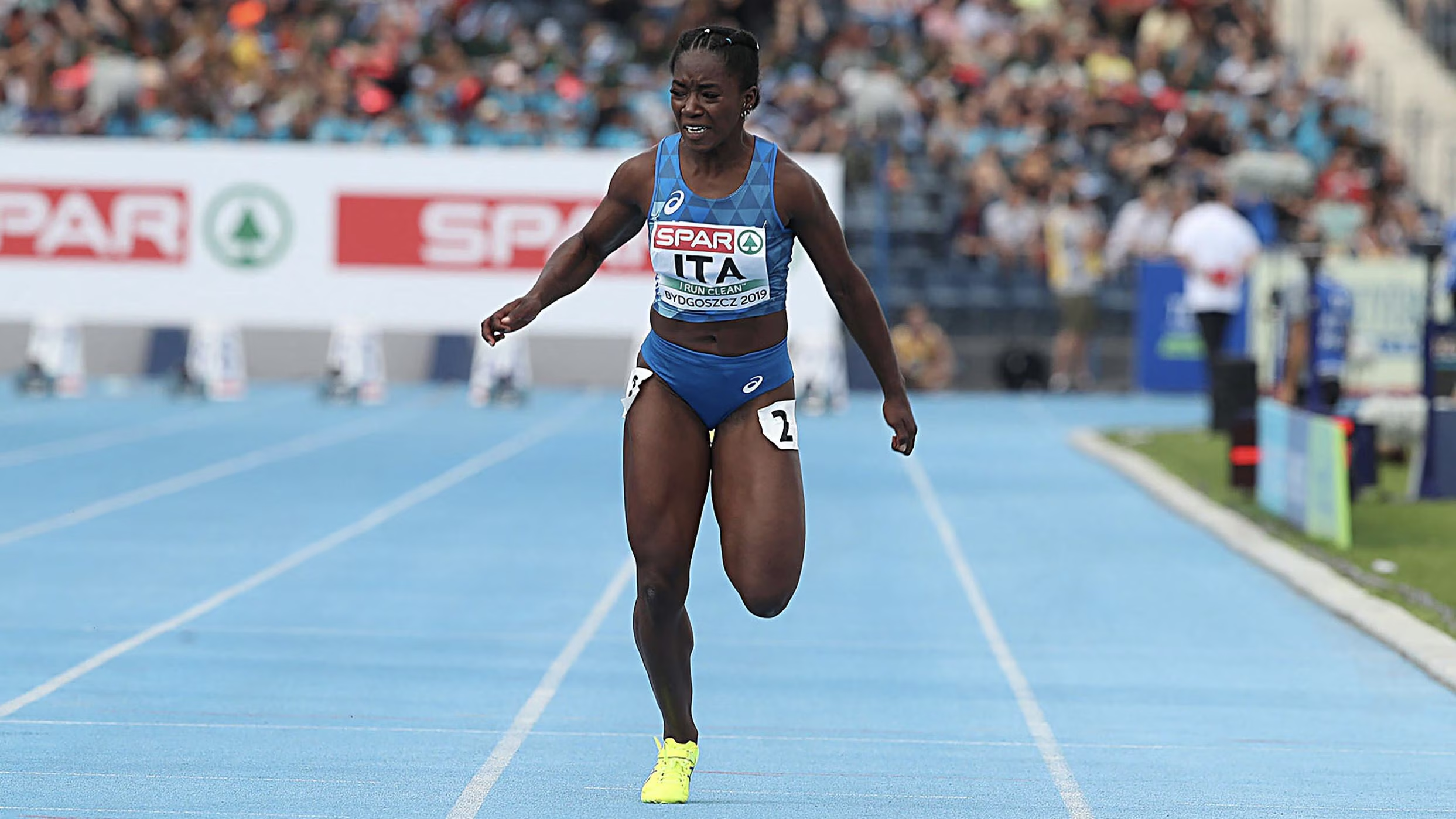
With the Italian record in the 60 meters indoors (6″99the first Italian to go under the 7-second barrier) and the one in 100 meters (11″01), Zaynab Dosso it is the reference point of the Italian sprint. Born on 12 September 1999 in Man (Ivory Coast), in her career she became world indoor champion in Toruń 2026 and European champion in Apeldoorn 2025 in the 60 metres, also winning bronze in the 100 meters at the European Championships in Rome 2024 and in the 4×100 in Monaco 2022. From her first races in Rubiera (Emilia-Romagna) to her transfer to the United States under the guidance of the coach Ken Harndenthe Italian sprinter talks about her sporting and scientific evolution between track details, mental management and goals towards Los Angeles 2028.
What was your path once you arrived in Italy and how did you approach athletics?
It all started a bit by chance, although I like to think that there is nothing purely random in life. As a child in Ivory Coast we constantly jumped over ropes: we played elimination competitions and I was unbeatable, so much so that the other children didn’t want to play if I was there. When I arrived in Italy I spent two or three years without practicing any sport.
Then in middle school there was the test week: I tested handball, water polo, basketball and tennis. When it came to athletics, at first I didn’t like it at all. I grew up in Rubiera, the town of Stefano Baldiniand there athletics was synonymous with long distance running and middle distance running. One day they signed us up for a 2,000 meter cross-country race: halfway there was a stand with hot tea and biscuits, so my friend and I stopped for a snack. There I realized that middle distance running wasn’t for me.
When did you realize that speed would be your path?
The turning point came with the selections for the Youth Games: I qualified in both the long jump and the sprint. From there I made it through the regionals, got to the national finals in Rome and it was my first real trip outside of Rubiera. I won the title and the prize was a ticket to the Olimpico stadium at Golden Gala.
That evening I saw it Usain Bolt live: seeing how he managed to enthrall and enthrall the entire stadium triggered something inside me. From that moment I understood that I would have given everything to get to where I am today.
Your choice to move to the United States to be followed by coach Ken Harnden is recent news. What pushed you to make this decision?
Over the last couple of years I felt like I had gotten into some sort of loopsI sensed a phase of technical stalemate. I am an extremely ambitious person and I said to myself: in two years there will be the Olympic Games in Los Angeles, if there is a moment in which to take a risk and attempt the leap in quality, that time is now.
I couldn’t wait for the pre-Olympic year. I spent days and nights researching and analyzing which technical figure could be right for me, until I identified Ken Harnden as the ideal person.
In the United States you will find a different climate, time zone and a new diet. How much do sleep, recovery and nutrition influence the performance of a sprinter?
They weigh a lot. I am a very methodical person and rigid in my routine: my sleep is sacred, it cannot be touched. Nutrition is equally crucial: I will rely on the American staff, but I will continue to be followed in parallel by my own Italian nutritionist.
The body of a sprinter is a very precise mechanism: if you take away the right rest or get the fuel wrong, the entire machine loses efficiency.
How is the preparation of a sprinter structured?
It’s much more diverse than you might think. A single session lasts at least three and a half hours; if we do double training, it’s two and a half hours in the morning and an hour and a half in the afternoon. In winter, for example, we put in significant volumes of running: repetitions of 400 or 200 metres, distances very far from those of the race, but essential for building the base.
Then there’s the gym, twice a week, alternating heavy strength sessions with specific reactivity and elastic rigidity work. No week is ever the same as another.
One of the key points of the work with coach Harnden will be biomechanics. What is sprinting actually about?
In sprinting we talk in particular about how energy is applied and distributed to the ground through the feet (biomechanics studies the forces and movements of the human body, ed). Contact with the ground lasts a few milliseconds in which, for example, the angle of thrust and the posture of the pelvis are fundamental.
If you get a micro-movement wrong, you waste energy and compromise the entire chain. Harnden is meticulous about this and his obsessive attention to these details is the reason I chose to work with him.
You have the Italian record in the 60 meters indoors (6″99) and in the 100 meters (11″01). What is the real difference between the two distances?
In Italy we often tend to label: there is the 60 meter specialist, the 100 or 200 meter specialist. In the United States, however, this rigid distinction does not exist: speed is speed. Their approach is that a sprinter must be able to run even a 200m hard to master the 100m.
We often hear about “lactacid speed”. Explained to those who watch the races from the sofa, what is it and what does it feel like in the muscles?
It is one of the hardest phases of preparation, one that no athlete likes to do but which is essential. It involves carrying out repeated tests at very high speeds with incomplete recoveries, leading the body to produce and accumulate high concentrations of lactic acid. Muscularly you feel burning, heaviness and your legs “become wooden”.
Training in that state serves to teach the neuromuscular system to maintain correct running technique and mechanical efficiency even when the body is tired. It’s what allows you to keep your posture straight and not collapse at the end of the race.
Starting from the blocks is a matter of fractions of a second: how do you train your reaction time?
It is partly an innate gift: there are those who have a quicker response to auditory stimuli and those who do not. However, it can be refined with specific reactivity work and starting simulations.
A factor that has helped me a lot in recent years has been constantly training with male athletes: having them on the blocks next to me, with their frequencies and their reactivity, inevitably pushes my nervous system to shorten the response times to the shot.
How much technology and how much digital data enters your training today?
Very many. In recent years we have introduced controlled resistance machinery, such as the 1080 Sprint system (used in the video above, ed). It is a device connected to a cable that detects the power expressed in kilowatts with each push, measures the speed meter by meter and records acceleration peaks. We know precisely how long it takes to travel the first 5 or 10 meters, or how many meters per second trip after ten supports.
This continuous monitoring allows us to understand if we are improving the traction phase or if there is a dispersion of force that needs to be addressed.
Yet, despite the evolution of telemetry, cutting-edge shoes and tracks, Usain Bolt’s world record (9″58) has remained unassailable since 2009. Why?
Because Bolt’s raw talent is unique. If you were to draw the theoretical model of the perfect sprinter on the computer, you would draw Bolt. Technology helps optimize potential, but physics and genetics remain a determining factor.
If you had to quantify the weight of the mental component in speed, what percentage would you give?
I would say 80%. In a race that lasts six or ten seconds you don’t have the material time to think: the mind must have already metabolised every single gesture for the body to perform it perfectly automatically. The real turning point in my career came when I started having someone follow me sports psychologist.
Training mentally doesn’t just mean visualizing the race, but understanding the profound mechanisms that push you to struggle. When the body says “enough” after exhausting series of repetitions, that’s where the real training begins: and it is entirely governed by the head.
The Italian team is having an exciting season, driven by you and very young emerging players like Kelly Doualla. Where can women’s athletics go?
We definitely have to aim for one medal in the relay at Los Angeles 2028. There has never been a moment in the history of Italian athletics with so much talent and youthful excitement at the same time. We must have the awareness that we can replicate what the boys did in Tokyo by winning the Olympic gold.
Italian athletics today demonstrates that nothing is impossible: once a final seemed like a miracle, today if a medal doesn’t arrive one almost regrets it. You have to dream big.
As far as personal goals are concerned, I have a specific habit: I always carry a diary with me and, on the first day of starting the training cycle, I write down the goal to be achieved in black and white, in large letters. Having it written before your eyes every day serves to direct every single drop of sweat towards that fixed point.
Today you are the fastest woman in the country: what would you say to a little girl taking her first steps on the track?
I would tell her to never be influenced by anyone who tells her that she isn’t good enough or that she doesn’t have the necessary talent. Must constantly believe in your own abilities and be resilient: the ability to get back up after defeats and persist in daily work is the only thing that gets you to your destination.
The objectives may be different for each of us, winning an Olympics or reaching the final of an Italian championship, but the value lies in the path and in the trust you place in yourself.