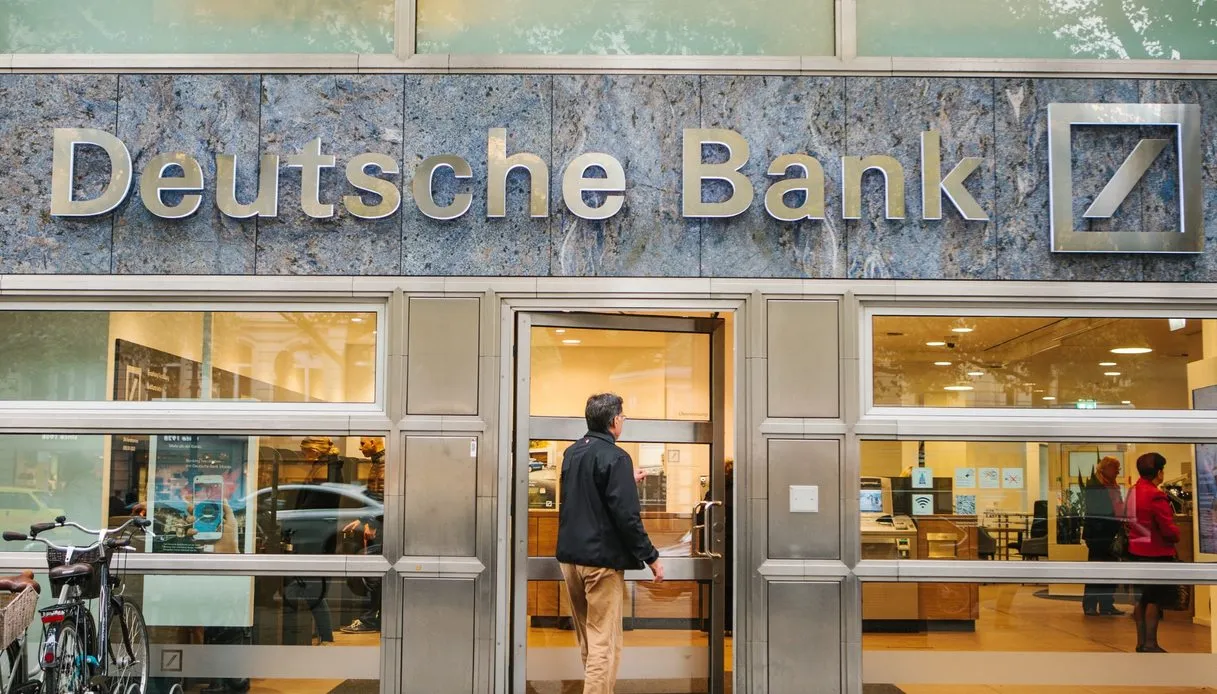
Deutsche Bank has operationalized its digital asset custody service for paying customers. The project announced in September becomes a commercial activity. The recipient is the world of businesses and institutional investors, not the generality of account holders.
The news opens a different perspective on Bitcoin. Alongside those who buy it hoping for an increase, there are those who build a business to safeguard it and manage its transfers. For a bank, the challenge is to become the intermediary to which large customers entrust these operations.
It is also an important step to understand the relationship between traditional finance and cryptocurrencies: institutions are looking for space in the services necessary to make the market work, beyond the fluctuations in prices.
What it means to store Bitcoin and Ether
Custody concerns the management of private keys, the codes that allow you to access digital assets and authorize transfers. Entrusting them to an intermediary means delegating a delicate technical and operational responsibility.
In the project presented in September, Deutsche Bank envisaged the management of digital wallets and keys on behalf of customers, with the possibility of transferring assets to third parties. Among the assets listed were Bitcoin and Ether. The infrastructure includes hardware protections, approval procedures and recovery systems.
Commissions and large clients: Deutsche Bank’s strategy
With the custody of digital assets, Deutsche Bank extends a central activity of traditional finance to the cryptocurrency market: administering and protecting client assets in exchange for commissions.
What is at stake is the relationship with companies and institutional investors. For these operators, entrusting digital assets to a bank means being able to integrate custody with already existing control procedures and financial relationships. For the institute, it means covering a new area of demand and expanding the services offered to professional customers.
The economic sustainability of the business will depend on the ability to attract sufficient assets to remunerate investments in technology, safety and regulatory compliance. Commissions represent a potential source of revenue, but must be compared to the costs of managing a complex infrastructure.
The launch therefore marks an expansion of the offering, while the contribution to profitability remains to be measured. The available information does not quantify the assets in custody nor the revenue objectives of the service: these elements will allow investors to evaluate their weight in the group’s accounts.
Because the project looks beyond cryptocurrencies
Deutsche Bank also announced a memorandum of understanding with Deutsche Asset Management, formerly DWS, to explore commercial and technical collaborations in digital assets. The bank indicates the integration of custody, tokenization and settlement of operations as a medium-term objective.
Tokenization consists of the digital representation of assets or rights through tokens, using technologies such as blockchain. It can also concern financial instruments: the potential market therefore goes beyond Bitcoin.
The prospect is to accompany an asset along multiple steps, from its digital representation to custody and completion of trades. The memorandum, however, remains an exploratory agreement: it is not equivalent to the announcement of new products already available.
What changes for Italian customers
The connection with Italy concerns, first of all, businesses and professional operators. Italian institutional and corporate clients can access through Deutsche Bank AG in Frankfurt, becoming clients of the Corporate Bank.
It is not, therefore, the announcement of a Bitcoin wallet available for every Italian account holder. It is an offer aimed at a specific clientele, with access and verification requirements.
For readers who invest, the interest is to follow how the financial offer changes: first comes the infrastructure for professional operators; any new services to the public require further decisions, which should not be anticipated.
Bank custody and market risk remain distinct
The entry of Deutsche Bank strengthens the offer of regulated infrastructures for digital assets. For professional investors, the value of the service lies in private key management, transaction controls and security procedures. These features are for safekeeping, without offering protection from market losses.
Bitcoin and Ether retain their volatility regardless of the intermediary that holds them. Furthermore, as the European authorities point out, crypto-assets do not benefit from coverage equivalent to the guarantee on bank deposits. The presence of a bank changes the service relationship, not the nature of the investment.
Deutsche Bank’s choice indicates where part of the financial competition is focusing: providing companies and managers with the tools necessary to operate in digital assets.
The next step will be to verify whether custody will be followed by integrated tokenization and settlement services, according to the direction indicated by the group. It is on this development that the industrial scope of the initiative will be measured.