It’s now been 23 years since Nasiriyah massacrethe most serious attack suffered by the Italian armed forces since the end of the Second World War.
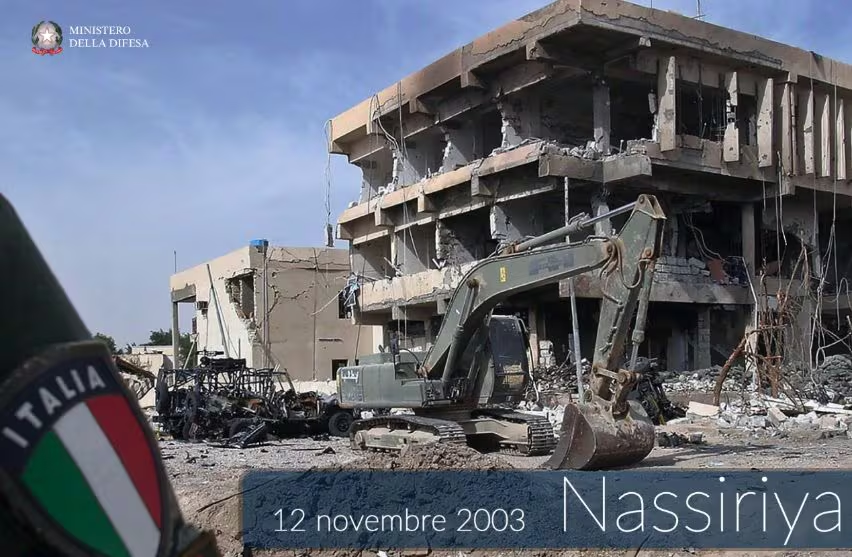
On November 12, 2003, at 10:40 local time (8:40 in Italy), a devastating explosion ripped through the “Maestrale” military base, headquarters of the MSU contingent of the Carabinieri in southern Iraq. 28 people lost their lives in the attack, including 19 Italians (12 Carabinieri, 5 Army soldiers and 2 civilians) and 9 Iraqis.
But what were our compatriots doing in Iraq if Italy had not participated in the US invasion? How was the attack technically organised, and why was the Italian contingent targeted? To answer these questions we must start from the context in which the story took place.
The context: the «Ancient Babylon» operation and the Italian mission
Let’s go back in time to the spring of 2003. In March, a US-led coalition invaded Iraq and overthrew Saddam Hussein’s regime.
Italy officially decided not to participate in the active combat phase, but when conventional operations ended in May and the UN approved resolution 1483 – which urged member states to contribute to the stability and security of the country -, the Italian Parliament intervened, launching Operation “Ancient Babylon”, a humanitarian support, reconstruction and stabilization mission in the area.
Thus it was that the Italian contingent, of 3000 men, including the Army, Carabinieri, Navy and Air Force, was sent to southern Iraq, in the province of Dhi Qar. It was an area with a Shiite majority, which until then was considered one of the quietest in the country.
The command was established 7 kilometers from the capital, in the White Horse base, while inside the city of Nassiriya two bases were built a few hundred meters from each other: the Libeccio base, where the Army was installed, and the Maestrale base, headquarters of the MSU Carabinieri, created in the former headquarters of the local Chamber of Commerce, on the banks of the Euphrates river.
The contingent had the task of:
- maintain public order and prevent looting and crime
- act as escort and protection for humanitarian convoys and NGO personnel operating in that area
- train the new Iraqi local police
- carry out demining and remediation of war remnants
Although that area was apparently peaceful – or at least apparently much more relaxed than the Sunni triangle around Baghdad – it was a territory full of tensions that would soon lead to violent actions. The factions linked to the remains of the regime and the first jihadist nuclei, in fact, perceived any foreign contingent as an enemy occupying their territory.
The dynamics of the attack: how the «Maestrale» base was hit
On November 12, 2003, at 10:40 local time (8:40 in Italy), a tanker loaded with hundreds of kilos of explosives (estimated between 150 and 300 kilos) approached the «Maestrale» base, the former Nasiriyah Chamber of Commerce where the headquarters of the MSU Carabinieri was located.
Suddenly, the vehicle turned and headed straight for the entrance of the base: one of the attackers opened fire on the soldiers on guard and officer Andrea Filippa, guarding the gate, responded by shooting at the cabin. According to many reconstructions and the stories of survivors, his shots killed the attackers.
The truck, however, managed to break through the entrance barrier, stopping a few meters later against the protective ramparts of the car park, about 25 meters from the building, and exploded anyway. Filippa died, but her reaction prevented the vehicle from reaching the building.
The explosion was devastating, and also triggered the explosion of the ammunition stored in the base. In a few seconds, the building was reduced to a concrete skeleton, and 28 people died: 19 Italians (12 Carabinieri, 5 Army soldiers and 2 civilians) and 9 Iraqis, including the two attackers. Another 20 Italians and at least a hundred Iraqi civilians were injured.
The Iraqi guerrilla war and the change in strategy of the insurgents
Nasiriyah was not an isolated episode. After the fall of Saddam Hussein in the spring of that year (9 April 2003), in fact, the Iraqi guerrillas began to attack American troops mainly with ambushes and bombs along the roads.
During the summer, however, with the coalition’s bases increasingly protected, the insurgents had to change strategy. It was precisely then that they aimed car bombs driven by suicide bombers at vulnerable targets.
On August 19, a truck exploded in front of the UN headquarters in Baghdad, while on October 27 it affected the Red Cross and three police stations.
It did not matter which allied country was hit: the objective of all these attacks was to isolate the great enemy, the United States, by making international organizations and those who collaborated with them flee.
The attack on Nasiriyah was also part of this plan, because it struck one of the main coalition partners, and moreover in an area considered relatively quiet. The message was clear: you can’t rest easy anywhere here.
Abu Omar al-Kurdi, believed to be close to Abu Musab al-Zarqawi, the jihadist leader from whom the Islamic State would be born, years later, confessed to having prepared the bomb. In Italy, however, a trial never took place, because al-Kurdi was hanged in Iraq in 2007.
Could the Nassiriya massacre have been avoided?
After the massacre, one question remained: could it have been avoided? According to the judges, at least in part, yes.
The signs, in fact, had been there, and they were not few.
Exactly one week before the tragedy, a military intelligence report had warned that a group of Syrian and Yemeni terrorists had moved to Nasiriyah. Furthermore, the base’s defenses were decidedly inadequate: at the entrance there was no zig-zag path that forced the vehicles to slow down, the ammunition depot was not sufficiently protected and the ramparts had been filled with gravel instead of sand, so with the explosion they turned into projectiles.
Even the choice of the building was judged to be wrong: the road leading to it could not be closed to traffic, and the investigations revealed that the attackers had chosen it precisely because it was an easy target.
The criminal trials ended with the acquittal of the three officers involved – generals Vincenzo Lops and Bruno Stano and colonel Georg Di Pauli, commander of the base – but in 2019 the Supreme Court, in civil court, condemned the former general Stano to compensate the families for having underestimated an “punctual and immediate” alarm. A sentence that still divides between those who consider it an act of justice and those who see the general as a scapegoat.
Regardless of how you think, the Nasiriyah massacre remains imprinted in the Italian collective memory, and is still an open wound. To commemorate the fallen, since 2009 November 12th has been, by law, the Day of Remembrance of Military and Civilian Fallen in International Peacekeeping Missions.