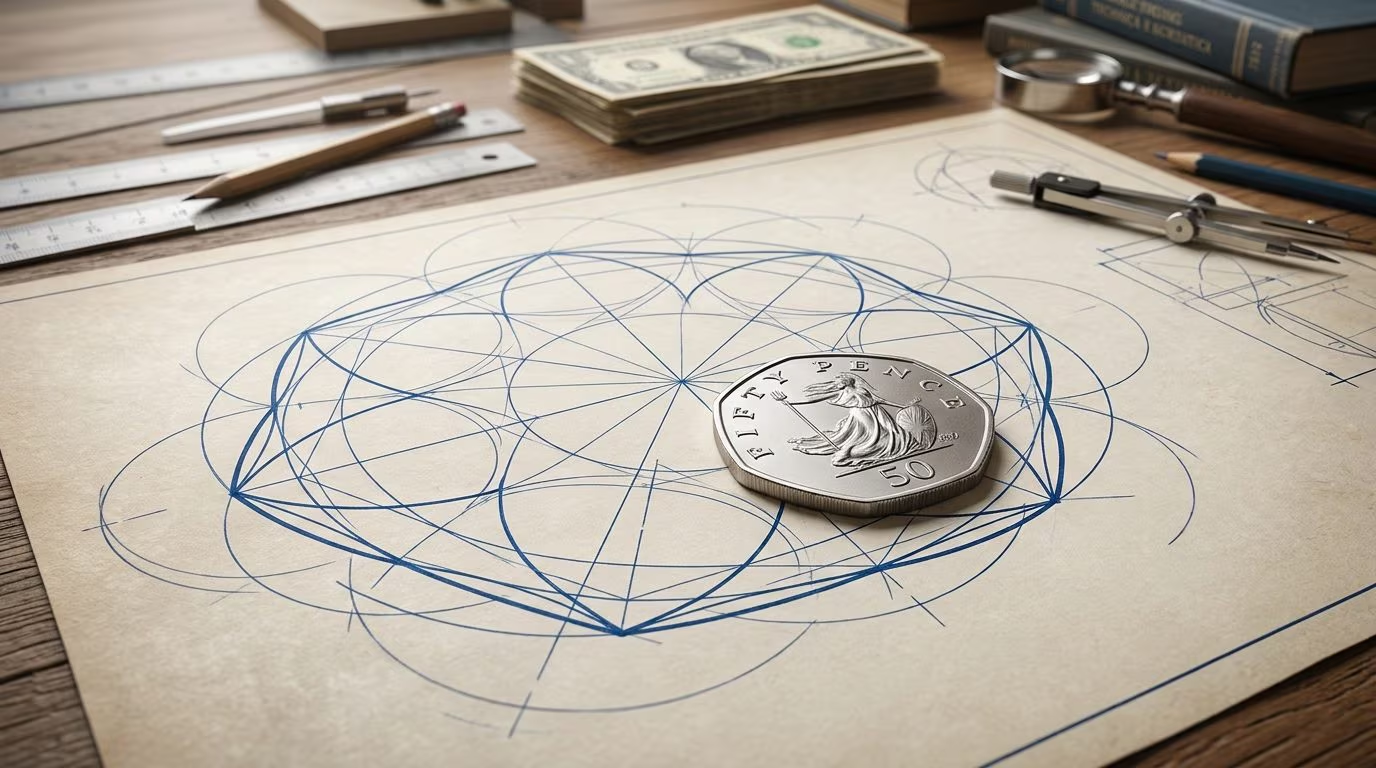
The 50 coin pence (50 cents British Pound) currently in use in the United Kingdom has a particular shape, called Reuleaux’s heptagon, with 7 equally curved sides. This coin with a heptagonal shape with an equilateral curve, designed with the technical support of aeronautical engineers, has existed since 1969 and was the first in the world with this shape, but why was it decided to make it exactly like this? It is a question that has to do with its recognizability and with a particular geometric characteristic that makes this coin ideal for use in vending machines.
The 50 pence coin was released in the United Kingdom in 1969 and, to make it easily distinguishable from other coins, a non-circular shape was opted for that would also allow it to be recognized by touch, perhaps simply by using the fingers inside a pocket. However, if the aim had only been to make it recognisable, a normal heptagon with seven straight sides and angular vertices would have been enough, but there was also something else at play.
At the time, parking meters and vending machines of various kinds that were operated by inserting coins were becoming increasingly widespread. In these devices a coin must be able to move, without blocking, inside a channel exactly as wide as the coin itself, a channel that is suitable only for that coin and not for other coins. From this point of view, the problem with the regular heptagon is that, if we try to turn it, it turns out to be a little wider or a little narrower depending on how it is turned (see figure below).
The Reuleaux heptagon, however, has a particular geometric characteristic, which is successful from the point of view of movement inside vending machines: however we place it, its width is always the same, even if we rotate it a little (see figure above). In other words, no matter how we turn it, its width doesn’t change. In mathematicalese it is said to have constant widtha feature that facilitates movement within the channels, allowing it to slide without blocking.
Furthermore, thanks to this feature, the 50 pence coin can roll much more easily than a regular heptagon-shaped coin with straight sides and corners, just think of the extreme case of a square wheel.
The reasons behind the choice of this particular shape for the 50 pence coin, therefore, are practical. However, not everyone welcomed it when it was introduced in 1969: retired Colonel Essex Moorcroft founded the Anti-Heptagon movement (Anti-Heptagonists) claiming that the new currency was “ugly” and considering it “an insult to the Queen whose image it bore”.
Those who joined the movement believed that this coin could also easily be confused with the 10 Pence coin which was circular but had almost the same size. However, the protests quickly died down, and today the shape of the 50 pence coin is considered iconic.