Canceling a subscription to watch a TV series, listen to music or perhaps use an app is not always as simple as activating it. The option to cancel service can be difficult to find, and a forgotten renewal can turn into an unexpected charge.
To address these issues, the European Commission presented on 11 November 2026 a proposal for a regulation to strengthen consumer protection online. The provision, called the Digital Fairness Act, aims to combat unfair commercial practices and will have to be examined and approved by the European institutions before coming into force.
Why the EU wants to change the rules on online subscriptions
A complicated cancellation process isn’t always the result of a poorly designed site. Sometimes it is a precise choice, designed to discourage those who want to interrupt a service. It is one of the examples of the so-called dark patterni.e. interfaces and navigation paths that deceptively guide users’ decisions. They can come in the form of screens insisting you maintain a subscription, or false warnings that a product is running out, pushing you to buy it now.
A significant precedent concerns Amazon Prime, whose cancellation system has also been contested in the United States. In the EU, already in 2022, after a discussion with the European Commission and national consumer protection authorities, the company has committed to simplifying the subscription cancellation procedure. European authorities had reported obstacles such as complicated navigation menus, ambiguous choices and constant invitations not to interrupt the service.
With the Digital Fairness Act, the Commission wants to make protections against deceptive commercial practices clearer and more uniform, not just those related to unsubscribes. The proposed rules also cover the presentation of prices and offers and would also apply to companies based outside the EU that target European consumers.
Cancellations, automatic renewals and free trials: what the proposal includes
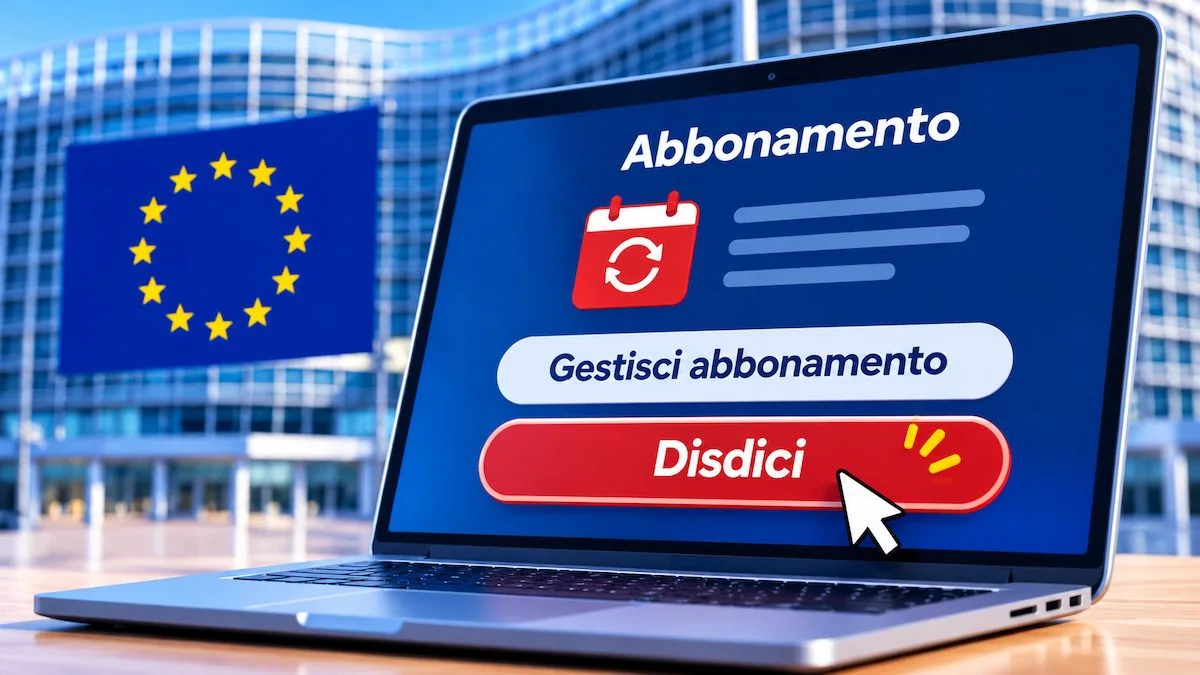
On the cancellation front, the proposal introduces a function to terminate contracts directly online. Companies that allow you to sign up for a subscription through a site or app would be required to make a clearly visible option available, with a clear indication such as “Cancel contract here”. The same possibility would also be recognized to those who entered into the agreement through another channel, for example by telephone.
After entering the data necessary to identify the subscription, the customer could confirm and send the request via a specific button. The company would then have a maximum of one week to send a receipt, without unjustified delays and also indicating the effective date of termination. This term only concerns the sending of the receipt: the service may be interrupted subsequently, based on the applicable contractual conditions. The proposal also includes an online function to exercise the right of withdrawal, in the cases established by law.
Another change concerns warnings before automatic renewals. Periodic renewal is also foreseen, for example, for the Plus plans of Facebook, Instagram and WhatsApp. For continuous supply contracts lasting at least six months, signed online or through other digital tools, companies would be required to send a reminder between one month and 14 days before renewal. The communication would indicate the date, price, duration of the following period and how to cancel, possibly with a direct link to the cancellation function.
For shorter contracts, however, the text provides for a notice at least one week before the renewal which brings the duration of the initial contract or a subsequent extension period to six months, or before the tenth renewal, depending on which of the two conditions occurs first. If the company did not comply with these obligations, the consumer would have the right to terminate the relationship free of charge, without the usual notice, according to the conditions set out in the proposal. Furthermore, when a contract is renewed for an indefinite period, it would be possible to cancel it at any time with a maximum notice of one month, paying only the amount due for the service received during that period.
In Italy, however, similar protection already exists. Article 65-bis of the Consumer Code, in force from 31 December 2023, establishes that, for fixed-term service contracts with automatic renewal, the professional must notify the consumer 30 days before the expiry, indicating when he can send the cancellation. If the communication does not arrive, the customer can withdraw without charge until the next deadline. The Digital Fairness Act would introduce a common European regulation, with specific conditions and scope of application.
The proposal also affects free trials that become paid subscriptions, such as those offered for some Spotify plans. Before the promotion expires, the company would be required to clearly inform the user about the end date, price and conditions of the next plan. To continue with payment, explicit consent would be required, to be provided before the end of the trial. Without the required notice or without this confirmation, the consumer would not be bound to the paid contract. The text does not establish a fixed number of days in advance for the reminder, but requires that it be sent within a reasonable period.
Another provision concerns customer support. When a company offers an online support service, the user would have the option to speak to a person, upon request, if other communication systems are not effective. A useful guarantee, for example, when a chatbot is unable to resolve a problem related to the cancellation of a subscription. The obligation would not apply to investment services identified by European legislation.
When the new rules might come into effect
According to the current text, the regulation would enter into force twenty days after publication in the Official Journal of the EU and would become applicable twelve months later. First, however, the European Parliament and the Council of the EU will have to examine the proposal and will also be able to change these deadlines. At the moment, therefore, there is no certain date yet.
In the meantime, the rights already recognized to consumers remain valid. For many service contracts concluded remotely, such as those signed online or through telephone offers for electricity and gas, there is generally a right of withdrawal of 14 days from signing, with exceptions and specific conditions for some services and digital content. Withdrawal, which allows you to rethink a purchase within a certain period, should not be confused with the cancellation of an already ongoing subscription, which serves to terminate the relationship according to the applicable rules.