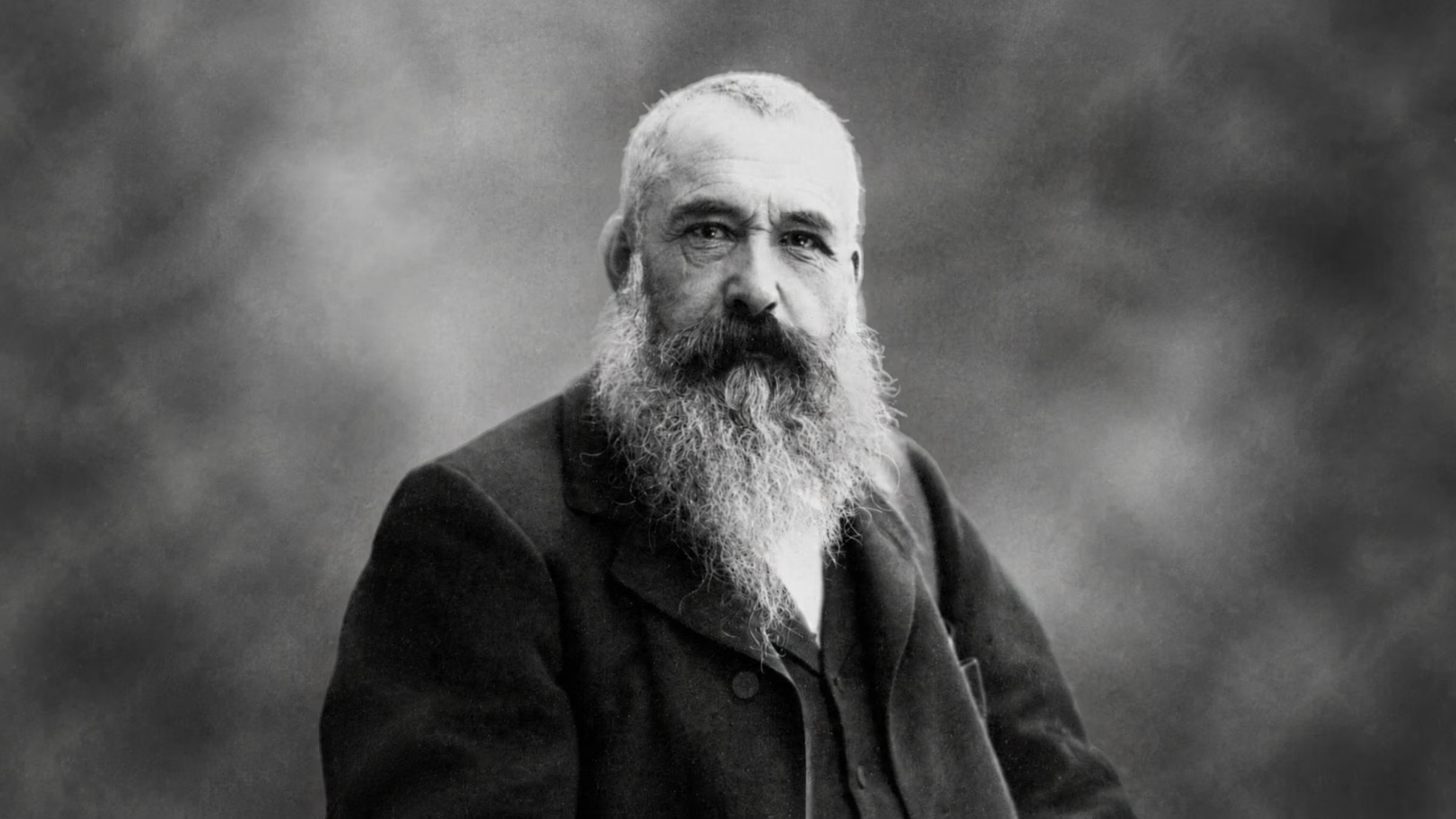
Oscar Claude Monet (1840-1926) was a French painter – considered one of the founders of French impressionism and master of painting en plein air (outdoors) –, author of more 2,500 works between paintings, sketches and pastels. Monet was one of the founders of the art movement.impressionismso defined because the paintings “they capture the moment”, and they capture real impressions of lightsshadows, colors and changes in the landscape and in the portrayed subject. This method of his was not immediately understood either by critics or the public, but Monet and his “group” continued in the search for a style that broke the canons compared to previous currents: when he died, Claude Monet was famoushighly appreciated in France and abroad. In the hundredth anniversary of his deathwe retrace the essential stages of his life and his artistic research, to understand which events and choices allowed a young boy passionate about outdoor painting to become the Claude Monet that the whole world knows.
The young Claude Monet: how his passion for painting was born
Born in 1840 to Paris, Oscar Claude Monet – who will go down in history simply as Claude Monet – was the son of a grocer, Claude Adolphe, and Louise Justine Aubrée, a cultured woman, passionate about reading, music and composing.
When he was five years old the family moved together with Claude and his older brother Léon-Pascal to Le Havre, by the sea: here Claude attended school, with little enthusiasm.
He preferred the hours in the open air to the hours spent at the desks, and the only subject that attracted him was the drawing.
He himself, as an adult, wrote that he preferred to spend his time:
Where the sun was tempting, the sea fascinating, and where it was simply wonderful to run along the cliffs, or perhaps splash in the water.
After the death of his mother, his father became a little present figure in Claude’s life, who was instead encouraged by his aunt to cultivate his passion for art: in 1857 he left school, and studied with the drawing teacher Jacques-François Ochard, and began to produce caricatures – much appreciated! – which he sold in a shop in Le Havre.
Monet’s career begins: the meeting with his master
The young Claude, after having gained some experience as a portraitist and having experimented with different techniques and styles, decided to undertake in all respects the career as a painter.
It was thanks to the owner of the shop where he exhibited his works that he met Eugene Boudinlandscape painter who became his guide: it was Boudin himself who understood that the boy’s temperament could not be supported if locked up in an aterlier, and that he would give his best by painting en plein air, in the open air.
Boudin then encouraged Monet to observe the light, the colours, the shapes and the movements immersed in the landscapes while he painted: both relied on the master landscape painter Johan Jongkindand specialized in the genre.
One of Monet’s first “conscious” works is “View in Rouelles”, painted in 1858, a painting that shows the young Monet’s great ability to capture the moment, which would later become the basis of the movement impressionist.
Paris, the meeting with Manet and the rebellion against the canons
In 1859, Monet went to Paris to visit the Salon, the artistic exhibition that took place every year at Louvreand where you could meet painters and intellectuals and learn more about the news of the moment. Monet was so fascinated by what he saw and the Parisian excitement that he decided to enroll in theAcademie Suissethe art school attended by the biggest names of the time.
In 1861 he was called upon to lend military service in Algeria: spending time in North Africa was, for Claude, a further opportunity to discover new lights and new landscapes: he wrote «I only thought about painting, that wonderful country intoxicated me so much».
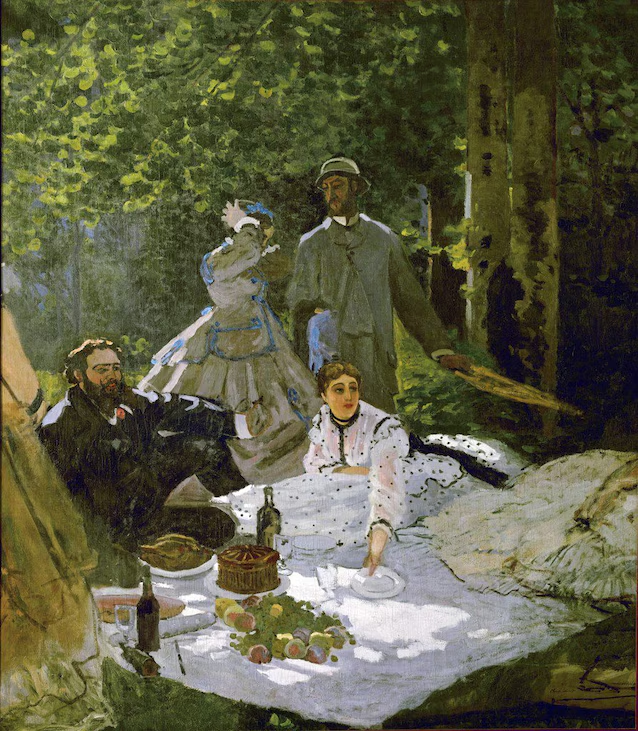
Upon his return, Monet became friends with Édouard Manetrealist painter, founder of artists who wanted to break with the rigid academic rules: his, among others, the painting Breakfast on the grass (1863), considered scandalous for the presence of the naked woman, and honored by Monet with a painting of the same title, between 1865 and 1866.
In both of these works the real protagonist is light: the new technique, based on capturing the exact moment of a reflection, is a real innovation, a break in all respects with the classic canons of landscape painting practiced up to that point.
Trips to London and the Netherlands, to discover new sights
In 1870 Monet married Camille-Léonie Doncieux: after having their first child, they moved first to Normandy, then to London, to escape the Franco-Prussian war. In the English capital, Monet came into contact with the art of Turner and others, and worked intensely to capture the colors of the Thames and the charm of London’s great parks.
After the end of the war, Claude and his family spent some time in the Netherlands, where the painter studied the windmills and plains. Returning to Paris in 1871, he became friends with Renoir and Pissarro, but realized that the big city that had contaminated him so much artistically no longer nourished him, and he moved with Camille and his son to the small village of Argenteuila town on the banks of the Seine.
Here they joined him Renoir, Sisley and Caillebotteeager to capture the impressions of light, so much so as to set up a floating atelier on the banks of the river to be able to paint better “immersed” in water.
The birth of the term “impressionism” and the characteristics of his painting
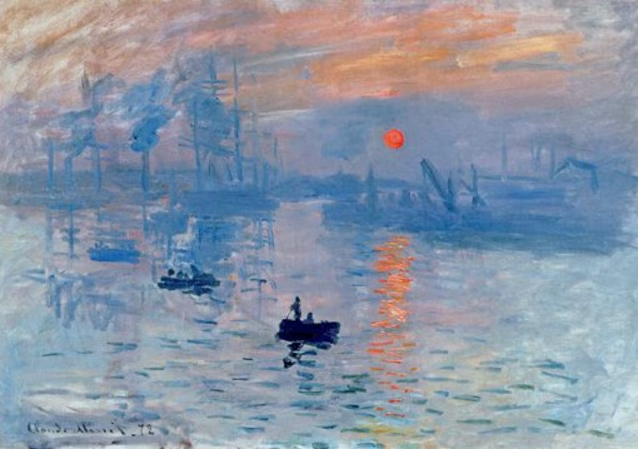
The artistic partnership that would soon become theimpressionism: the first exhibition of Monet and his group – where they also exhibited, among others, Degas, Cézanne, Boudin, Pissarro, Renoir and Sisley – was staged in Paris in 1874.
Here, Monet exhibited his canvas Impression, sunrise (1872): as a comment, the journalist Louis Leroy wrote an ironic criticism where this phrase appeared «Impression, I was sure of it. There must be some impression in there.”
Monet and his men took the provocation and, from that moment on, called themselves “The Impressionists” and the term for the movement was officially coined.
On a technical level, impressionist painting breaks with the academic tradition by favoring work en plein air to capture the changing variations of natural light.
Once the preparatory drawing and clear outlines have been abolished, the shapes come to life through rapid brushstrokes and pure colours, placed side by side on the canvas without being mixed on the palette.
Even black and traditional chiaroscuro disappear, leaving room for colored shadows obtained through the contrast between complementary shades, so that the observer’s eye can recompose the image from a distance.
The house in Giverny and the paintings dedicated to water lilies
His wife Camille died in 1879 shortly after giving birth to their second child: it was a strong blow for Claude and he was so impressed that he wanted to portray her on her deathbed, in a painting entitled Camille’s death.
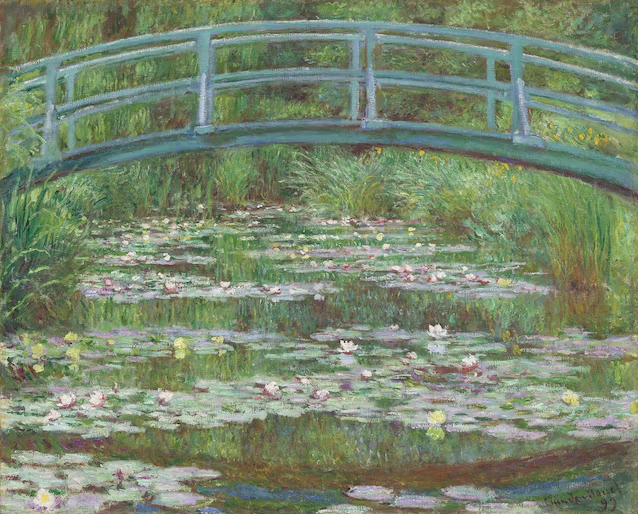
In 1880, Claude Monet bought a house in Givernyon the banks of the Seine, about an hour from Paris, where he had a magnificent garden and a pond full of water lilies created. Right here, in what is still his home today, visited by thousands of people, he painted the water lily cyclewonderful paintings – there are over 250 of them, preserved in the largest museums in the world.
After moving to Giverny, Monet joined Alice Hoschedé, who moved into the Giverny house with her six children, giving life to a group of eight children in the water lily house. From 1880, Monet began to travel all over the world: by now he was famous, and impressionism, initially understood with difficulty, is now a famous and appreciated movement, and Monet immortalized in his paintings the large cities and natural views he observed.
He died in 1926elderly and practically blind due to cataracts, leaving a thought that summarizes his career and his artistic thought:
My only merit consists in having painted directly in front of nature, trying to immortalize my impressions in the most fleeting moments.