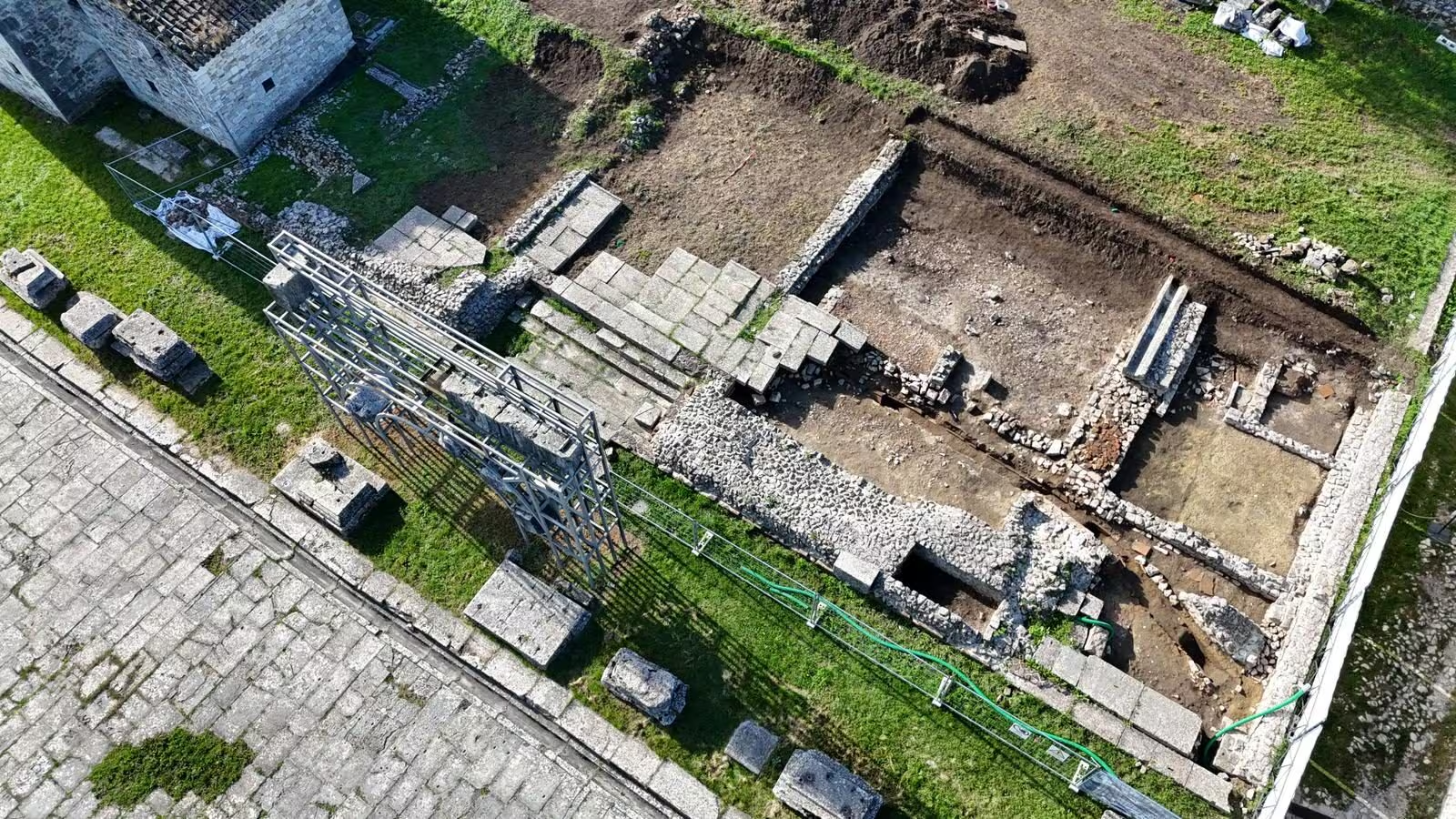
In the Sepino Archaeological Park, built around the remains of the ancient Roman city of Saepinum in the province of Campobasso, one was brought to light domus imperial building of exceptional importance, which adds a new piece to the history of the city, giving us a more complex and multifaceted image.
The archaeological park of Sepino and the new discoveries
The archaeological park of Sepino has a very interesting history, here coexist the remains of an early Samnite settlement, dating back to the 4th century BC; a beautiful Roman theater and the structures of a medieval town. The park’s heritage is also enhanced thanks to the twentieth-century exhibition spaces, specifically designed to preserve and make accessible the archaeological finds.
The new investigations, conducted between 2023 and 2025 and supported by Development and Cohesion funds and funding from the General Directorate of Museums, have brought to light a series of new fundamental elements for reconstructing the history and evolution of the city over the centuries and opening up new research perspectives on one of the most important archaeological sites in central-southern Italy.
Concentrating above all in the urban sector of Porta Bojano, one of the four access gates to the city, the research made it possible to bring to light a domus of exceptional importance with a monumental entrance overlooking the decumanus (i.e. one of the main streets of the Roman city, oriented in an east-west direction), which over the centuries has seen numerous transformations, also testifying to the evolution of the city: the villa – whose boundaries go beyond the current excavation area and will be the subject of new studies – existed from the early imperial age until the 6th century AD. Its dimensions testify to a high lifestyle, similar to that of the most important Roman cities in central Italy.
Understanding the history of Sepino through domus
But how has the evolution over time been reconstructed of domus? The oldest phases of the complex are documented both by structural elements such as the antefixes (i.e. parts of the roof covering) and by furnishing elements such as ceramics from the Augustan and Tiberian periods, which allow dating to the 1st century AD. Common and sealed African imported ceramics from the full imperial age (up to the 3rd century AD) were therefore found, confirming that Saepinum was well inserted in the commercial circuits of the Mediterranean. In late antiquity, between the 4th and 6th centuries AD, it was always the materials found that signaled to researchers a new use of the environments for production and storage purposes.
Other elements found inside have allowed both to better understand the daily life of the time – such as coins, lamps and a rare terracotta incense burner, small ceramic containers and personal objects in bronze (rings and a treasure chest key) – and to study the technologies of the time up close. In fact, a large cylindrical lead container was recovered (decorated in relief with stylized solar motifs and Gorgon heads) belonging to a sophisticated domestic system for heating water.
The other discoveries in the new excavations
With the recovery of marble architectural fragments and an important honorary inscription from 139 AD, dating back to the reign of the emperor Antoninus Pius, an intervention by the imperial house in the city was then witnessed, confirming the privileged link between Saepinum and the central administration of the Empire. Knowledge of the imperial period was also deepened with the resumption, after over 20 years, of excavations in the forum in the area preceding the so-called Arco dei Nerazi and of the numerous architectural elements present in the area (around 400 stone blocks).
Research is shedding light on the transition from the Samnite settlement of the Hellenistic age (2nd-1st century BC) to the progressive formation of the Roman city: alongside the canalizations of the sewerage network, rooms and tanks have emerged that can be traced back to a building from the late Republican age, probably intended for wool processing.
Finally, with the restoration of the accessibility of the cardo maximus (i.e. the main road of the Roman city, oriented in a north-south direction) near Porta Terravecchia, research has made it possible to reconstruct the stratigraphic sequence of the road, documenting its use even in the phases following the end of the ancient age. A hoard of coins dating back to the 5th century AD was even found, located in the level attributable to the Byzantine occupation phase.