The rules for rescue interventions by the Financial Police have officially changed. From now on, anyone who deliberately or through gross imprudence causes an emergency situation, as well as anyone who alerts rescuers without a real need or justified reason, will be required to reimburse the costs.
No generalized payment is being introduced, the Fiamme Gialle specify in a press release: those who are truly in danger, or those who concretely fear for the safety of another person can and must continue to ask for help without hesitation. “Payment will not be automatic”, specifies the official press release, “Aid will always be provided first and only after the conclusion of the operations will the circumstances that led to the intervention be reconstructed and evaluated”.
What changes with the new provisions on unjustified assistance: when you pay
The principle behind the innovations that have come into force is linear, namely that when a person is in danger, every minute is decisive, which is why it is essential that the rescue system is launched promptly and that it can concentrate its forces on real emergencies.
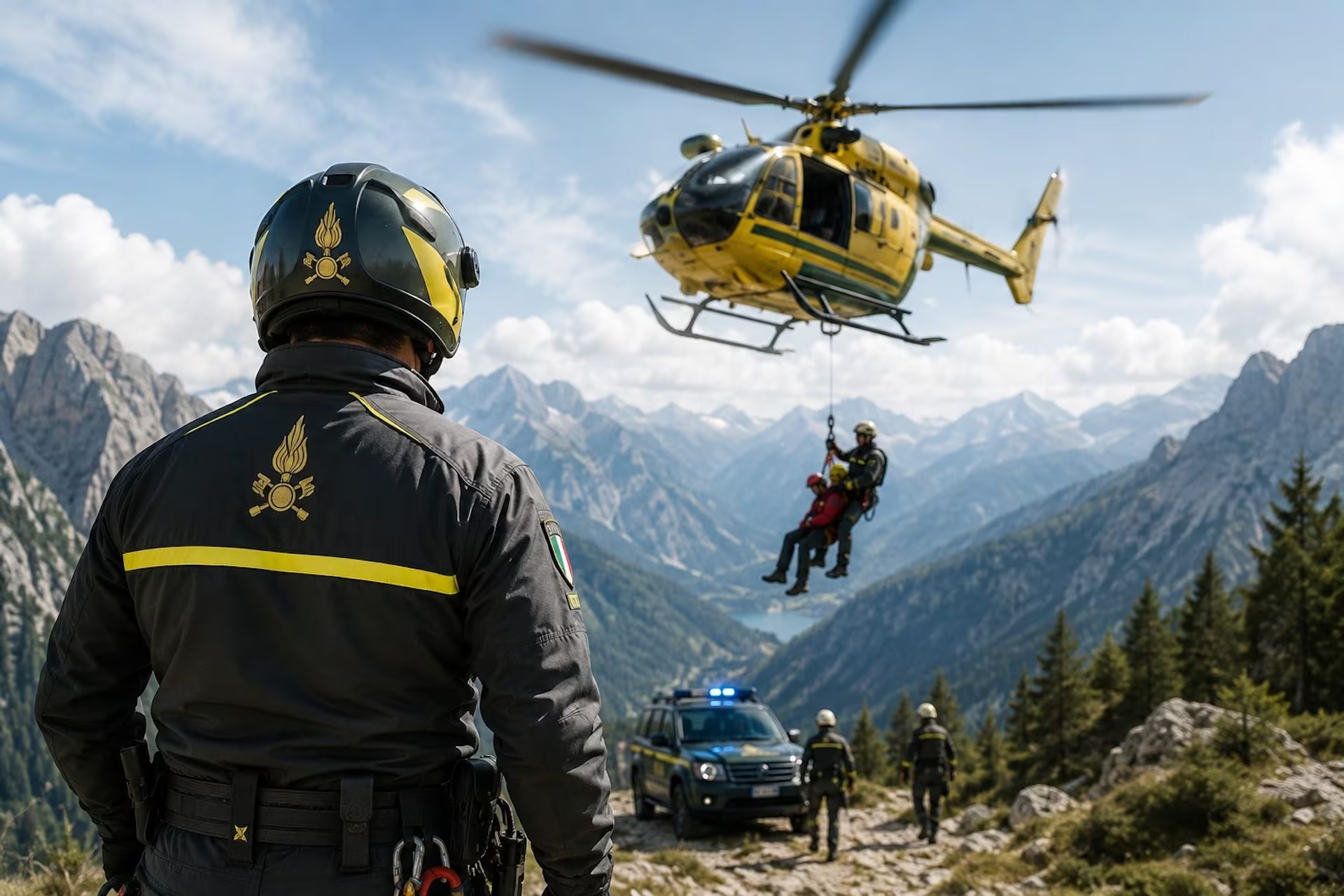
It should be remembered that the Guardia di Finanza contributes to the national search and rescue system together with other military and civil institutions. At sea, in the mountains, in the most difficult to reach areas and during disasters or other emergencies, the Corps deploys specialized personnel, dog units, vehicles, helicopters, planes, drones and naval units.
The role of the Financial Police
Behind every intervention there is a complex machine, operations can last for many hours and require “a significant use of men and means”. An unfounded request, underlines the Financial Police, is therefore not without consequences, because it can tie up resources which, at the same time, could be used to help those who are actually in danger.
The declared objective, explains the press release, is not to discourage people from asking for help, but rather to stem requests made lightly or without a concrete reason. “In this way, public resources and, above all, the response capacity of the entire rescue system are protected”, they specify. A way to preserve the efficiency of the entire rescue system for the benefit of those who really need it.
How much does a rescue cost for no reason: the ministerial price list
The charging principle was established by the 2026 Budget Law and the fees were actually determined by the decree of the Ministry of Economy and Finance of 24 July 2026. The price list attributes a cost based on the qualification of the staff and the characteristics of the vehicles involved. It should be noted that the highest figures in each category are peak values, i.e. the maximums set out in the price list.
For personnel there are specific figures based on the figures mobilised, such as those of the specialized departments which are the most expensive to mobilise, with the senior officers of the air sector valued at up to 70 euros for each hour in the field and those of the naval sector up to 65 euros, while for the other components they range from 60 euros per hour for senior officers to 30 euros per hour for financiers and officers. As the official text explains, “If the services last less than an hour, the fee is due for a whole hour. If they last more than an hour, the fractions of time must be calculated for a whole hour if they are equal to or greater than thirty minutes, they must not be calculated if less than thirty minutes”.
If followed, a table of the Guardia di Finanza’s rescue operations (source: Annex I, MEF decree 24 July 2026, Official Gazette n.178 of 3 August 2026):
The situation changes for aircraft. When the Corps’ aerial vehicles, with the relevant equipment, are directly used in search, rescue or rescue interventions, the hourly rates rise. In fact, for an hour’s flight on an average twin-engine helicopter it costs over 4 thousand euros, as do turboprop planes, the cost of which is close to 5 thousand euros per hour. On the opposite side there are vehicles such as drones, the use of which starts from less than 100 euros per hour for mini models. At the same time, for land vehicles, the calculation takes place on the kilometers travelled, with tariffs differentiated based on the vehicle’s fuel supply. The most expensive item is the snowmobile, which reaches 1.50 euros per kilometer, followed by the ATV quad at 0.80 euros. For naval vessels there is a wide range, from the most modern patrol boats that exceed one thousand euros an hour, to smaller units that start from around 155 euros.
Furthermore, the 2026 Budget Law has extended the possibility of charging the costs of interventions also for the State Police, Carabinieri, Fire Brigade and Coast Guard. If fraud or an unjustified request are ascertained, the person responsible could therefore receive multiple requests for payment from the various administrations involved.