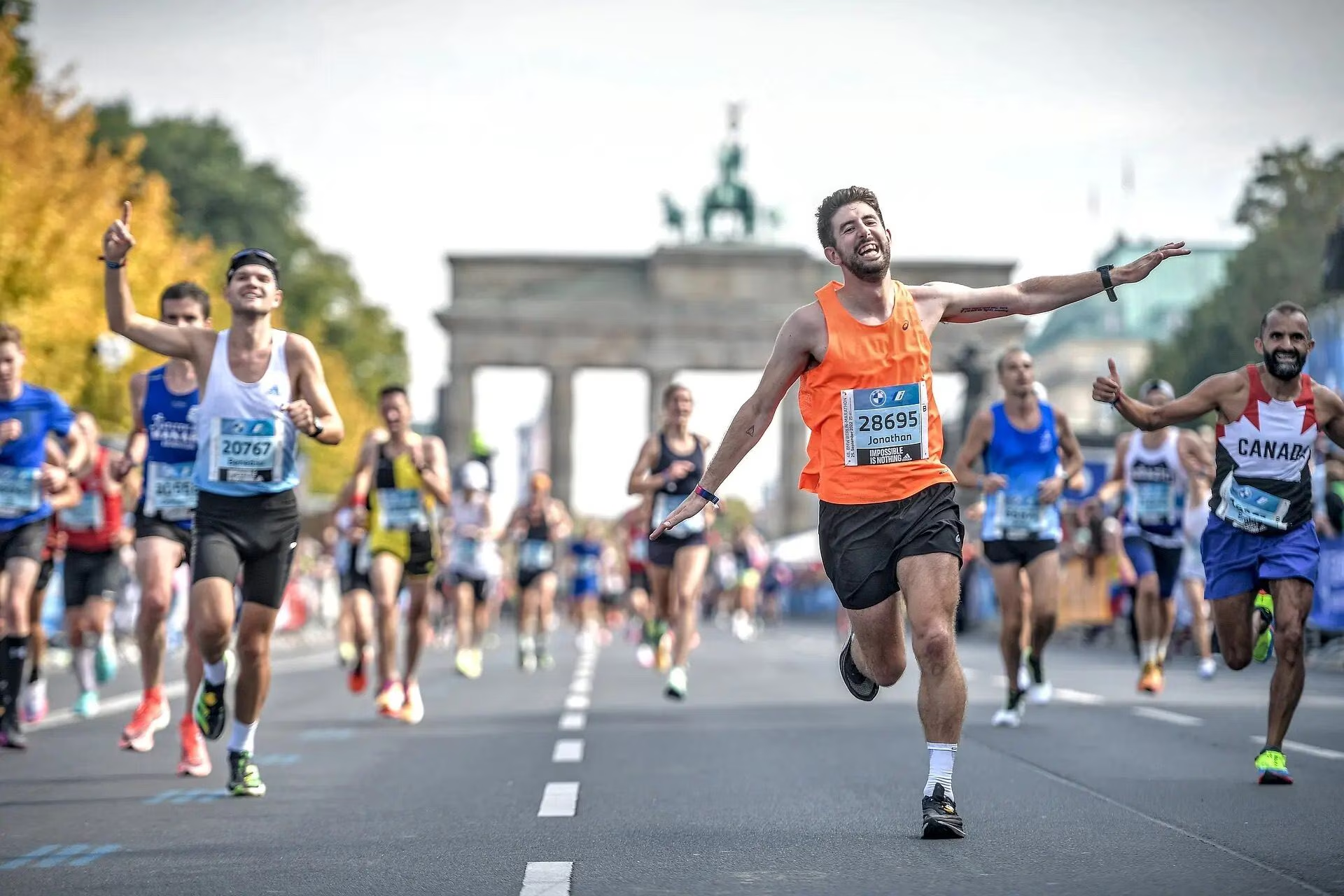
On the streets of Berlin, 13 world records have been set in the marathon, 9 for men and 4 for women, more than in any other race over this distance. The route that will host the 52nd edition on Sunday 27 September has just over 70 meters of positive altitude difference in 42.195 km, as much as the Chicago marathon and less than a third of what is accumulated in Boston or New York. But above all he loses just as many, because he starts and arrives at the same point.
The explanation for this very small difference in height lies under the asphalt and is about 20 thousand years old. At the end of the last glaciation, the front of the ice cap covering Northern Europe began to melt, eroding a band several kilometers wide and filling it with sand and gravel up to 50 meters thick, the same materials that the melting torrents of the Alpine glaciers accumulated in the Po Valley. It is the Warschau-Berliner Urstromtal, a valley that no river has carved, which crosses the center of Berlin from east to west and continues towards the Elbe valley and then reaches the North Sea basin. Berlin grew up there, on a valley floor that remains around 35 meters above sea level.
The route almost never leaves the valley floor
The race starts and arrives on the Straße des 17. Juni, after passing under the Brandenburg Gate, and draws a ring that touches the centre, north and south of the city without ever really moving away from the sandy plain. The highest point is around 53 meters above sea level and the lowest is located at 37, with a range of just over 15 meters spread over 42 kilometres.
The only perceptible slopes are in the southern sector, between Schöneberg and Steglitz, where the route approaches its edge. Everything else is flat, the few real tears in the route are the bridges over the Spree in the first part of the race. The same geological conditions also explain the second characteristic of the route, that is, its geometry. A flat terrain has made wide and straight avenues possible, and the track takes advantage of this with wide curves and few tight corners, a detail that matters less than the difference in altitude but which allows you to run without interruptions in pace.
How 15 meters of difference in altitude make the difference in Berlin
The reason why a race run with very little difference in altitude is fast may seem obvious, but it must also be considered that the time lost by slowing down uphill is not fully recovered in the following downhill. Studies on the energy cost of running, which consider the energy expended for each kilogram of body mass and for each meter travelled, show an asymmetric curve. On flat ground the cost is around 3.4 joules per kilogram per metre, regardless of the speed at which you proceed. Going up a 5% slope increases the cost by about 30%, while going down the same slope reduces it by about 24%. A kilometer uphill followed by a kilometer downhill, therefore, is not equivalent to the same length traveled on flat ground but costs a few percentage points more in terms of energy, because the muscles convert chemical energy into mechanical work with a much lower efficiency than that with which they brake downhill.
How much this asymmetry is worth in a race can be understood by taking as an example Eliud Kipchoge’s two attempts to go under two hours in the distance. One study simulated the two venues, the Monza racetrack and the Vienna Prater, and estimated that the difference in height alone was worth over 46 seconds in Vienna’s favor. Two routes that anyone would describe as flat were separated by almost a minute for the simple fact that one was a little flatter than the other. The same study gives the measure of how much the curves matter: in Monza the 71 changes of direction, with the very large radii that the Formula 1 circuit guarantees, cost a total of a second and a half, and a really sharp curve causes you to lose a few tenths at most. For this reason, the more or less sharp curves of a city route do not have such an impact on the outcome of a marathon.
The rules of the record marathon allow a slightly downhill race
Geology also comes into play because the records must comply with very precise rules in order to be approved. World Athletics ratifies records only if the route is measured by certified technicians, if the start and finish are less than 50% of the race distance apart as the crow flies and if the net downhill difference in altitude does not exceed one meter per kilometer travelled, i.e. 42 meters in total over the entire distance. It is the rule that the time of 2:03’02” run by Geoffrey Mutai in Boston in 2011, which would have been a record, was never approved, since that track loses more than three times more altitude than the regulation allows.
Berlin avoids this problem by building the route (it starts and arrives at the same point) and its net difference in altitude is practically zero, but right here we see the limit of the geological advantage. The regulation does not impose absolute flatness, it allows those 42 metres, and London uses almost all of them, starting from Blackheath at around thirty meters above sea level to arrive on the Mall just above the level of the Thames, with a descent concentrated between the fifth and seventh kilometre. It’s one of the reasons why the last men’s record, Sabastian Sawe’s 1:59’30”, came there and not in Germany.
The valley is not enough: climate, shoes and hares
However, a flat valley floor is not enough to justify the shower of records on this route, and at least three other factors weigh on the final time.
The first is the air temperature, with an optimal window which for the best athletes is between 4 and 10°C, values which are the norm on the last Sunday of September.
The second is technology, because footwear with a carbon plate has lowered the energy cost of running, creating an advantage that is worth more than any altimetric profile.
The third is purely organisational, because a route considered “fast” attracts record attempts, high-level athletes, hares (the athletes in charge of maintaining a certain pre-established pace for the first part of the race), prizes and a large number of members, in a self-sustaining circle which in recent years cities like Valencia have learned to build ad hoc.
The 2026 edition awaits over 56,000 athletes from more than 160 nations but will be missing last year’s winner, as Sawe withdrew due to injury at the end of August. In the women’s race, Tigst Assefa returns, who in Berlin in 2023 ran 2:11’53”, then a world record and still the course record today, and who has announced that he wants to attempt the record again. Among the men, the course record remains Eliud Kipchoge’s 2:01’09” set in 2022.