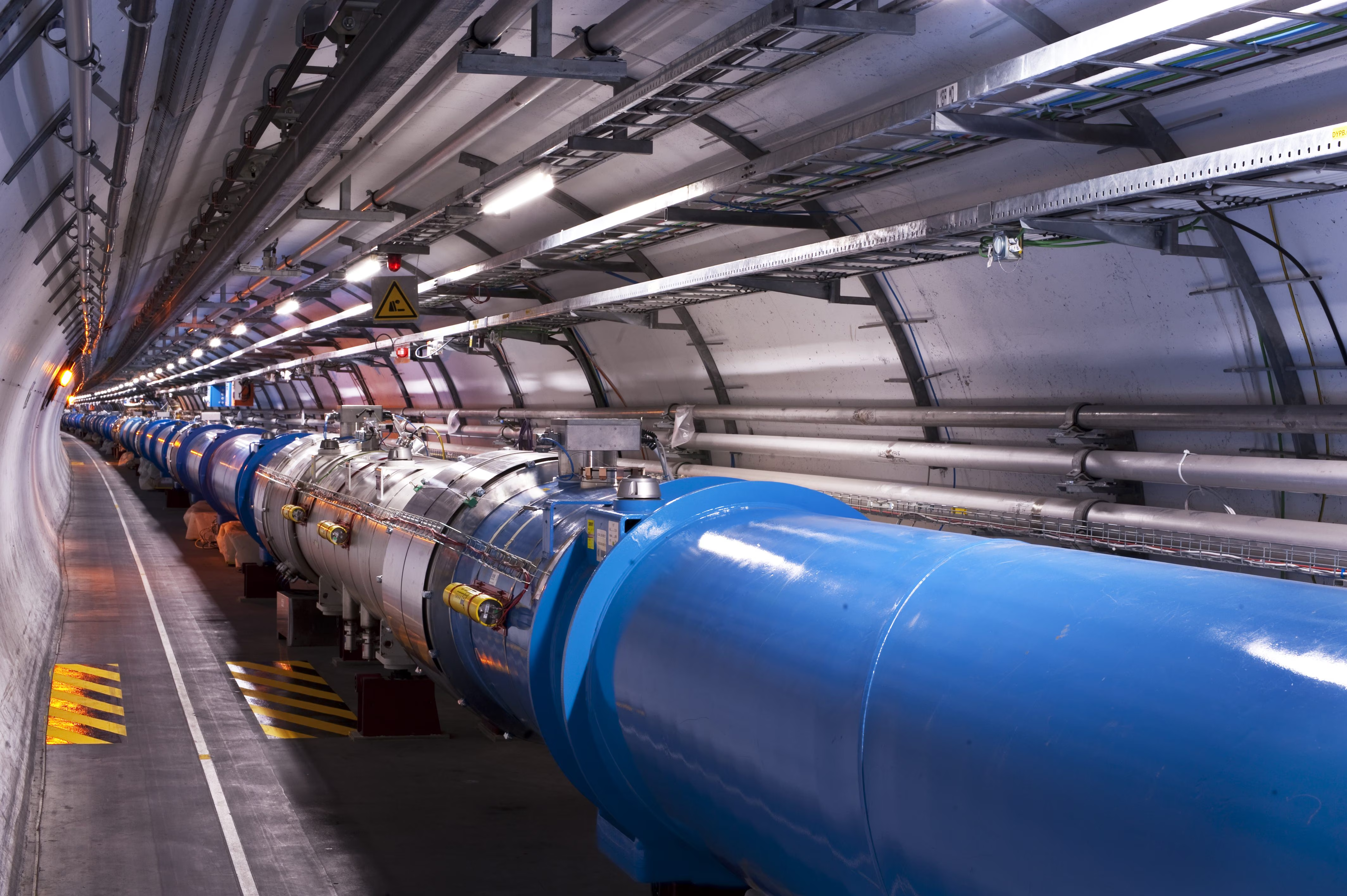
A few months ago the Large Hadron Collider (LHC) was shut down forever at CERN. The LHC has entered a shutdown period, called Long Shutdown 3 (LS3), in which it will change configuration to birth the Hi‑Lumi LHC (HL-LHC). The first beams of this enhanced version will begin in 2028 and the ring will enter full capacity in 2030. Thus a chapter that has revolutionized particle physics closes and a new one opens.
Eighteen years of discoveries at CERN: the LCH and its limits
The LHC came into operation in 2008 and has pushed physics beyond its limits. It produced collisions, accumulated data and in July 2012 the discovery of the Higgs Boson was announced, through the ATLAS and CMS experiments.
It then led to the discovery of over 85 new hadrons, i.e. particles composed of quarks, explored the plasma of quarks and gluons, and investigated the asymmetry between matter and antimatter. It has been a driver of technological innovation, for superconductivity, for scientific computing and for international collaboration.
The largest intervention since the particle accelerator came into operation
In this new transformative phase, 1.2 km of magnets and components will be removed, replaced with new pieces, thanks to the collaboration and coordination of specialists from all over the world. Changes will include:
- the consolidation of the Northern area of the Super Proton Synchrotron (SPS), i.e. the accelerator that supplied protons to the LHC;
- the dismantling of the area that sent neutrinos to the Gran Sasso laboratory, namely CERN Neutrinos to Gran Sasso (CNGS);
- the transformation of the Experimental Cavern North 3 (ECN3) into a new facility;
- the renovation of the plant dedicated to the production and study of radioactive isotopes, Isotope Separator On‑Line Device (ISOLDE);
- the updating of safety systems, technical tunnels and electrical networks.
Thanks to these modifications, the HL‑LHC accelerator will obtain 10 times more luminosity – that is, the measure of how many potential collisions occur in a certain time per unit area – compared to that of the LHC. This translates into a greater number of collisions: the ATLAS and CMS experiments will have to manage 140-200 collisions for each event, compared to around 60 collisions in the last period of LHC activity. For this, for example, new silicon trackers with billions of reading channels and new calorimeters capable of operating at frequencies in the megahertz order are needed. This technological leap is necessary to select the most interesting events from over five billion interactions per second.
During this work, no proton beams will circulate but the research continues. Not all the data collected over the years has already been examined. Many physicists will be able to continue the analysis phase, preparing new experiments in parallel.