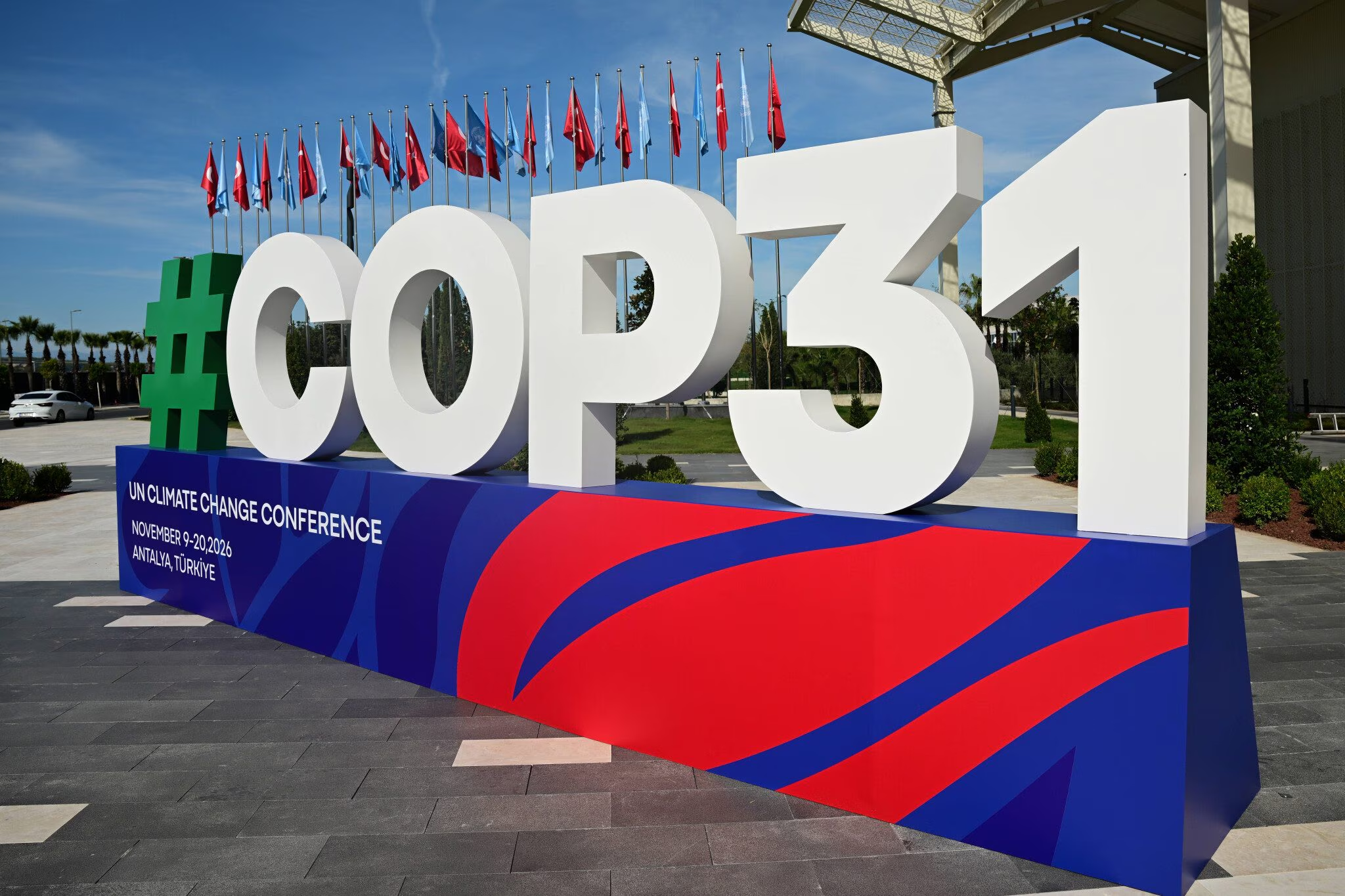
COP31, the thirty-first Conference of the Parties to the United Nations Convention on Climate Change (UNFCCC), opens today, November 9, in Antalya, Türkiye. Until November 20, representatives of around 200 countries, scientists, international organizations and associations will meet to discuss measures to reduce emissions, adapt to climate change and finance.
But are COPs still needed if global temperatures continue to rise and government commitments do not seem sufficient to stop global warming? According to the World Meteorological Organization (WMO), 2025 was the second or third warmest year on record, with the global average temperature around 1.43°C above pre-industrial levels. What makes the problem even more evident is the gap between the declared objectives and those actually achievable with current policies.
But to understand whether COPs are still useful, we must first understand what they have achieved and, above all, why these results are not yet sufficient.
From Kyoto to Paris: the results and agreements reached
To evaluate the effectiveness of COPs we need to look at long-term results, not just at the agreements reached during a single edition. With the Kyoto Protocol, adopted in 1997 and entered into force in 2005, for the first time in history quantitative objectives were established to reduce emissions for industrialized countries.
Its main limitation, however, was coverage: not all states were involved in the same obligations and the United States, despite having signed the protocol, did not ratify it. The real turning point came in 2015 with COP21 which led to the adoption of the Paris Agreement, establishing the objective of keeping the increase in global average temperature well below 2°C compared to pre-industrial levels, trying to limit it to 1.5°C.
But rather than imposing the same emissions cuts on all countries, the agreement introduced NDCs (Nationally Determined Contributions), i.e. nationally determined contributions. Each state establishes its own climate objectives and undertakes to update them every five years, trying to progressively increase the level of ambition. The important element – and the limit – however, is that there are no international sanctions if they do not reach the emissions reduction targets they have declared.
Have the most recent COPs produced results?
In recent years, some important agreements have been reached during COPs, although often below expectations.
- During COP27 in Sharm el-Sheikh (2022) an agreement was reached to establish a dedicated loss and damage fund. Its aim is to support countries that are particularly vulnerable to the impacts of climate change, which have often contributed little to historical emissions.
- During COP28 in Dubai (2023) for the first time the need for an energy transition without the use of fossil fuels, in a fair and equitable way, was explicitly recognized.
- During COP29 in Baku (2024) the main result was a new climate finance goal: the most developed countries will have to contribute to mobilizing at least 300 billion dollars per year by 2035 for developing countries. The agreement also indicated the need to increase overall financing, public and private, towards $1.3 trillion per year by the same year.
- During COP30 in Belém (2025), support for developing countries was strengthened, to increase financing for adaptation and a new just transition mechanism. The Brazilian presidency has announced the development of two action plans, one dedicated to fossil fuels and one to deforestation, to be carried forward in view of COP31.
The balance of the latest conferences therefore shows an evolution: the COPs have managed to bring issues such as climate losses and damage, the transition from fossil fuels and the financing of the most vulnerable countries to the center of the negotiations. However this does not seem enough.
Why is it difficult to achieve concrete results? The limits
The reasons are different and mainly concern the functioning of the negotiations, the economic interests of individual countries and the distribution of the costs of the transition.
- One of the main difficulties of COPs is their decision-making mechanism: decisions are based on the consensus mechanism. In the absence of agreement on majority voting rules, a text must be able to be accepted without formal objections from participating countries. This means that even a relatively small number of states can hinder or undermine an agreement. The reason lies in the fact that, for example, a country heavily dependent on coal, oil or gas has very different interests than one that has already invested massively in renewables.
- To reach a shared understanding, it is often necessary to accept political compromises that greatly change the initial objectives and therefore the final texts that are approved may contain generic formulations or objectives without precise deadlines.
- Another major divide concerns the distribution of responsibility: industrialized countries have contributed the most to historical greenhouse gas emissions, while many developing countries are particularly vulnerable to the effects of global warming. These States therefore call for the energy transition and adaptation to climate change to be accompanied by adequate financing, technology transfer and economic support.
- Agreements do not automatically translate into national policies. Perhaps this is the most important limitation of COPs: reaching an international agreement does not mean that individual countries actually put it into practice at a national level. The Paris Agreement, for example, is based on national climate goals (NDCs) so each government decides how to reduce its emissions, but the policies needed to achieve these goals must be approved and implemented at a national level.
The numbers show that we are still far from the climate goals
According to the United Nations Environment Program (UNEP)’s new Emissions Gap Report 2026, released on October 21, if governments continue with current climate policies, global warming could reach around 2.8°C by the end of the century. Even if all countries fully respected their declared climate commitments, temperatures would still increase by around 2.6°C.
The report also highlights that the possibility of limiting global warming to 1.5°C without exceeding this threshold, or exceeding it only to a limited extent, is now lost. The priority therefore becomes to limit the exceedance as much as possible and bring global temperatures back to within 1.5°C by 2100. To achieve this, global greenhouse gas emissions would have to fall by 18% by 2030, 45% by 2035 and 69% by 2040, compared to 2025 levels.
So are COPs still useful?
COPs continue to have a fundamental role because they represent the only space in which almost all countries in the world can negotiate common climate objectives. They allow us to establish shared rules, monitor national commitments and mobilize funding to support the most vulnerable countries. They are also a space for political pressure, where scientists, associations and civil society can bring issues often overlooked by individual governments to international attention.
COP31 in Antalya opens precisely in a phase in which the need to move from negotiation to implementation has become increasingly urgent: among the central themes there will be climate finance, adaptation, community resilience and energy transition.
A theme to follow will be that of the roadmaps for exiting fossil fuels and stopping deforestation, announced by the Brazilian presidency after COP30. So are COPs still needed? Even if they cannot be considered a tool that alone is capable of solving the climate crisis, the measure of their effectiveness lies in the ability of governments to transform the agreements into effective reductions in emissions and the achievement of climate objectives.
Türkiye and Australia share the presidency for the first time in history
COP31 will also be particular for its organization: for the first time in the history of climate conferences, the leadership of the conference will be shared between two countries, Türkiye and Australia. Turkey will host the conference in Antalya, maintain the official presidency of the COP and lead the Action Agenda, the program dedicated to concrete climate initiatives.
Australia, however, will have the task of leading the international negotiations through the Minister for Climate and Energy Chris Bowen, appointed President of Negotiations. The collaboration also involves the Pacific islands, which are particularly vulnerable to rising sea levels: the pre-COP took place in Fiji, while a meeting of Pacific leaders was organized in Tuvalu, precisely to give greater visibility to the communities that are on the front line in combating the impacts of climate change.