Europe has become the largest importer of weapons in the world, with a share of 33% of total global imports: this is what emerges from the new SIPRI report (Stockholm International Peace Research Institute) which compared global arms flows in the period 2021-2025 with the previous five years (2016-2020). Thanks to the war between Russia and Ukraine, at a European level war imports have almost tripled, going from 12% to 33%: such high values have not been seen since the 1960s, at the height of the Cold War.
The growing tensions in Asia and the Middle East then caused an increase in the global volume of weapons, which grew by as much as 9.2% between 2016-2020 and 2021-2025: in this context, the United States confirms its dominant position as the largest arms exporter, while Europe – now the first reference market for US weapons – has overtaken the Middle East for the first time in 20 years.
Italy, on the other hand, is positioned as the sixth largest arms exporter in the world, with growth of 157% compared to 2016-2020.
Europe is the leading arms importer with a share of 33%
The five-year period 2021-2025 has been characterized by a European comeback in arms imports: over the last 5 years, in fact, Europe has been the region with the largest share of total arms imports, equal to 33%. In second place, however, Asia and Oceania (31%) and third place for the Middle East (26%).
Furthermore, for the first time in about 20 years, Europe has once again become the first reference market for US weapons – with European demand for American war equipment skyrocketing by 217% – thus surpassing the Middle East.
Between 2021 and 2025 the Old Continent purchased 38% of all armaments exported by the USA, compared to 33% in the Middle East: of these weapons, approximately 1/4 was allocated to military aid to Ukraine.
After Kiev, Poland and the United Kingdom were the largest European importers of war equipment: almost half of these transferred weapons (48%) came from the United States, followed by Germany (7.1%) and France (6.2%).
It must be said, however, that this surge in war purchases does not only depend on military aid destined for Kiev, but also on the new perception of Russia as a threat to European security, together with the gradual disengagement of the United States and its “military umbrella” to protect Europe: it is no coincidence, in fact, that arms imports from the 29 European states part of NATO grew by 143% between 2016-20 and 2021-25.
Italy is the world’s sixth largest arms exporter
However, within this context of European importers there is Italy, which is positioned as the sixth global exporter of weapons (we were in 10th place in the period 2016-2020) and third among European countries alone, preceded by France and Germany.
More specifically, in the last 5 years Italian arms exports have increased by 157%, covering a share of 5.1% of global arms exports. More than half of these exports went to the Middle East (59%), while 16% went to Asia and Oceania and only 13% to other European countries. Qatar was our first target market (26% of arms exports), followed by Kuwait (17%) and Indonesia (12%).
Global arms trafficking and US dominance
Given the data, it is therefore not surprising that in the period 2021-2025 global arms trafficking grew by as much as 9.2% when compared to the previous five years (2016-2020): this is the largest increase since 2011, largely due to the war in Ukraine, which as a country received 9.7% of the global arms transfers that occurred in these 5 years.
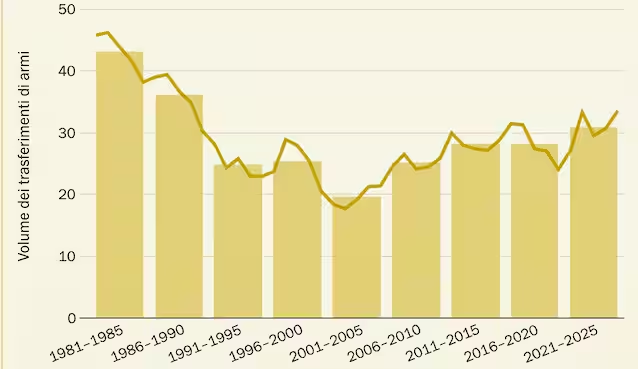
The United States, however, remains the world’s largest supplier of weapons: of all the weapons exported to the world between 2021 and 2025, 42% were American (+27% compared to 2016-2020), a large share if we consider that the second global exporter, France, reached just 9.8%. This is followed by Russia (6.8%), Germany (5.7%), China (5.6%) and Italy (5.1%).
Excluding Europe and the Americas, arms imports decreased in all the other continents: in the case of African states they fell by 41%, while Asia and Oceania recorded a -20%, mainly due to China, with war imports plummeting by 72%.
In the period 2021-2025 the Middle East also recorded a decline, recording a –13% of arms imports, a figure which, however, could change considering the current war in the Middle East.