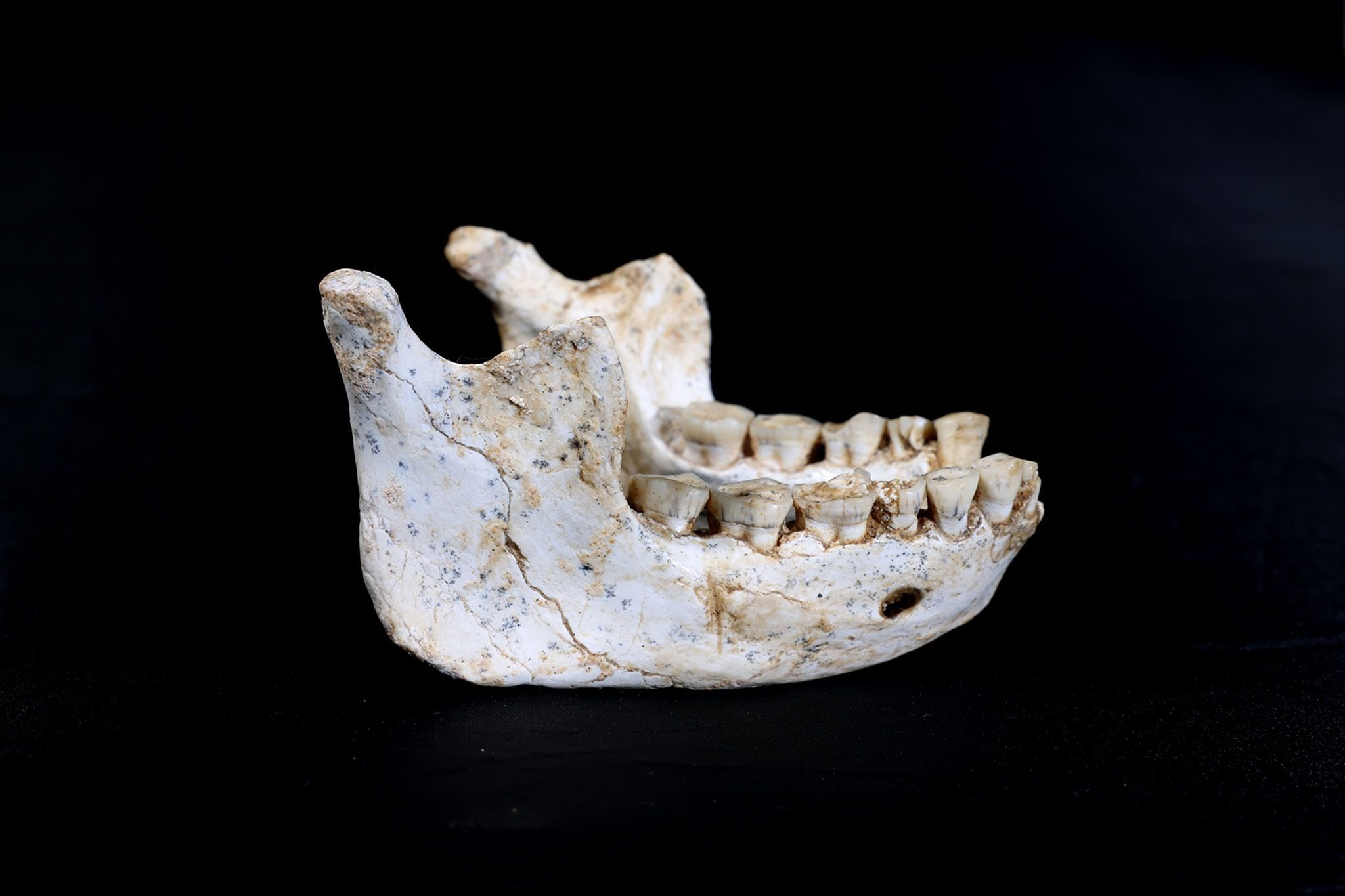
A study published in Nature reported that a group of researchers has discovered new hominin fossils dating back to 773 thousand years ago in a cave near Casablanca (Morocco), remains that could belong to the closest ancestor (among those known to date) of modern humans – Sapiens, Neanderthals and Denisovans – and who lived when these three human groups had not yet distinguished themselves.
In particular, the research group found the remains (two partial mandibles equipped with teeth and vertebrae) in the Grotte à Hominidés (Hominid Cave), i.e. in the Thomas quarry.
The study, coordinated by Jean-Jacques Hublin of the Center for Interdisciplinary Research in Biology of the College of France and Abderrahim Mohib of the Moroccan National Institute of Archaeological and Heritage Sciences, also saw the participation of researchers from the University of Milan and the University of Bologna.
In particular, UNIMI researcher Serena Perini, responsible for the analysis that allowed the dating of the finds, told ANSA that the discovery of these fossils is exceptional, because the critical period in which the divergence between Sapiens, Neanderthals and Denisovans began (between 1 and 0.6 million years ago) has seen very little fossil evidence to date. According to what we know so far, in fact, the last common ancestor of the three lived between 765 thousand and 550 thousand years ago, but it is not known with certainty where he appeared. Some European finds, such as that of Homo antecessor in Spain, have led to the hypothesis of a European origin, but the lack of contemporary African fossils has so far prevented the question from being clarified.
But how do we know the remains are so ancient? We know this because the sediments in which the fossils are found retain the orientation of the Earth’s magnetic field at the time they were deposited. Thanks to the magnetostratigraphic dating technique, which uses the inversions of the Earth’s magnetic field as a “natural clock”, it is possible to know when the sediments were deposited: in this case they date back to 773 thousand years ago.
The years are the same as those of the previously mentioned Homo antecessor (some of his fossils have been dated to around 800 thousand years ago) but the morphological characteristics of the two hominids are different, suggesting that a differentiation had already occurred between the inhabitants of Europe and those of North Africa.
According to the authors of the study, it is not yet entirely certain that the Moroccan remains belong to the most recent ancestor of modern man, but in any case, they are “very close”. In any case, the discovery strengthens the hypothesis of an African origin of our species, rather than a European one.