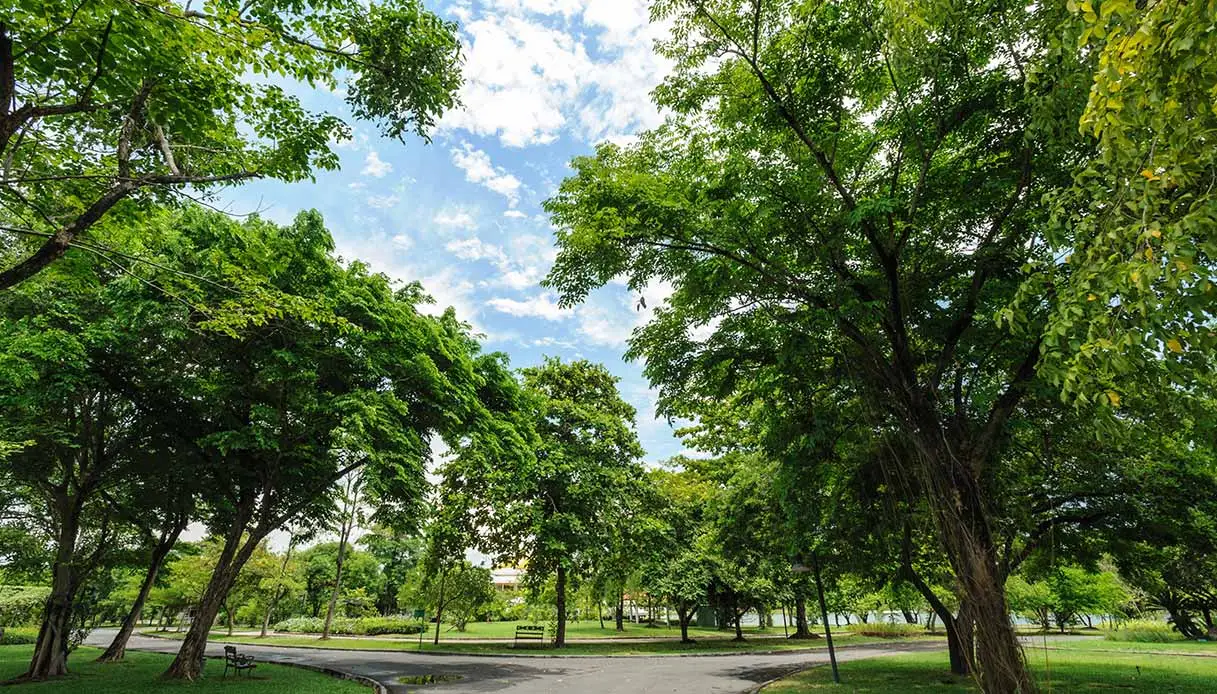
They’ve told us this many times. Even the place where you live matters in terms of the well-being of the heart and arteries. And there are many epidemiological observations that indicate how much and how it helps to live in greenery, even in the city, signifying the importance of the environment. But thinking only in terms of the presence of urban greenery, in the form of parks or dedicated spaces, is perhaps not enough. It also matters a lot whether there are trees or not, and not just lawns.
This is according to research that appeared in Environmental Epidemiology, coordinated by experts at the University of California at Davis (first author Peter James). According to the analysis, living in urban areas with a higher percentage of visible trees is associated with a 4% reduction in cardiovascular disease. On the contrary, living in cities with areas where there are higher percentages of grass would be associated with a 6% increase in cardiovascular diseases. Similarly, a higher rate of other types of green space, such as bushes or shrubs, however was associated with a 3% increase in cardiovascular disease. In short: greenery helps, but the presence of trees would make the difference.
AI analysis on Street View images
The research considered more than 350 million Street View images to estimate the amount of trees, lawn or other green space. And it goes some way to clarifying the results of other research which have nevertheless shown the value of green areas in cardiovascular prevention, while specifying that not all “green” would have the same protective weight. James himself reports this in a note from the University recalling that
“Satellite imagery has provided a new and meaningful understanding of how the landscape, both built and natural, can influence human health. But because the view is from far, far up and lumps all types of vegetation into one category, it can mask differences that could be significant.”
The research, which used Artificial Intelligence, made it possible to analyze a very large number of Street View images and therefore to estimate the surface area of each neighborhood covered by trees, lawns or other green spaces. The information on urban environments was then associated with the health of just under 90,000 women, involved in the very large “Nurses’ Health Study”. Thus we were able to define both the type and percentage of greenery – trees, grass or other spaces – within a radius of approximately half a kilometer from the participants’ residential address. At that point, the absolute presence of environmental greenery and the type of “material” that is linked to nature were compared with the health data collected for 18 years, also including medical records and death certificates, to determine which study participants had developed cardiovascular diseases.
Here’s what emerges
Let’s start from the positive data: in general, for those who live in green areas, a lower incidence of cardiovascular diseases such as heart attacks has been observed. But be careful: the researchers discovered that in the presence of higher percentages of visible trees, a 4% lower incidence of cardiovascular diseases was observed.
It’s not enough. In the presence of a higher percentage of grasses (i.e. more or less well-kept lawn, but without trees) a 6% increase in cardiovascular diseases was observed, while other types of green spaces were associated with a 3% increase. As if that wasn’t enough, it must be said that the association between greater visibility of trees and the lower presence of heart attacks, strokes and other pathological conditions of the heart and arteries was also consistent when other variables were considered, from population density to air pollution and the socioeconomic status of the neighborhood, just to name a few.
How to explain this trend? We report the study authors’ hypotheses, which explain the possible negative association of green grass with a possible greater use of compounds for the health of lawns, a different air quality for mowing, a lower cooling capacity compared to trees and a lower ability to filter noise and air pollution. But, it must be said, these are only hypotheses.
Your zip code reveals a lot about your health
To define people’s health and social risks, on the other hand, it is not the first time that images of the neighborhoods where they live have been analyzed. Some time ago this was demonstrated by research that appeared on European Heart Journal: by using Google Street View to study buildings, green spaces, sidewalks and streets, we have come to understand how the relationships between these elements can influence the risk of coronary artery disease and therefore of heart attack. The study was led by Sadeer Al-Kindi and Sanjay Rajagopalan of the Harrington Heart & Vascular Institute at University Hospitals and Case Western Reserve University, along with Zhuo Chen.
In practice, the research confirms the old theory that zip code can be considered a predictor of people’s health status. More than half a million Google Street View images of Detroit, Kansas City, Cleveland, Brownsville, Texas, Fremont, California, Bellevue, Washington State and Denver were examined. The researchers also collected data on coronary heart disease rates by analyzing small areas involving an average of 4,000 people. Then artificial intelligence did the rest. By mixing all the information, it was seen that simply by studying the built environment we could better predict who is at greater risk of heart attack and angina. Elements such as green spaces and pedestrian streets are in fact associated with a lower risk.
In short, the lesson that comes from science is clear. For everyone, we need to pay more attention to the world we live in. Promoting a life in nature as much as possible. And if what has been said is still not enough, it is worth reviewing a study that appeared on Journal of the American Heart Associationwhich finds that people living in areas with social and environmental adversity may have up to double the risk of developing heart disease and stroke.