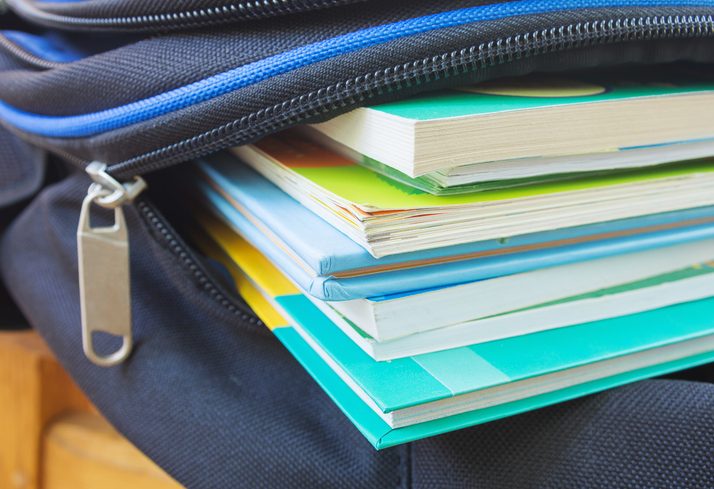
In recent weeks, Italian families are purchasing the new school texts: if in primary school the costs are almost totally absorbed by the educational institution, in subsequent degrees – middle and higher – the purchase is borne by the family, net of possible subsidies and contributions to the purchase. According to the latest report of theCompetition and market authority authority – also called Antitrust – the costs have grown by 25% from 2005 to today, with an accelerated in recent years: a 800 million euro market that weighs more and more on domestic budgets. The increase in expenditure is certainly driven by rates of paper and energy, from the frequent release of new editions, even with minimal changes, and with limits to the second -hand market.
How much Italian families spend for textbooks: what the data tell us
The antitrust highlights how the overall value of the 2024 textbook market market is in fact approximately 800 million euros, against approximately 705 million euros of 2006, given that in turn it grew up of 1.4% compared to the previous year. This increase, according to the Italian publishers’ association, is to be attributed to the growth of the cost of the raw material, the charter paper. In particular, the report shows that, in the last school year, Italian families have spent on average, for the entire school cycle:
- € 580 to first grade secondary schools (middle)
- € 1,250 per second degree (superiors).
Only in the last year, according to the Codacons data reported by the Antitrustust, this expense had a surge of 18%, a percentage higher than inflation.
It is an important change of costs compared to the last 10 years, with an increase of 13% on 2014. It is also interesting to observe how this growth mainly interests high schools, while instead it has remained stable for the primary school range – where, as regards public school, most of the costs are incurred by the institution – and for the second degree secondary school.
What is the increase in prices for?
The AIE, an Italian publisher Association, clarified that the increase in prices is primarily due to the increase in the raw material before paper, as well as energy. According to the data reported by the Sole 24 Ore at the end of 2024, the prices of the raw material charter have reached 90 euros per ton, with a +52% compared to the same period of 2023. The increase in the raw material is therefore effective, but it is still necessary to expand the gaze and keep in mind that in a market dominated by 4 groups – Mondadori, Zanichelli, Sanoma and the school – from year to year, numerous new editions are produced, where they come entered updates and new equipment. From this it follows that the reuse of textbooks in view of a saving – whether it is sale or loan between private individuals, or of the second -hand market – is therefore present, but not always possible.
Although the increase has been gradual and not, according to the report, out of scale, the perception of families is negative, because the spending power of the Italians has however dropped. The contributions and subsidies are active but, as reported by the same investigation, dysomogeneous.
Another important fact to consider, to understand how the market is moving today is the overall value of the market in relation to the number of pupils enrolled in school, an element that highlights the increase in the cost per family.
According to the Observatory of the whole school, in the 2004/2005 school year there were about 8.7 million total students (against a market value of around 700 million euros): in the school year 2024/2025, however, the Italian pupils were “only” 7.9 million (with a market value of 800 million) and, for the school year that starts now, a further drop of 134 thousand pupils is expected. A change that had already been highlighted by observing the years from 2019 to 2024, in which a 7%decrease was measured, estimated at around 600 thousand students in all.
Increasing expenses and critical issues on the use of digital
However, it is essential to observe that in 2007, Altroconsumo submitted an investigation into the prices of the texts – specifically those of high schools – to Antitrusta because from 2005 to 2007 an increase in expenditure between 11% and 18%, even higher than inflation.
In 2008, in fact, it was announced – with the law nr. 133, in article 15 dedicated precisely to the “cost of school books” – which starting from the following school year, “The competent bodies preferably identify the textbooks available, in whole or in part, on the Internet” (…) “In order to strengthen the availability and usability, at the costs of the costs of texts, documents and didactic tools by schools, pupils and their families” and then “Starting from the 2011-2012 school year, the teacher college adopts exclusively books that can be used in online versions downloadable from the Internet or mixed”.
Digital usability in order to break down costs – and the weight on the backs of the boys – to date is still a dark point, which obviously also crosses with the delicate relationship of teenagers with technology. In many schools a paper-digital mixed form is adopted, but a way of making digital use has not yet been found a real solution that breaks down the cost, also because families, or schools, are not always able to guarantee the presence of tools suitable for studying, such as tablets or computer.