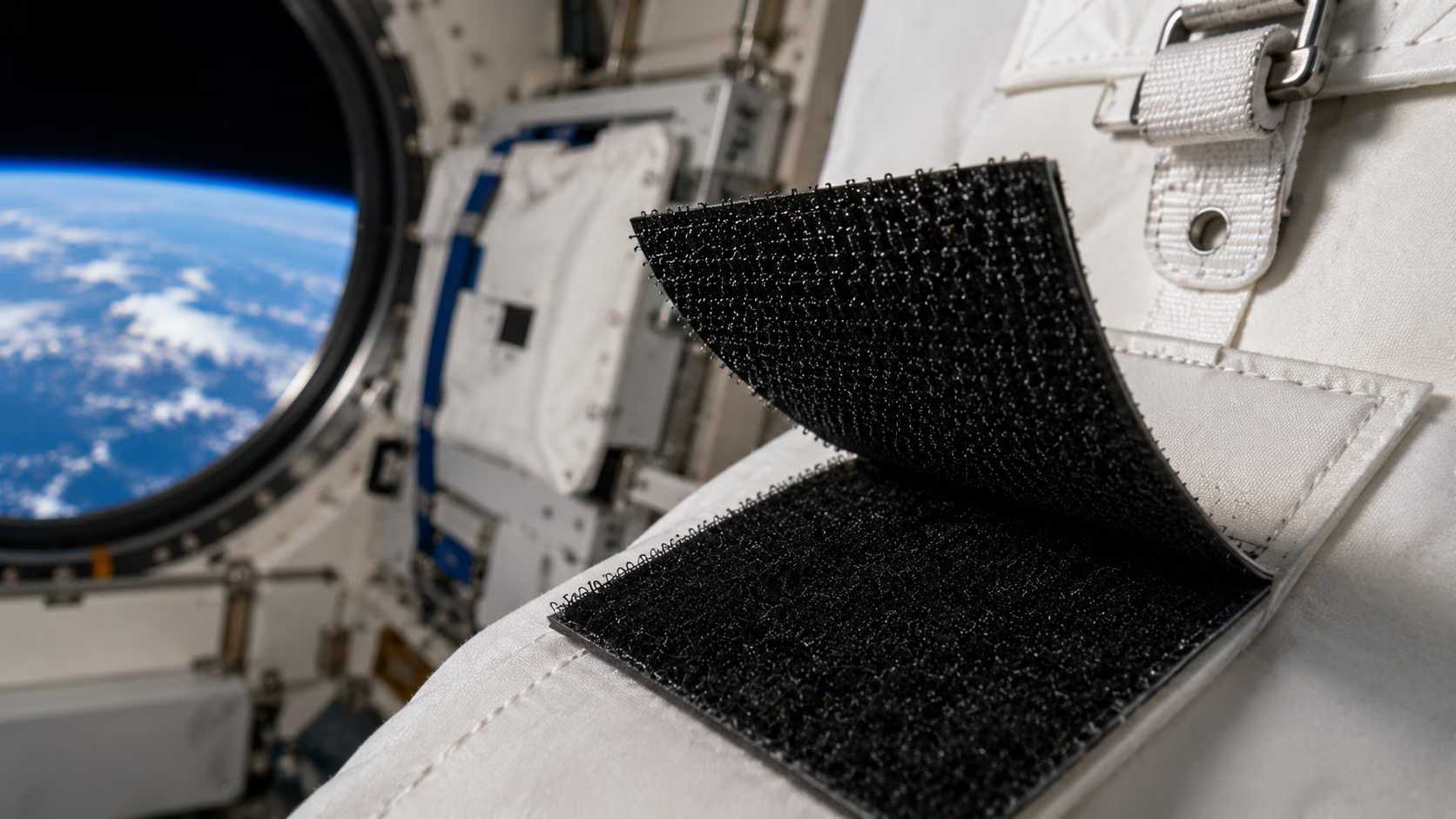
The Swiss engineer George de Mestral invented Velcro by observing under the microscope the burdock curls that remained stuck to the trousers and fur of his dog after an excursion in the woods of the canton of Vaud in 1941. The system works thanks to two complementary strips of fabric, one covered with tiny hooks and the other with rings, which fit together creating thousands of micro-hooks. The patent only arrived in 1955, after years of attempts with different materials. Since then, Velcro has conquered unthinkable areas, including the space race: NASA used it extensively on the Apollo missions, with consequences that go far beyond the comfort of shoes and jackets.
How a burdock curl inspired the invention of Velcro in 1941
In 1941, the Swiss engineer George de Mestral, 34 years old at the time, returned from a hunting trip in the woods with his dog and found himself annoyed by burdock curls, small prickly fruits of the plant, which had become entangled in the animal’s fur and in his own clothes. Instead of simply removing them, he put them under the microscope in his laboratory and discovered that those curls did not have sharp thorns as they seemed to the naked eye, but hundreds of tiny hooks capable of hooking into the small buttonholes of a fabric.
From that observation was born the idea of a closure made of two complementary surfaces: one covered with small hooks, the other with soft slots in which the hooks could get caught. Nature thus offered a model of closure durable but reversiblebased on mechanical fastening rather than glues or buttons. However, it took more than ten years of experiments, also conducted in Lyon, before being able to industrially reproduce this structure on a nylon fabric, and the Swiss patent did not arrive until 1955. The name velcro it is nothing other than the portmanteau of the two French words velours (velvet) e crochet (hook), which respectively recall the softness and hooking capacity of the material.
How the hook-and-loop system works and what it is used for
The Velcro mechanism, technically known as a “hook and loop fastener” (a way to temporarily fasten two surfaces quickly) relies on two distinct textile surfaces working in pairs. One strip is covered with small rigid hooks, obtained by shaping and cutting nylon filaments in order to transform a simple loop into a working hook. The other strip is made up of a surface of small soft buttonholes, similar to short-pile velvet. When the two surfaces are pressed together, hundreds of hooks fit into their respective slots per square centimeter, distributing the holding force over many contact points. This explains why Velcro holds up well to tension applied parallel to the surface, but comes off relatively easily if pulled perpendicularly and “peeled” from an angle, exactly like the burdock curls observed by de Mestral. In the video below, macro images of its operation.
From shoes to wallets: a material with slow but unstoppable success
Despite the genius of the idea, Velcro did not immediately hit the market. In the 1950s and 1960s, the textile industry considered it unelegant, more suitable for technical clothing than for everyday fashion, and it took years before it appeared on commonly used shoes, jackets and wallets. The turning point came, paradoxically, thanks to television: reports on astronauts using Velcro closures on their suits fascinated audiences around the world, making this closure system a symbol of high technology and reliability, even in extreme conditions. Velcro thus became synonymous with modernity, while finding application in everyday objects, from sneakers to pockets, up to watch straps.
The zipper in space: from Apollo 11 to the shadow of Apollo 1
In space, Velcro has solved a problem that doesn’t even exist on Earth: in microgravity conditions, any unsecured object tends to float and move away. On board Apollo 11, Velcro was used in many places in the command module and the lunar module to secure instruments, accessories and small on-board objects. The advantage was in its simplicity: a lightweight closure that can be reopened and independent of electrical power or complex devices.
Special versions of Velcro that were resistant to extreme temperatures were also developed for some space applications. The model HI-GARDEmade of stainless steel, was designed to fix the ablative shield of the capsule and withstand temperatures up to 427°C during atmospheric reentry. But Velcro also appears in a much darker page in NASA history. In the Apollo 1 capsule, destroyed by fire in 1967were present 3.2 square meters of Velcro together with other flammable materials. The investigation established that the fire was probably started by an electrical fault, but the Velcro, together with the nylon and the pure oxygen atmosphere present in the cabin, contributed to fueling and rapidly spreading the flames. After the tragedy, NASA drastically reduced the use of combustible materials inside the capsules.