If we were to rely solely on videos circulating online, it might seem that humanoid robots are now ready to enter the workplace. In recent years several models have been shown running, balancing and tackling increasingly complex demonstrations. But how big is the real market already?
One of the first global data collected by the International Federation of Robotics (IFR) helps put the phenomenon into perspective. As of 2025, approximately 7,000 humanoids have been sold worldwide for industrial applications and professional services. It is the first time that the organization has counted them separately in the statistics it has collected for about thirty years. The number remains very small compared to traditional robotics and allows us to better distinguish between what is shown in demonstrations and what is actually purchased. Their use as domestic assistants in homes, therefore, is still extremely limited.
What does the figure of 7,000 humanoid robots really mean?
That number does not correspond to all the human-like robots in the world. The survey considers units intended for industrial and professional uses and excludes consumer and military models, while medical devices are classified separately.
The definition of humanoid is also broader than one might imagine. According to the IFR, a machine falls into this category if it has a human-like appearance and is capable of operating autonomously in environments designed for people. It doesn’t need to have two legs. The point, therefore, is not to perfectly reproduce the human body, but to be able to use spaces, tools and infrastructures already designed for human beings without requiring radical changes.
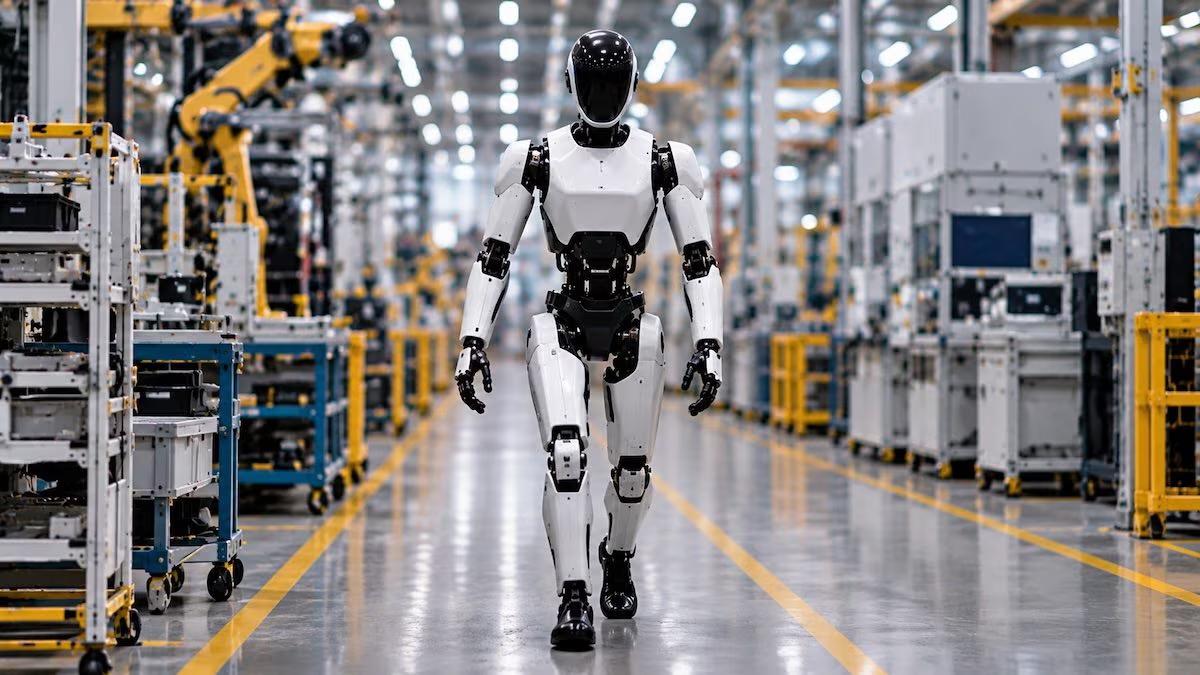
Having been sold, however, does not necessarily mean you are already at work. Many of the specimens purchased last year ended up in research centers or at companies that use them to generate data with which to improve AI models. Even the automotive sector, among the first to experiment with this technology, is proceeding on a smaller scale: in pilot projects we are generally talking about single-digit or, in some cases, double-digit numbers per plant.
The comparison with traditional robotics makes the proportions clear. In 2025, factories around the world have installed over 600,000 industrial robots and the operational total has reached a record of around 5 million units. Humanoids therefore constitute a niche compared to machines that have been welding, assembling, moving components or repeating operations on production lines for years.
Because humanoid robots are not very common in factories and even less for home use
Being able to complete a demonstration does not automatically mean being able to repeat the same task for hours, with precision and without interruptions. This is where the difference emerges between a successful test and a machine suitable for being permanently inserted into an industrial process.
The IFR identifies several obstacles to overcome. The first concerns small volumes. These systems are built in relatively small quantities and have not achieved economies of scale comparable to those of mature industrial robotics, i.e. the economic advantages obtained by making large quantities of the same product. In other words, small-scale production makes it more difficult to reduce costs.
Then there is the issue of performance. A robotic arm designed for a single task can be optimized to perform the same movement thousands of times. Humanoids, at present, do not compete with conventional industrial machines in terms of speed, precision, reliability and repeatability. In return they promise greater versatility, because they can be used for different tasks.
Another difficulty concerns energy. According to the IFR, one battery cycle does not cover an entire working day. For models that walk on two legs, safety also comes into play: they must continually maintain their balance and a fall or power problem can cause damage to the machine or put those nearby at risk. Standardization is also evolving, with specific safety rules for humanoids and other legged robots under development.
AI can help make these systems more autonomous and adaptable. IFR indicates, for example, that generative models can offer new ways to acquire skills, learn from a demonstration, and tackle a task without every single movement being programmed in advance. It is one of the aspects of the so-called Physical AIthat is, the application of artificial intelligence to machines that must perceive and act in the physical world. Software advances, however, do not erase the limitations present on a mechanical, energetic and operational level.
How much the humanoid robot market could grow in the coming years
The approximately 7,000 units sold represent above all a first reference with which to compare the evolution of a sector which has so far been told through prototypes, announcements and large investments.
Expectations are much higher. Bank of America Global Research estimates that about 90,000 humanoids could be shipped in 2026 and that deliveries could reach 1.2 million by 2030. However, these are forecasts, not sales already realized, and should not be confused with the IFR count, which is based on information from suppliers and national industry associations.
Among the countries on which most attention is focused is China, already the world’s largest market for industrial robots and intent on developing the mass production of humanoids. In the United States the sector attracts large private investments, while in Europe the focus is mainly on safety, efficiency and ethical implications. Japan is also looking at possible applications related to the aging of the population.
To understand whether this growth will materialize, therefore, it will not be enough to count how many models are presented publicly or announced by manufacturers. The decisive step will be to see how many can emerge from the laboratories and pilot projects to carry out useful, reliable and cost-effective activities on a large scale. The available data shows that humanoids have already begun to find concrete applications, but that their diffusion remains very far from the impression given by the most spectacular videos.