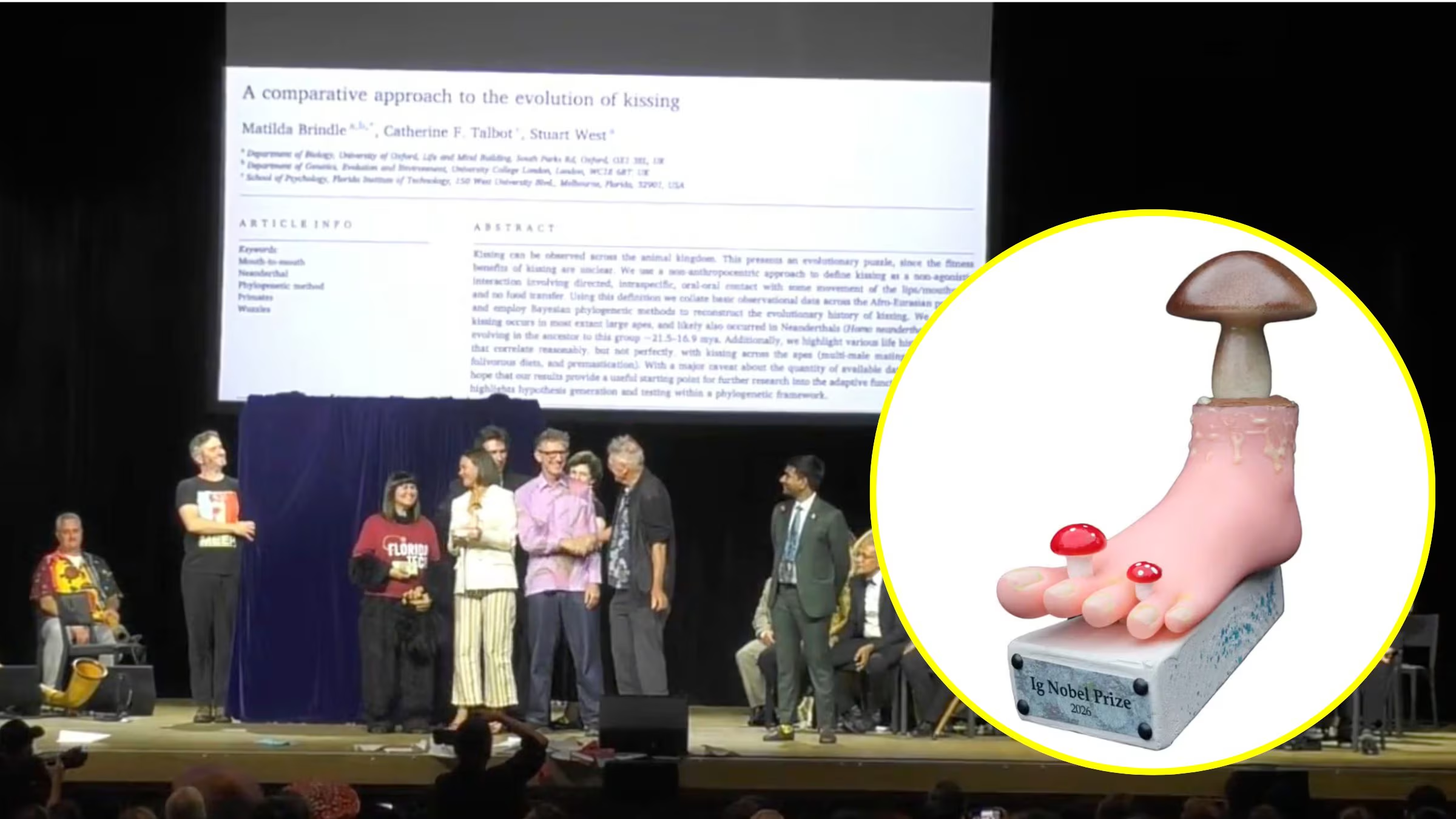
Imagine a day in September, a theater full of scientists and curious people and a group of Nobel Prize winners on stage… dressed up as mushrooms! This is what happened last night at the Kongresshaus in Zurich, Switzerland where, for the first time outside the USA, the award ceremony of the Ig Nobel Prize 2026 was held, the prizes for the most absurd research, which first make you laugh and then make you think, awarded by the scientific-humorous magazine Annals of Improbable Research. The theme of this 36th edition, both in the winning research and in the display, is precisely the fungi that “live in our toenails, armpits and… elsewhere”, as specified by the “Master of Ceremonies” Marc Abrahams, founder of both the award and the magazine.
The move to Zurich and the plans for the next editions
Born in 1991, the Ig Nobel Prizes have always been held in Massachusetts, initially at MIT, then at Harvard, with an entirely online interlude during the pandemic years. This year the ceremony moves to Europe due, according to what the organizers said, of the hostile and unscientific climate created by the Trump administration. According to the Boston Globe, organizers were concerned about the safety of international winners and press in having to travel to the US.
From 2026, the ceremony will therefore become itinerant: it will return to Zurich every two years and travel in odd years. The stop for 2027 is at the University of Antwerp, Belgium.
The ceremonies and awarding of prizes
As always, after the initial presentation, some great scientists and thinkers (Els Titeca, Tim Hunt, Marcel van der Hiejden, Alessio Figalli and Tess Heeremans for this edition) held the “lessons 24/7”. That is, they had to explain their research first 24 seconds and then in the sun 7 words. This year’s prize winners were Nobel Prize winners Esther Duflo and Abhijit Banerjee (both Nobel Prize in Economics 2019), Michel Mayor (Nobel Prize for Physics 2019) and Tim Hunt (Nobel Prize for Medicine 2001).
The prize this year consists of a sculpture in the shape of a mushroom-foot-slice of cheese and 10 trillion Zimbabwe dollars… equivalent to a few US cents. For the more curious, the entire ceremony can be viewed on the event website. Here is a brief summary of this year’s ten winners.
For soil science: the burial of underwear
Probably the most iconic quest of this edition. The winners are Swiss and Dutch researchers who also involved citizens in a project citizen science (scientific research that calls together and brings citizens and “non-experts” into the field). The researchers sent a pair of identical cotton underwear to over 1000 Swiss citizens, for a total of more than 2000 pairs of underwear. Each participant then received two pairs of underwear and had to bury them in two different places (in their garden or in the chosen area), and then dig up one after 30 days and one after two months. The project has made enough of a splash, the researchers say, that it has gone further 25 countries in the world, going well beyond the borders of Switzerland.
The more fungi, worms and bacteria populate the soil, the more the tissue degrades, and a soil teeming with life is, by definition, healthy soil. For researchers therefore the degree of decomposition of underwear is a good indicatorsimple and economical, soil health: the more they are worn out, the more alive and healthy the soil is.
Biomechanics: evolution of kissing in the animal kingdom
With research published in Evolution and Human Behaviorthe winners, Matilda Brindle, Catherine Talbot and Stuart West studied the evolution of kissing in the animal kingdomarriving at a universal definition applicable to every species from humans to ants and birds! Kissing has been defined as an activity with “non-agonistic interactions involving direct, intraspecific oral-to-oral contact, with some lip/mouth movement and no food transferThe researchers hope that this study provides a basis for understanding the real adaptive reasons for kissing.
Economy: study between different social classes
The prize went to a Berkeley team with a study published on PNAS which found that people belonging to high and wealthy social classes tend to have bad behavior more often than the less well-off classes, such as cutting off pedestrians and breaking traffic rules. In the series of 7 experiments conducted by the team it also emerged that: those who were richer tended to make unethical decisions; to appropriate other people’s valuable assets (specifically, also to steal candy from a jar specifically intended for children). Experiment subjects belonging to higher social classes were also more likely to lie during a negotiation, to cheat to increase the chances of winning a prize and, finally, to justify unethical behavior at work.
Chemistry: cockroach milk
The prize for chemistry goes to researchers who we would definitely define as… patients. Banerjee and the international group spread across Japan, USA, France and India have discovered that the cockroach milk Diploptera punctata uses to nourish their embryos is incredibly nutritious. With the same volume, it contains up to three times more energy than cow’s milk. An interesting piece of information, in case you want to start milking cockroaches (just kidding!).
Medicine: how to blow your nose
Tokuji Unno posthumously receives the Ig Nobel for medicine for his 1977 research, with Hiroshi Yajima, on how to blow your nose. The search (How to Blow the Nose – An Aerodynamic Study of the Nose Blowing) was based on aerodynamic measurements of speed, of volume of nasal breathing and the pressure exerted on the ears, in 15 people aged 14 to 48.
Biology: trampling vipers
The winners of the award looked for the specific conditions (including climatic conditions such as temperature and humidity) that make a viper’s bite more likely when stepped on. Stomping repeatedly (they assure us it was done gently) different parts of the body of specimens of Bothrops jararacaa venomous South American snake, concluded that hitting the head, especially of young specimens, leads to an increased risk of being bitten. It must be said that the search was retreat due to concerns about animal health and the lack of authorization to use newborn specimens.
Physics: the perfect anti-splash urinals
A round of applause to the engineers who have identified the perfect design for urinals, to avoid splashes and spills, with research published in PNAS Nexus. The most efficient shapes were obtained only by changing the geometry of the urinals, in particular the critical angle within which there is a lower risk of splashes (splashback), which coincidentally is also the strategy used by dogs to avoid peeing on their paws. The designed models have an angle equal to or less than 30° and are called Cornucopia And Nautilus.
Technology: animals and 3D printers
A little macabre, and always with animals as protagonists, the award for technology goes to a group coordinated by the Department of Mechanical Engineering of the Mc Gill University of Montreal, in collaboration with the Department of Biology of the Drexel University of Philadelphia for having used the proboscises of dead female mosquitoes as 3D printer nozzles! The technique, called Necroprintingallows you to print very thin filaments of just 20 μm, surpassing those currently available on the market which are in the order of millimetres!
Smell: the smell of newborns
Ilona Croy and colleagues at the University of Dresden have collected evidence that parents perceive their children’s odor as newborns as extremely pleasant in 93.7% of cases. A liking that decreases during adolescence: in this period only 72.5% of parents find the smell of their adolescent child pleasant. The explanation, according to the authors, can be traced back to the olfactory recognition mechanisms underlying the creation of the parent-child bond. The hypothesis that this “repulsion” for adolescent odor is linked to an evolutionary strategy to avoid incest is less valid, however, and not confirmed by the study.
Peaceful friends or bad friends
Do you know when an ex, boss, colleague or simply an annoying neighbor does you wrong? Do you vent to your friends and your favorite people: who tries to see the good in your “enemy” or who gets angry with you? The winners of the 2026 Ig Nobel Peace Prize in research published on Evolution and Human Behavior they confirm that every now and then we prefer those friends who are “bad” and side with us in our personal aversions.