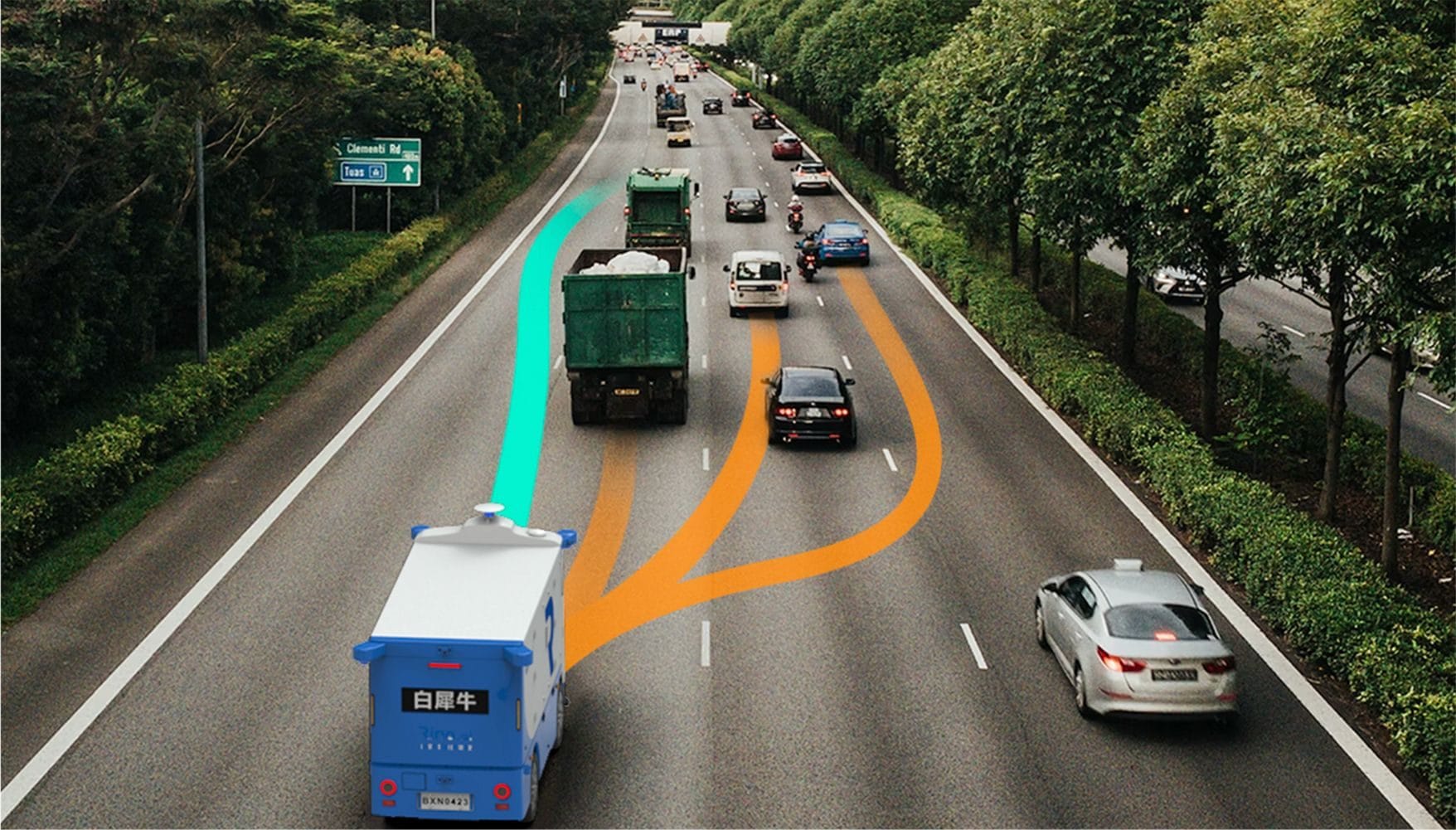
In China it is becoming more and more common to find autonomous driving trucks on the urban roads: from the delivery of expenditure to the transport of goods between one location and another, all without the need for a driver on board.
The development of these autonomous vehicles is still in the hands of a few companies, including pony.ai (which last April began to test its autonomous driving cars in Luxembourg) and rino.ai: for the moment, however, the trucks are developed according to a level 4 of automation (which requires a remote human supervision, despite being without people on board) and are mainly used for short and rather short and rather flat. The final goal, however, is to expand this technology also to long -distance trucks within the next 5 years.
How autonomous guided trucks work and what the automation level 4 is
Basically, the operation is that of any other autonomous driving vehicle: the development of these trucks has been made possible thanks to the rapid evolution of artificial intelligence in recent years. Specifically, these autonomous guided trucks are equipped with:
- Movement sensors and Lidar (acronym for Light Detection and Ranging): it is a remotely tender technology, which uses laser impulses to measure distances and create high resolution 3D maps of the surrounding environment. In this way, trucks can more easily detect objects and any obstacles around them, but also evaluate road conditions.
- High resolution cameras: used to identify road signs and surrounding vehicles.
- Machine learning algorithms: it is the set of processes used by a model to to perform tasks. In this case, it allows autonomous driving vehicles to process all data collected and improve their driving performance based on these.
- GPS and connectivity systems: guarantee more accurate navigation and communication with traffic systems.
As mentioned, most of the Chinese autonomous guided trucks have a level 4 of automation (on a scale of 5): in this case, also called “High Driving Automation”, there is no person on board the vehicle, but remote control is still mandatory in case of emergencies. In any case, at this level the vehicle is able to manage complex driving situations (such as road works or other unexpected events), without any human intervention.
How these trucks and manufacturers are used
To make autonomous guided trucks in China are several companies, from Pony.Ai (which last April brought to Europe its autonomous cars prototypes, starting to test them in Luxembourg) up to Rino.ai, which by the end of the year aims to expand also to Australia for the delivery of food goods on behalf of a supermarket chain.
As anticipated, these truck prototypes have quite small dimensions compared to normal cargo: they have an average autonomy of 120 km and are able to transport between 800 and 2,400 kg of goods, far from 40 tons of the fully loaded trucks.
Precisely for this reason, at the moment these trucks are mainly used for short -range journeys, between 10 and 30 km. These paths, being fixed, involve less technical risks: at the same time, the authorities are more likely to allow the movement of autonomous driving vehicles if the distances are smaller. It is then to be considered that larger trucks need more advanced (often non -cheap) technologies to map the entire path, during which the chances of unexpected events due to intense traffic or even weather conditions increase, which could cause faults.
In short, the use of these driver -free trucks is becoming increasingly common in China: more than 100 cities have authorized the circulation of autonomous driving vehicles within their territory, while Chinese transport companies (including Zto and China Post) or even multinationals such as Ikea are taking advantage of these services to reduce costs.