Industrial autoclaves work through cycles in which temperature, pressure, time and treatment methods are set according to the product and the process. The load is placed inside baskets or equivalent systems, subjected to the expected conditions and subsequently unloaded at the end of the cycle.
The continuity and regularity of the process also depend on the way in which the load is organized within the plant. The arrangement of the layers, the stability of the piles, the passage spaces and the behavior of the materials during the treatment contribute to the correct carrying out of the cycle.
The components that participate in this structure include the interlayers, technical elements called upon to work in repetitive and often demanding conditions, with an important role in the management of the product inside the autoclave.
What are autoclave interlayers?
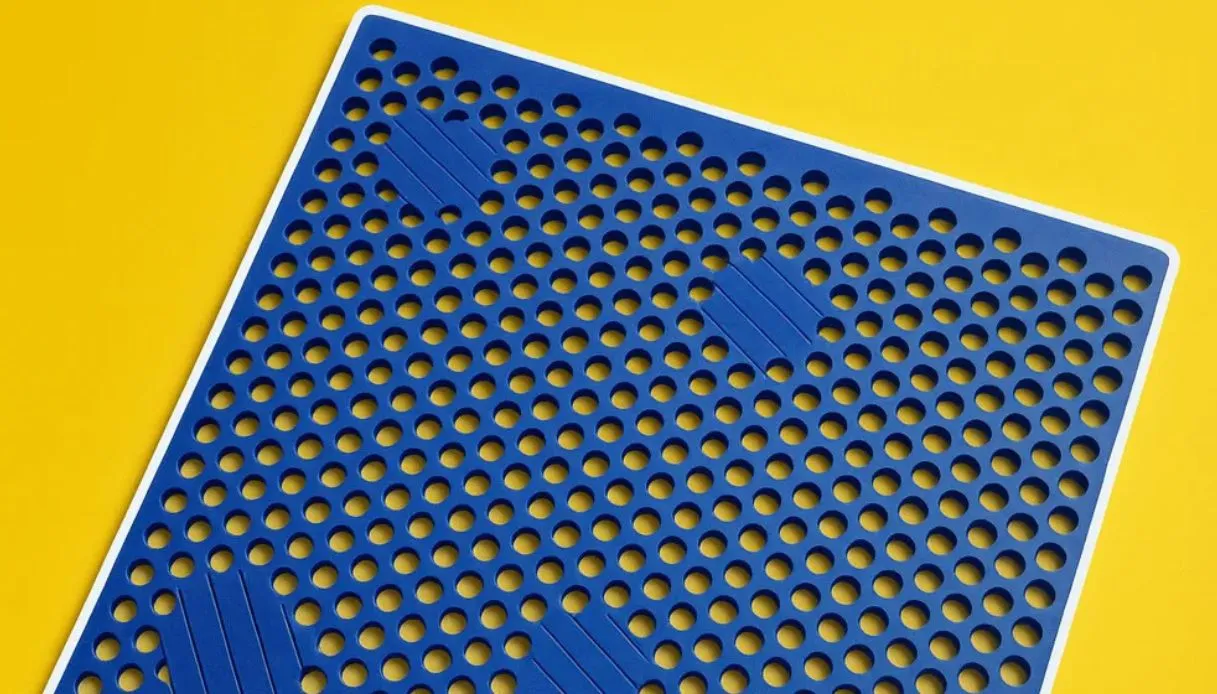
The interlayers are components placed between one layer and another of the load inside the basket. Their function is to contribute to the separation, support and correct arrangement of the products during handling and throughout the treatment cycle.
Contrary to what you might think, these are not necessarily simple flat elements. Depending on the application, the interlayers can have different geometries, shaped surfaces, rounded profiles, reliefs, perforations or other construction features designed to adapt to the type of product and the behavior required within the system.
For the silicone versions, Lineagomma has also developed its own solutions over time, born from application experience and the analysis of needs encountered in the field.
During the process, the interlayer may be subjected to temperature, humidity, mechanical stress and repeated contact with the product or with the internal environment of the autoclave.
For this reason, geometry, thickness, material and surface finish directly affect the behavior of the component and its durability over time. Although the unit cost of a pad may be relatively low compared to other elements of the plant, frequent replacement can have effects on warehouse management, operating times and production continuity.
The technical functions in static and rotary systems
The requirements of the interlayers also change depending on the type of autoclave. In static systems the load remains substantially stationary for the entire duration of the treatment. In this case, the ability of the interlayer to maintain its geometry, the stability of the load and the resistance to the thermal and environmental conditions foreseen by the cycle become particularly important.
In rotary systems, however, the load is moved during treatment.
This condition introduces different stresses and requires greater attention to mechanical stability, resistance to deformation and the component’s ability to maintain its structure over time. The choice of geometry and material cannot therefore be separated from the actual conditions of use.
An interlayer that excessively loses flatness, stiffness or geometry can change the behavior of the overlapping layers and affect the regularity of the load during the process. For this reason, in the most demanding applications, it is important to evaluate the component as an integral part of the product handling and treatment system.
The focus on materials: silicone and plastic materials
Lineagomma, based in Parma, produces interlayers intended for various industrial applications and has developed over time particular experience in the use of silicone for this type of component. Silicone is used when the application requires elasticity, thermal resistance, stability over time and the ability to withstand repeated cycles.
The choice of compound is made based on the expected operating conditions, temperatures of use, stresses and characteristics required of the product.
When the application requires it, silicone compounds formulated for specific uses and accompanied by the relevant technical and declarative documentation from the material manufacturer can be used.
In addition to silicone, Lineagomma can also evaluate plastic materials and other technical solutions, depending on the application and the needs of the system. The selection of the material is therefore not approached in a standardized way, but by considering the behavior required of the component, the expected duration and the actual operating conditions.
Design, customization and tailor-made workmanship
One of the most relevant aspects of the Lineagomma experience concerns the possibility of creating customized interlayers. In some cases the component is produced based on the drawing and specifications provided by the customer. For silicone interlayers, however, Lineagomma also has solutions developed internally, the result of direct experience, proprietary design and knowledge of application problems.
Dimensions, thicknesses, geometries, surfaces, shapes and finishes can therefore vary depending on the system, the product treated and the operating conditions. The processes can include moulding, cutting, finishing and other operations necessary to obtain uniform, repeatable and consistent products with the defined characteristics.
When the product is made to the customer’s specifications, Lineagomma supports the customer in evaluating the manufacturability, in the choice of materials and in the definition of the construction aspects. The verification of the final suitability of the component with respect to the system and the application validation remain the responsibility of the customer or the person responsible for the design of the system.
In the case of solutions developed directly by Lineagomma, the experience gained over the years allows us to make already tested models and configurations available to the customer, adaptable, where necessary, to the characteristics of the specific application.
The operational advantages for companies
An interlayer developed according to the application allows you to define geometry, thickness, material and finish taking into account the real characteristics of the system, avoiding having to adapt the process to a standard product not designed for that specific use. For companies this means being able to have components that are more consistent with the operating conditions and the behavior required during the cycle.
Another advantage concerns the repeatability of supply. Once the characteristics of the component have been defined and the solution validated, subsequent supplies can be made on the basis of the same configuration, simplifying the management of reorders and stocks. This aspect is particularly important when the interlayer performs a recurring function within a continuous production process and when the availability of the replacement must be guaranteed over time.
Lineagomma operates with an ISO 9001 certified quality system and carries out internal controls aimed at verifying the conformity of the products with the agreed specifications. The experience gained in the processing of silicone and technical materials now allows the company to deal with supplies intended for both static and rotary autoclaves, with particular attention to the choice of material, the geometry of the component, production repeatability and continuity of supply.
A path built since 1987 and grown over time through production experience, technical specialization and development of solutions capable of responding to the concrete needs of industrial plants.