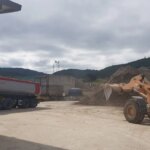
Protests by hauliers in Southern Italy against expensive fuel continue, with trucks still blocked in some areas of Campania. Despite the discussion with the Minister of Transport and the interventions (it must be said, limited) to support the sector, Autostrade per l’Italia has confirmed blockades on the A30 Caserta-Salerno for today, 22 October, with the Nocera-Pagani exit closed in both directions due to the ongoing demonstrations.
In the meantime, the Ministry of the Interior has confirmed the identification of the demonstrators who are implementing “illegal road blocks” which obstruct traffic, especially in Campania. More specifically, 1,339 people were identified, with 71 people reported and 242 administratively sanctioned. Today at 12 the Council of Ministers will meet to adopt a decree that brings together interventions for road transport and agriculture.
The hauliers have been demonstrating peacefully since the beginning of October, but they will not be the only ones to protest in the coming weeks: the Italian Union of Trade Unions and other grassroots unions have proclaimed a national strike for 30 October 2026 against the high cost of living for all categories of public and private work. And to always stay informed about the peaceful demonstrations organized throughout Italy, an interactive map of the demonstrations is now also available.
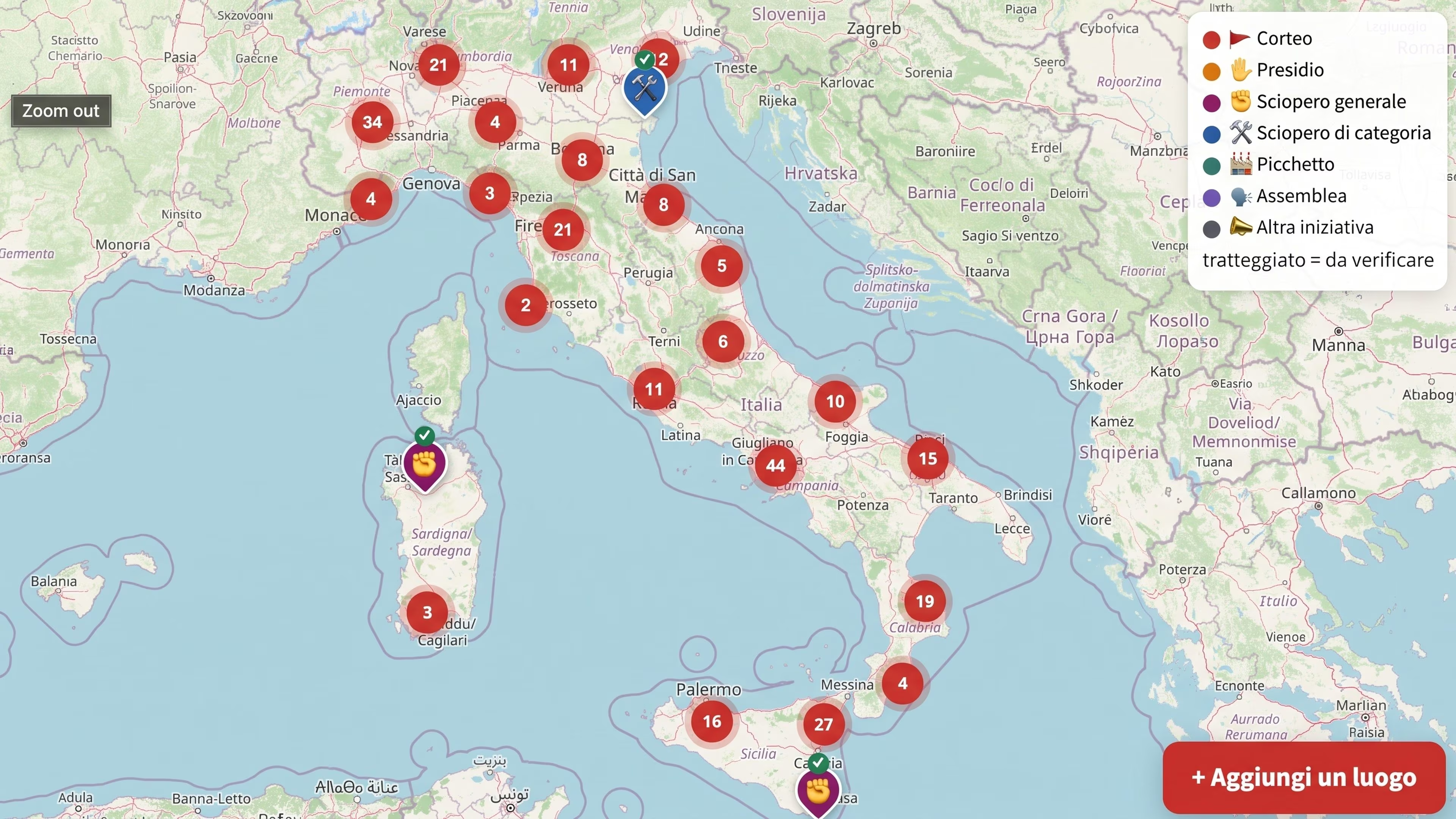
The map, available at this link and clearly visible in the post below, indicates the various demonstrations scheduled in the Peninsula in a map similar to that of Google Maps: exactly as for the navigation service, it is possible to click on the geolocalized protests to find out more details.
Each of the 288 mobilizations is divided by category (processions, general strikes, sectoral strikes, demonstrations or assemblies), as well as by date and indicative time. 46 mobilizations are scheduled for today, October 22, but the protest calendar extends until Friday, January 29, 2027. At the moment, the day with the most protests scheduled is October 30, with 57 mobilizations on the occasion of the general strike.
An important element, also reported in the site regulations: the mobilizations indicated are exclusively peaceful initiatives, regularly announced and given advance notice at the Police Headquarters.
Therefore, any violent demonstrations or protests organized outside the perimeter of legality are excluded from the platform. In the event that the reports sent by users have not yet been confirmed by official sources (press release, union website, official strike calendar), the demonstration is labeled with the acronym “to be verified”.
But what is needed, in Italy, to organize an event? The right to assemble And guaranteed fromarticle 17 of the Constitutionwhich establishes two fundamental conditions: the meeting it must be peaceful and the participants Not they must have with them weapons. For meetings in a public place, such as a square or a street, the promoters of the event must give notice to the Police Commissioner at least three days in advance, indicating the place, time and method of holding.
The Police Commissioner can decide to ban the demonstration, but only for proven reasons of security or public safety, not for reasons that have to do with the reason for the protest. For places open to the public (such as clubs or theatres), advance notice is not necessary.
Returning to the “map of mobilizations”, the creators of the site have specified that their intent is to inform, and not to organize or promote specific initiatives. Their idea is inspired by a model in some countries such as France, where an interactive map was created on the website in recent weeks Mobilization Vests Jaunes, which collects all the scheduled actions, divided by day and type of event, from principals to high school blocks.
In general, the common objective of all these projects is the same: to inform and, above all, raise awareness among the population regarding peaceful protests, trying to encourage participation in demonstrations organized to protest against real problems that affect the whole of society, such as the high cost of living, the increase in fuel prices, medical malpractice or funds allocated to rearmament (with cuts to other essential services such as school or healthcare).