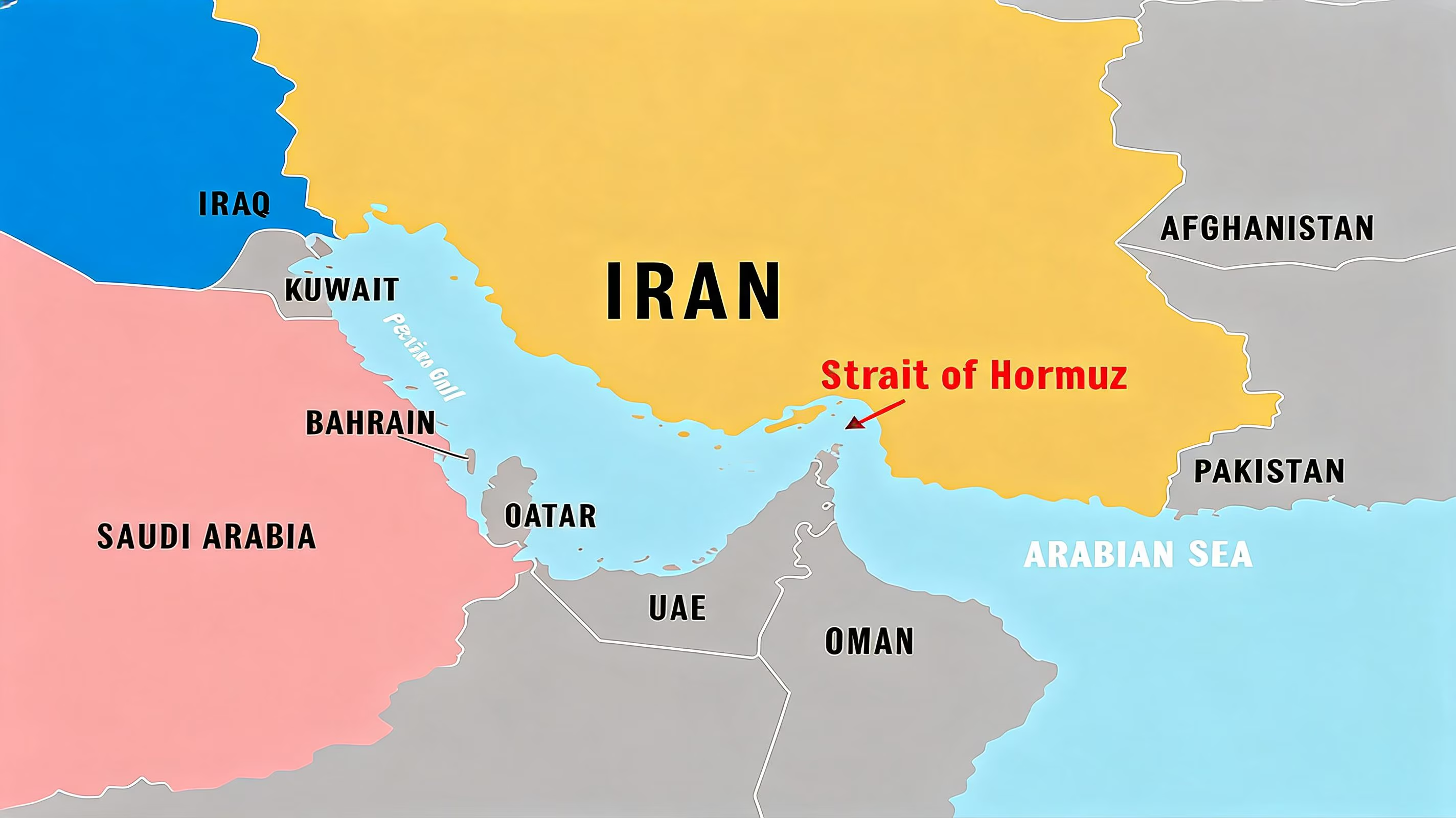
The joint attack conducted by the United States and Saudi Arabia against targets linked to pro-Iranian militias in Iraq represents an important turning point in the current crisis scenario in the Middle East.
The Washington government has been targeting armed groups supported by Tehran for years, but the direct participation of Saudi Arabia constitutes a political and strategic novelty. For years the Saudi kingdom has in fact preferred to limit itself to diplomatic or logistical support for US operations, while now it has decided to participate directly in the raids, an element that could mark a change in the balance of power in the region.
The operation comes after a series of drone attacks against Saudi infrastructure, attributed to groups linked to the “Axis of Resistance”, the network of allies and armed militias supported by Iran. This gives rise to numerous questions: why did Riyadh decide to intervene directly? Is Iraq at risk of being dragged into a regional conflict? And what does all this mean in relations with Tehran?
Why this attack is different from others: Saudi Arabia decides to intervene
The United States has for years conducted operations against pro-Iranian militias in Iraq and Syria when it believes they pose a threat to itself or its allies. The real novelty, however, is the direct participation of Saudi Arabia: in recent years the Riyadh government had progressively tried to reduce tension with Tehran, culminating in the diplomatic rapprochement of 2023 mediated by China.
This did not mean the end of the rivalry between the two regional powers, but the desire to find alternative channels while avoiding a direct clash. According to Reuters, the latest attacks conducted against Saudi infrastructure were organized by Iraqi militias together with the Yemeni Houthis with the coordination of groups linked to the Iranian Pasdaran (Islamic Revolutionary Guard Corps – IRGC).
With this raid, Saudi Arabia therefore enters directly into military operations against pro-Iranian groups present in Iraq and indicates that the Saudi leadership now considers attacks on its infrastructure a threat to its national security such as to justify a military response across the border, transforming Iraq from a neighboring country to an operational platform from which attacks against its own territory start.
Why Iraq protests: the violation of the principle of sovereignty
The Iraqi government has strongly condemned the attacks, calling the bombings a violation of its national sovereignty. In international law, sovereignty is one of the fundamental principles: a State cannot use force in the territory of another State except in exceptional circumstances, for example by invoking the right of self-defense provided for in Article 51 of the UN Charter.
Then there is an element that makes the situation even more delicate: many of the militias affected are part of the Popular Mobilization Forces (PMF, in Arabic Hashd al-Shaabi), an umbrella organization bringing together dozens of Iraqi armed militias. The PMF was established in 2014 to support the army in the fight against the Islamic State (ISIS): currently some brigades are considered very close to Iran, but as a whole the PMF are formally part of the Iraqi security apparatus and receive public funding.
This creates an almost paradoxical situation: for the United States and Saudi Arabia some of these militias represent armed organizations responsible for regional attacks and are therefore a military threat, while for the Baghdad government hitting them means hitting, at least formally, forces belonging to the Iraqi state. The Iraqi condemnation therefore concerns both the political defense of the affected militias, but also and above all a defense of the principle of sovereignty.
Is there really a risk of escalation with Iraq?
At the moment the hypothesis of a direct war between Iraq and Saudi Arabia-United States is an unlikely scenario: the Iraqi government does not seem to have an interest in opening a conflict with Riyadh or Washington. On the contrary, his goal is to prevent the country from being drawn into the conflict between Iran and its regional rivals.
Iraq, in fact, finds itself in an extremely complex position, as it hosts US forces, maintains economic and political relations with the Gulf countries, but at the same time numerous militias close to Iran operate on its territory and have considerable autonomy. If these militias continue to launch attacks against Saudi or US targets from Iraqi territory, it is possible that Washington and Riyadh will decide to intervene again without waiting for Baghdad’s consent.
The risk, therefore, is not so much a war between Iraq and Saudi Arabia, but a progressive erosion of the authority of the Iraqi state, increasingly incapable of preventing its territory from being used both as a base for attacks and as a target for reprisals.
What changes in the regional balances of the Middle East
The most important aspect is not so much a possible conflict between Iraq and Saudi Arabia, but rather whether Saudi Arabia has decided to take a more active military role against the network of armed groups supported by Iran. In recent months, attacks have involved Iran, Israel, the United States, Yemen, Syria and now increasingly directly Iraq.
Each new front increases the risk that countries that have previously remained relatively on the margins will be dragged into the conflict. Saudi Arabia’s direct participation could in fact indicate that Riyadh no longer intends to limit itself to supporting the United States or strengthening its internal defenses, but is willing to intervene militarily even outside its borders when it believes that a threat has become immediate.
If operations of this type were to be repeated, the Middle East could enter a different phase, characterized by an increasingly direct involvement of the main regional powers and an increased risk of military operations that could further widen the conflict.