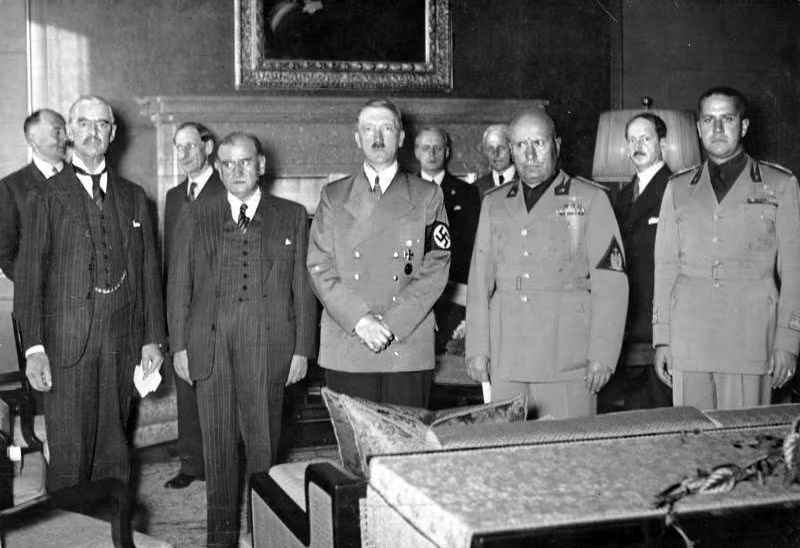
The Munich conference of 29 and 30 September 1938 was the summit between the prime ministers of Germany, Italy, France and the United Kingdom to discuss the territories inhabited by the Sudetenland, i.e. portions of Czechoslovakian territories inhabited by ethnic German populations, to avoid the imminent war – Czechoslovakia was not invited to the negotiations. Nazi Germany claimed control of the territories in which the Sudetenland lived and at the conference the democratic powers accepted the requests, trusting in the promise that Hitler would not make any further territorial claims. Subsequent events proved that trust was misplaced, to the point that, less than a year after Munich, the Second World War broke out.
The expansion of Nazi Germany and the annexation of Austria
The Nazi regime, which came to power in Germany in 1933, initiated an expansionist policy. The first objective was to annex all territories inhabited by Germans, since the Treaty of Versailles, imposed on Germany after the First World War, had led to heavy territorial losses, including territories inhabited by Germanic populations.
Already in 1934, Nazi Germany attempted to annex Austria, but failed, also due to the opposition of fascist Italy. In the following years he remilitarized the Rhineland region and strengthened the army. In March 1938, in a changed geopolitical context, the Nazis attempted the coup in Vienna again and, this time, completed the annexation. Austria became part of the Third Reich.
After the annexation of Austria, Hitler decided to address the issue of the Sudetenland, that is, the South German inhabitants (Sudetendeutsche), residing in Czechoslovakia. After the First World War, a new state, Czechoslovakia, had been founded on some of the territories previously belonging to the Habsburg Empire, which, in addition to the Czechs and Slovaks, included within its borders approximately 4,000,000 Germans: the second largest ethnic group after the Czechs.
After the rise of Nazism in Germany, the majority of Sudetenland progressively moved to pro-Nazi positions. Thus, the Sudetenland became an instrument of Hitler’s expansionist policy.
Hitler’s demands on the Sudetenland in Czechoslovakia
After the annexation of Austria, Nazi claims to the territories inhabited by the Sudetenland became more pressing. Hitler unleashed a violent press campaign against Czechoslovakia and ordered the armed forces to prepare plans for the invasion. The dictator’s only concern was the possible reaction of the democratic European powers, France and the United Kingdom, with which Germany had signed the Treaty of Versailles.
The United Kingdom and France, however, did not intend to decisively oppose Hitler’s requests. In particular, the British Prime Minister, Neville Chamberlain, followed the policy of appeasement, that is, of meeting German demands. In September 1939 Chamberlain flew twice to Germany to meet Hitler and seek a diplomatic solution with him. The issue was complicated by the fact that two other countries, Hungary and Poland, also made claims on the territory of Czechoslovakia.
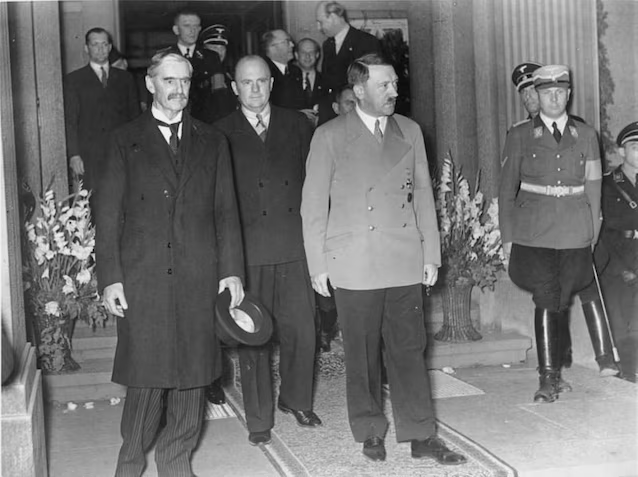
Although Chamberlain was willing to accept most German claims, he was unable to reach an agreement with Hitler in either meeting. War seemed inevitable. On September 26, Hitler delivered a fiery speech, assuring that the German army would invade Czechoslovakia by October 1. Two days later, however, the dictator changed his mind and, on the proposal of Chamberlain, who also availed himself of Mussolini’s mediation, he agreed to participate in a new meeting, which would also include the French president Édouard Daladier.
The conference: 29 and 30 September in Munich
The conference opened on September 29 in Munich. Hitler, Chamberlain, Mussolini and Daladier participated. The Soviet Union was not invited, despite the fact that it was a power with great interests in Central Europe, and, what is worse, the Czechoslovakian representatives were not invited, despite the fact that their country’s territory was being discussed. The country’s representatives, having arrived in Munich, awaited the outcome of the summit in the antechamber.
On September 30, the four prime ministers present signed the agreement which, in essence, gave Hitler the green light. Germany could send its troops into Czechoslovakia and annex the Sudetenlands. The final proposal for the agreement was formally put forward by Mussolini, who therefore took credit for having saved peace in Europe, but in reality the Italian dictator had limited himself to reporting the solution that the Germans had dictated to him.
In fact, Hitler won across the board and the democratic powers, thinking they were saving the peace, lost face. However, they obtained a promise: Hitler assured that, once the Sudetenland question was resolved, Germany had no other claims to make.
The Consequences: Why the Pact Did Not Avoid World War II
Immediately after the Munich Agreement, Poland and Hungary, governed by pro-fascist regimes, occupied other portions of Czechoslovakian territory. Furthermore, Germany’s promise not to make any further claims soon proved false. In March 1939, less than six months after the conference, the German army invaded Czechoslovakia, established a protectorate over Bohemia and Moravia (i.e. the current Czech Republic) and facilitated the establishment of an independent Slovak state, with a pro-Nazi government.
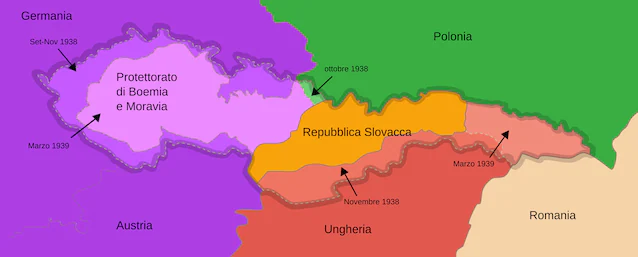
The democratic powers finally realized that they could not trust Hitler. In September, when Germany, claiming the Danzig corridor, invaded Poland, France and the United Kingdom finally went to war. Thus began the Second World War: the surrender shown by the democracies in Munich had not prevented the conflict from breaking out.