The Ethiopian War, fought between 3 October 1935 and 5 May 1936, was a conflict unleashed by fascist Italy to conquer the African country and transform it into a colony. Having begun with the invasion of the country by order of Benito Mussolini to make up for the defeat at Adwa in 1896 and demonstrate the power of fascism, the war ended with the Italian victory, the occupation of the capital Addis Ababa and the proclamation of the empire, although the Italian troops had not taken control of the entire territory. During and after the war, the Italians committed serious crimes against the local population and used illegal weapons, such as aggressive chemicals (gas). Furthermore, the Ethiopian conflict had profound consequences on the fascist regime, starting the phase of “totalitarian acceleration” and pushing it towards the alliance with Nazi Germany.
The historical and geographical context of the Ethiopian war
Fascist Italy’s decision to attack Ethiopia arose from the fact that the African country was located, geographically, between two colonies conquered by Italy in the nineteenth century: Somalia to the south and Eritrea to the north. Ethiopia, not surprisingly, was an old Italian claim: already in 1895 the troops of the Peninsula had tried to occupy the country, but suffered a humiliating defeat in Adua. For this reason, Ethiopia – which was home to an ancient civilization and was in many ways different from other African territories – was the only country on the continent, together with Liberia, to have retained its independence and not to have been colonized by European powers.
After Adwa, Italian-Ethiopian relations were relatively relaxed and in the 1920s Italy facilitated the African country’s entry into the League of Nations. Ethiopia was under the monarchy of the negus (emperor), Haile Selassie, who ruled with the support of the local aristocracy.
The reasons for the attack on the Kingdom of Italy and the Ual Ual incident
The reasons why, in 1935, Mussolini decided to attack Ethiopia have never been fully clarified. Probably, the dictator’s motivations were more than one. First of all, he thought that the fascist regime, having obtained broad internal consensus, was now ready for international expansion, which would also guarantee the dictator’s personal prestige. He also believed that he could divert the migratory flows that, before fascism, were directed towards the American continent towards African territories.
Tension between Italy and Ethiopia increased in 1934. In December, an incident took place in the locality of Ual Ual, disputed between Ethiopia and Italian Somalia. A violent firefight developed between the Italian soldiers who controlled the territory and the Ethiopian troops. The Italians repelled the attack, but tensions increased and the fascist regime, exaggerating the incident, started a vast press campaign against Ethiopia.
The military operations desired by Mussolini
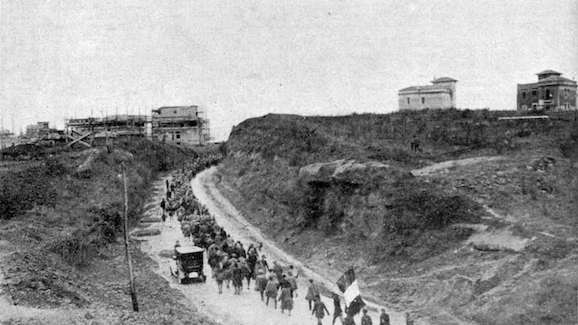
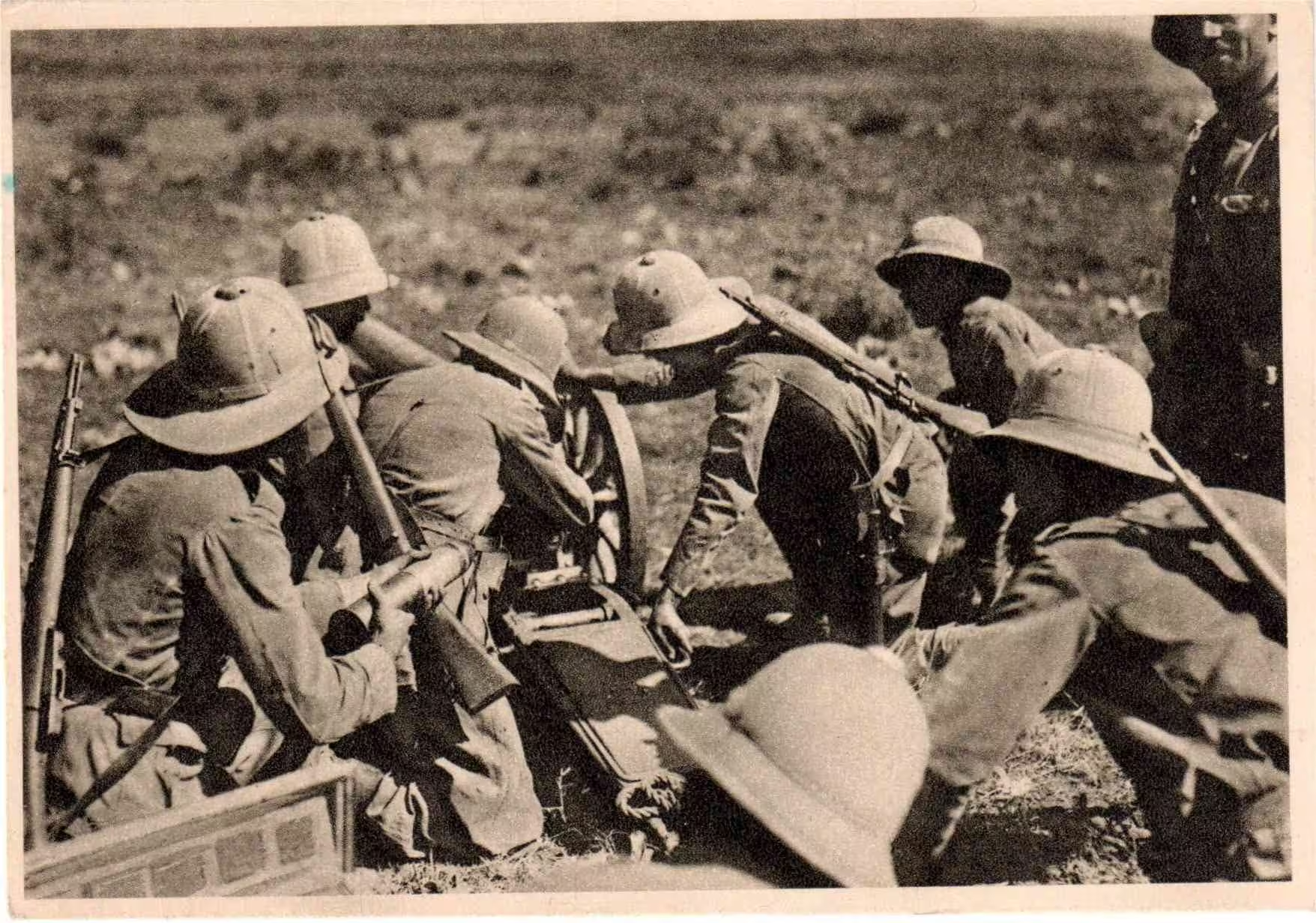
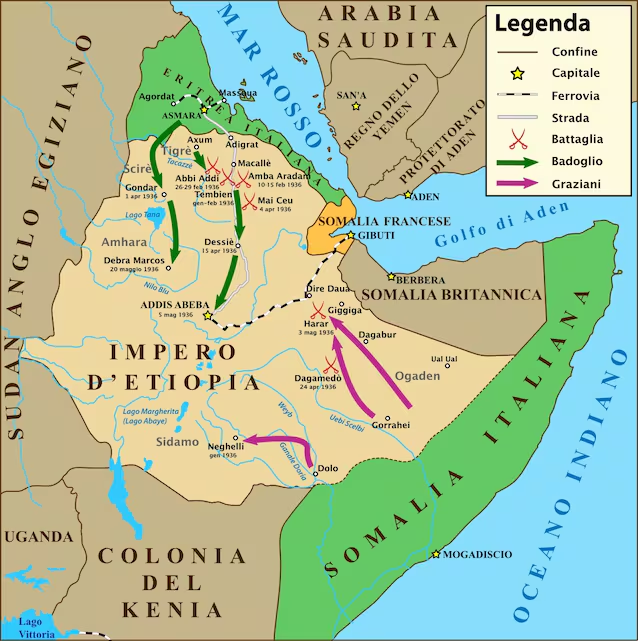
Italian troops invaded Ethiopian territory on 3 October 1935. The army attacked the African country both from the north, starting from Eritrea, under the command of General Emilio De Bono, and from the south, starting from Somalia, with a contingent under the orders of General Rodolfo Graziani. The fascist regime deployed a very powerful army, made up of several hundred thousand personnel, reinforced by detachments of askari (indigenous soldiers from the other Italian colonies) and equipped with advanced means, first of all aviation.
In no previous colonial war had such a powerful army been deployed. Ethiopia did not have modern military means, except in minimal quantities, and was much weaker on a military level. Nonetheless, the Italian troops advanced slowly and with difficulty. In December Mussolini replaced De Bono with Pietro Badoglio, chief of the general staff. In Italy, propaganda presented the war as a triumphal march against a barbaric country. For propaganda reasons, Mussolini had important exponents of the regime participate in the war, including two of his sons, his son-in-law and future foreign minister Galeazzo Ciano, and the secretary of the National Fascist Party Achille Starace.
On the international level, the attack provoked a reaction from the League of Nations. Italy had attacked another member state without valid reasons and the League, mainly at the instigation of France and the United Kingdom, imposed economic sanctions on the aggressor. The sanctions, presented in Italy as “a siege” and an injustice, were in reality rather mild and included neither the ban on the sale of oil nor the blocking of the Suez Canal to Italian ships.
The use of gas and other war crimes
During the operations, the Italians committed serious war crimes against the Ethiopian population. First of all, they used gases on a large scale, banned by an international convention and not used by armies even during the Second World War. Furthermore, they treated the Ethiopians with the utmost cruelty, ordering numerous summary executions. In some cases, when they had to kill captured enemies, they shot them in the testicles, instead of the chest, to ensure that they did not die immediately but first suffered atrocious suffering. The Italian soldiers also had no scruples in using sexual violence on Ethiopian women and girls, sometimes establishing asymmetric relationships in the form of madamato.
The Ethiopians were also guilty of crimes, such as the use of dum dum bullets, prohibited by international agreements, but at much lower levels than the Italians.
The victory, the proclamation of the empire of Ethiopia and the consequences of the conquest
The Italian troops entered Addis Ababa on 5 May 1936. The negus left the country and four days later Mussolini, appearing on the balcony of Palazzo Venezia, pompously proclaimed “the rebirth of the empire”. Victor Emmanuel III assumed the title of Emperor of Ethiopia. In reality, the Italians did not control the entire territory of the African country: some regions remained under the control of the Ethiopian partisans, the arbegnuoc, that fascism was never able to completely defeat.
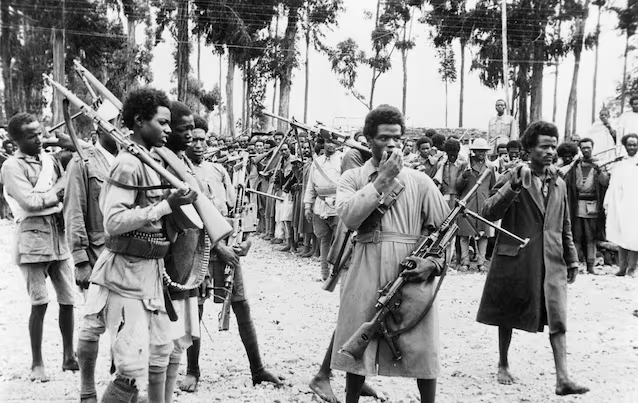
This victory cost the lives of approximately 275,000 Ethiopian soldiers and 4,350 Italians, including soldiers and civilians. In Italy, the conquest had profound consequences and started the phase of “totalitarian acceleration”, during which fascism increased the mobilization of citizens, further centralized power and tried to impose its own models of behavior and lifestyles to a greater extent than in the past. On an international level, sanctions were suspended as early as July 1936, but the diplomatic distancing from France and England pushed the regime to move ever closer to Nazi Germany.
In Ethiopia, the Italian government appointed a viceroy, first in the person of Rodolfo Graziani and then in that of Amedeo d’Aosta, and governed Ethiopia until 1941, continuing to commit serious crimes. During the Second World War, the Peninsular troops stationed in Ethiopia were defeated by the English, who restored the Selassie monarchy. Ethiopia had regained its independence.