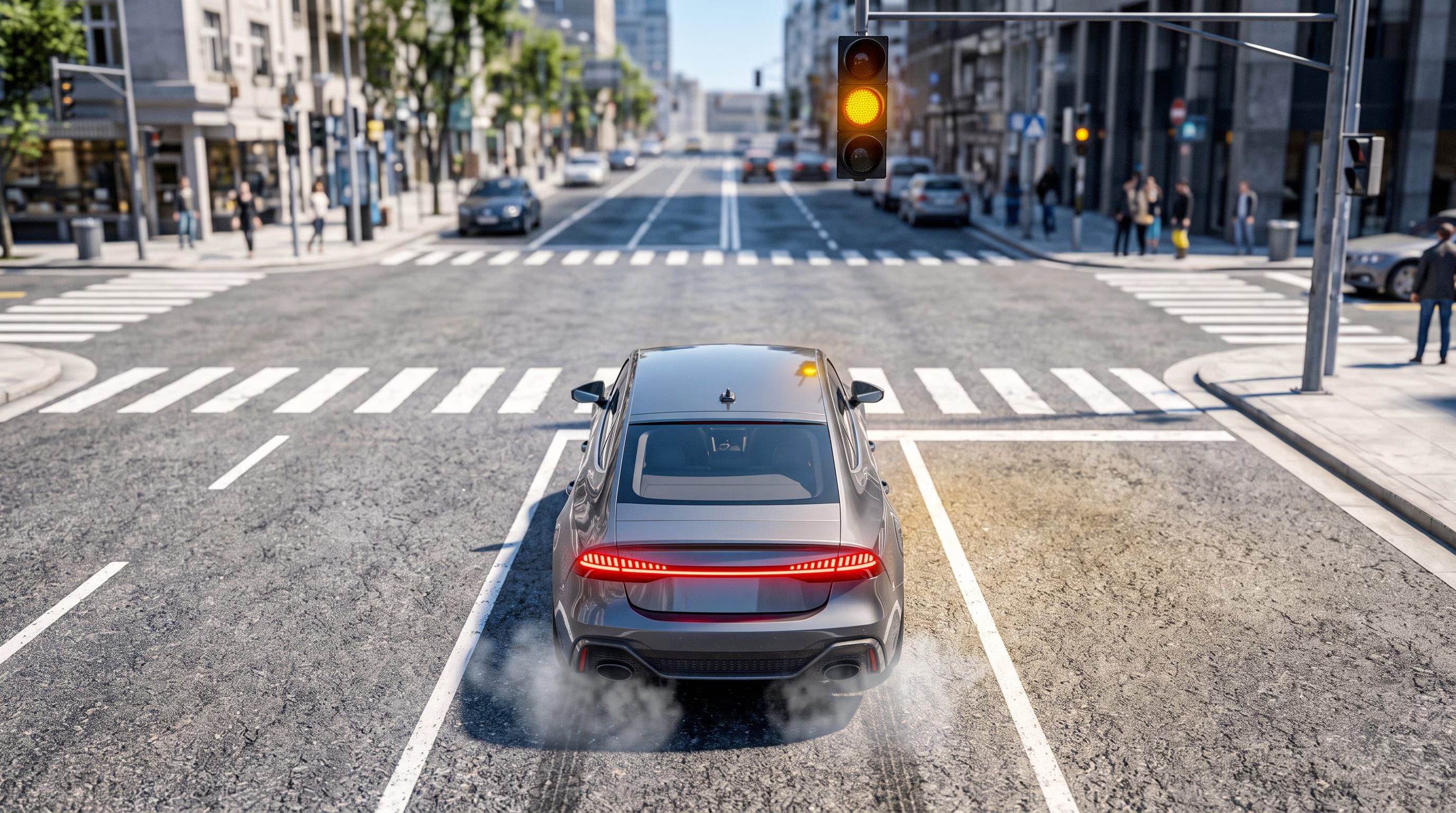
How many times have we found ourselves near an intersection and seen the yellow traffic light go off? At that moment a sort of dilemma arises: should you brake, with the risk of crashing at the last moment, or accelerate to pass before the red? Let’s face it, most motorists tend to speed up, but the Highway Code provides for something completely different.
Article 41 of the Highway Code, in fact, clearly establishes that you must stop at a yellow traffic light with one exception: if the distance from the intersection is so short that it is not possible to stop safely, then the vehicle can cross the traffic light even with a yellow light, always with appropriate caution.
The sanctions, however, are triggered only when the vehicle passes the red light: according to article 146 of the Highway Code, in this case the administrative fine ranges from 167 to 665 euros, in addition to 6 points deducted from the driving licence. In Italy, among other things, the so-called Photoreds are increasingly common, which use intelligent cameras and sensors to detect going through red lights.
What does the yellow color of the traffic light mean and when you can pass: article 41 of the Highway Code
The heart of the issue lies in paragraph 10 of article 41 of the Highway Code. This paragraph establishes that, during the period in which the yellow light is on, vehicles cannot go beyond the established stopping points, unless they are so close that they can no longer stop in conditions of sufficient safety.
Only in this case is it permitted to continue, but with the obligation to promptly clear the intersection area with the utmost caution.
In other words, the yellow light is not a “conditional green light” nor an invitation to quickly clear the intersection if you are still far away. The yellow light indicates, on the contrary, a warning of a stop, with cars, motorbikes and other vehicles that must stop unless they are so close to the stop line that sudden braking would be dangerous (with the risk of being rear-ended). In that case, and only in that case, it is permissible to cross the intersection, but doing so with the utmost caution.
Paragraph 11 of the same article completes the picture: during the red light, vehicles must not cross the stop line. If the strip is not present, vehicles cannot enter the intersection area, the pedestrian crossing, or go beyond the traffic lights.
How many seconds does the yellow light last
One of the most frequent questions in this regard concerns the duration of the yellow light and here the answer may surprise you: the Highway Code does not set a minimum duration for the period when the yellow light is on. It is a point confirmed several times by jurisprudence: the Court of Bologna, in fact, with sentence no. 927 of 2017, established that the Code does not provide anything regarding a specific duration for the projection of traffic light signals and the Court of Cassation, with order no. 567 of 2019, reiterated the same principle.
To fill this legal gap, however, there is a technical reference, namely the Resolution of the Ministry of Transport n. 67906 of 2007, according to which the minimum duration of the yellow light varies based on the speed:
- 3 second yellow traffic light for speed of oncoming vehicles equal to 50 km/h;
- 4 second yellow traffic light for speed of oncoming vehicles equal to 60 km/h;
- 5 second yellow traffic light for speed of oncoming vehicles equal to 70 km/h.
In practice, however, to have maximum application uniformity, fixed times of 4 seconds on urban roads and 5 seconds on extra-urban roads are generally adopted.
These provisions, however, do not exclude that during the design of the traffic light system the yellow light may have a different duration (without prejudice to the minimum duration of 3 seconds) based on the size of the intersection, the speed of the oncoming vehicles and their length.
Penalties in case of infringement: the amount and how soon the fine arrives
The sanctions for those who do not respect the traffic lights are governed by article 146 of the Highway Code. Paragraph 3, in particular, provides that anyone who continues driving despite the traffic light (or the traffic officer) prohibiting transit is subject to an administrative fine ranging from 167 to 665 euros, in addition to 6 points deducted from the driving licence. If the infringement is committed between 10pm and 7am, the fine increases by 1/3.
In the event of a repeat offense – i.e. the same offense within a two-year period – the license is also suspended for one to three months. The fine, however, arrives within 90 days of the violation of the Highway Code.
Today, however, many intersections are equipped with electronic equipment for detecting passing a red light, the so-called Photored. As emerges from the case examined by the Court of Cassation in the 2019 ruling, these devices take a series of frames (in this specific case, three) which document the infringement and allow the precise reconstruction of the moment in which the vehicle crossed the traffic light line and the state of the light at that instant.