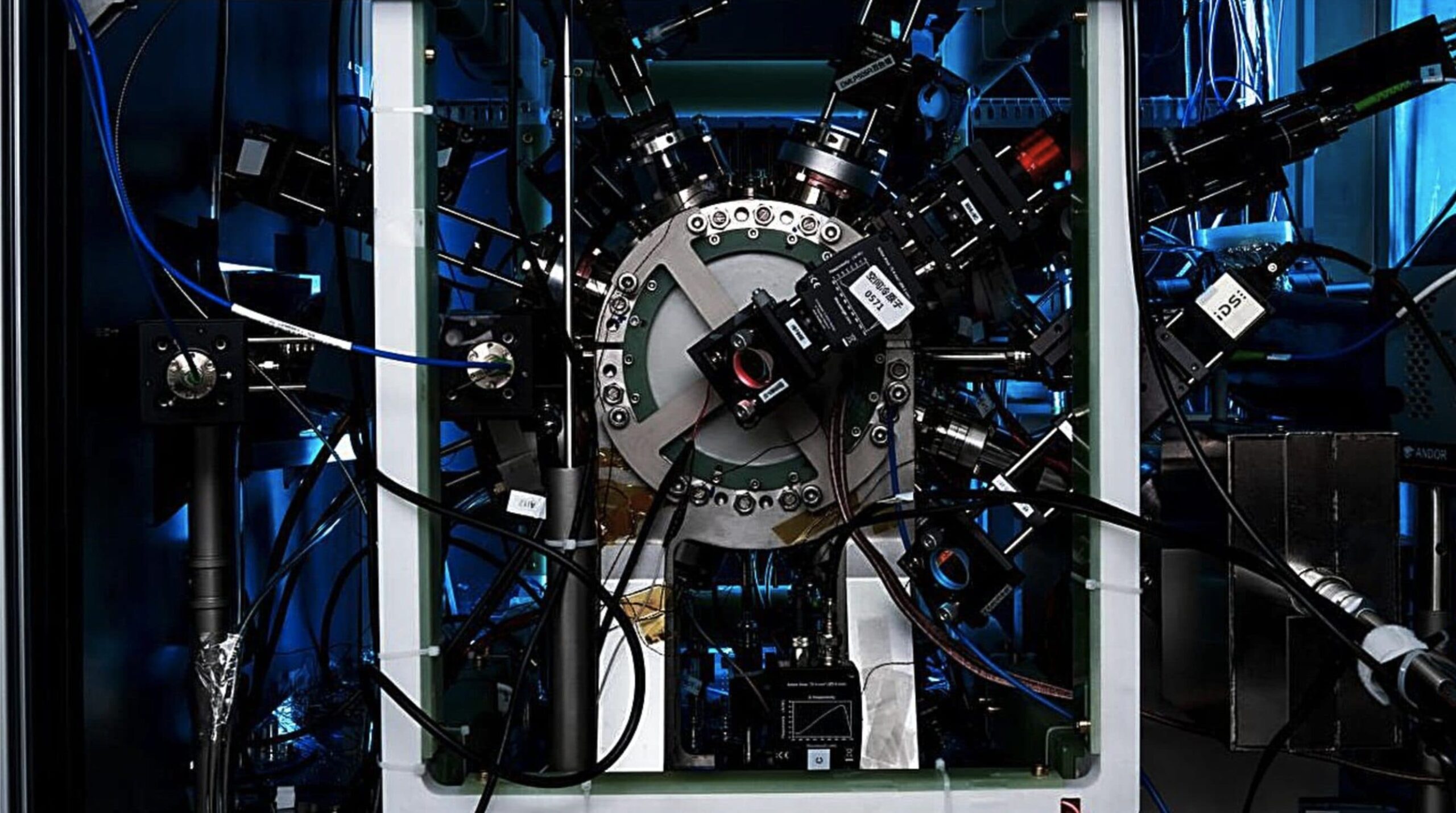
Imagine a clock so precise that if you started it today and let it run for 30 billion years (more than double the current age of the universe) it would be just one second behind. It’s not science fiction: it’s the result of a study just published in the journal Metrology by researchers at the University of Science and Technology of China (USTC). This strontium optical clock can measure the second with an accuracy of 19 decimal places, enough to help establish a new world standard for measuring time, which will be discussed in 2030.
Because this Chinese clock is more precise than atomic ones
To understand what we are talking about, it is useful to take a step back. The official definition of the second that we use today dates back to 1967: from that moment, in the International System of Units of Measurement, one second is defined as the time interval in which 9,192,631,770 oscillations of the cesium-133 atom occur. Cesium atomic clocks have been the gold standard for measuring time for decades, and remain highly precise instruments. But with strontium we can do better, because it oscillates about 700,000 billion times per second, that is, with an oscillation period tens of thousands of times shorter than that of cesium-133. This translates into more “marks” on which to measure time, and therefore greater precision.
In particular, the new Chinese optical clock has achieved an accuracy of 9.2 · 10–19 (translated, it means that the relative error of its measurement of time is less than a billionth of a billionth) with a stability of 6.3 · 10–19. These are numbers that cesium clocks can’t even come close to, but the key point is this: they exceed the requirement of 2 · 10–18 set by the international metrological community as the minimum threshold for considering an optical clock suitable for redefining the second.
What does it take to redefine the second beyond the USTC clock
This new Chinese clock, although precise, is not enough to change the definition of the second. To proceed with the redefinition, the international scientific community requires that at least three optical clocks based on the same type of oscillation, and with adequate levels of precision and stability, be operational in different institutions around the world.
The new USTC clock joins a group of instruments that are gradually reaching these requirements: two other strontium and two aluminum ion-based optical clocks have already exceeded the required threshold. In short, there are the foundations for arriving at a more precise official definition of the second. This will be discussed at the next General Conference on Weights and Measures, which will be held in October this year. On that occasion, the foundations will be laid for a formal proposal to change the definition, which will be addressed in the next general conference, which will be held in 2030.
What is the point of such an accurate watch?
It is legitimate to ask: but in practical life, what difference does it make if the second is defined with 18 or 19 decimal places? The answer is: very much, for some applications. Let’s think about the ultra-precise measurement of the differences in the Earth’s gravitational field (what in technical jargon is called relativistic geodesy): according to Einstein’s general relativity, in fact, time flows slightly more slowly where gravity is more intense, therefore an extremely precise clock becomes an even better gravitational field measurer, with applications in geophysics, geology (think of the monitoring of the movements of the earth’s crust) but also to improve navigation systems such as GPS.
Clocks of this precision could also help astronomers search for dark matter. Some theories predict that this hypothetical and elusive type of matter could cause small fluctuations in fundamental physical constants, which could – the conditional here is a must – be detected as imperceptible variations in the rhythm of time measurable by ultra-precise clocks.









