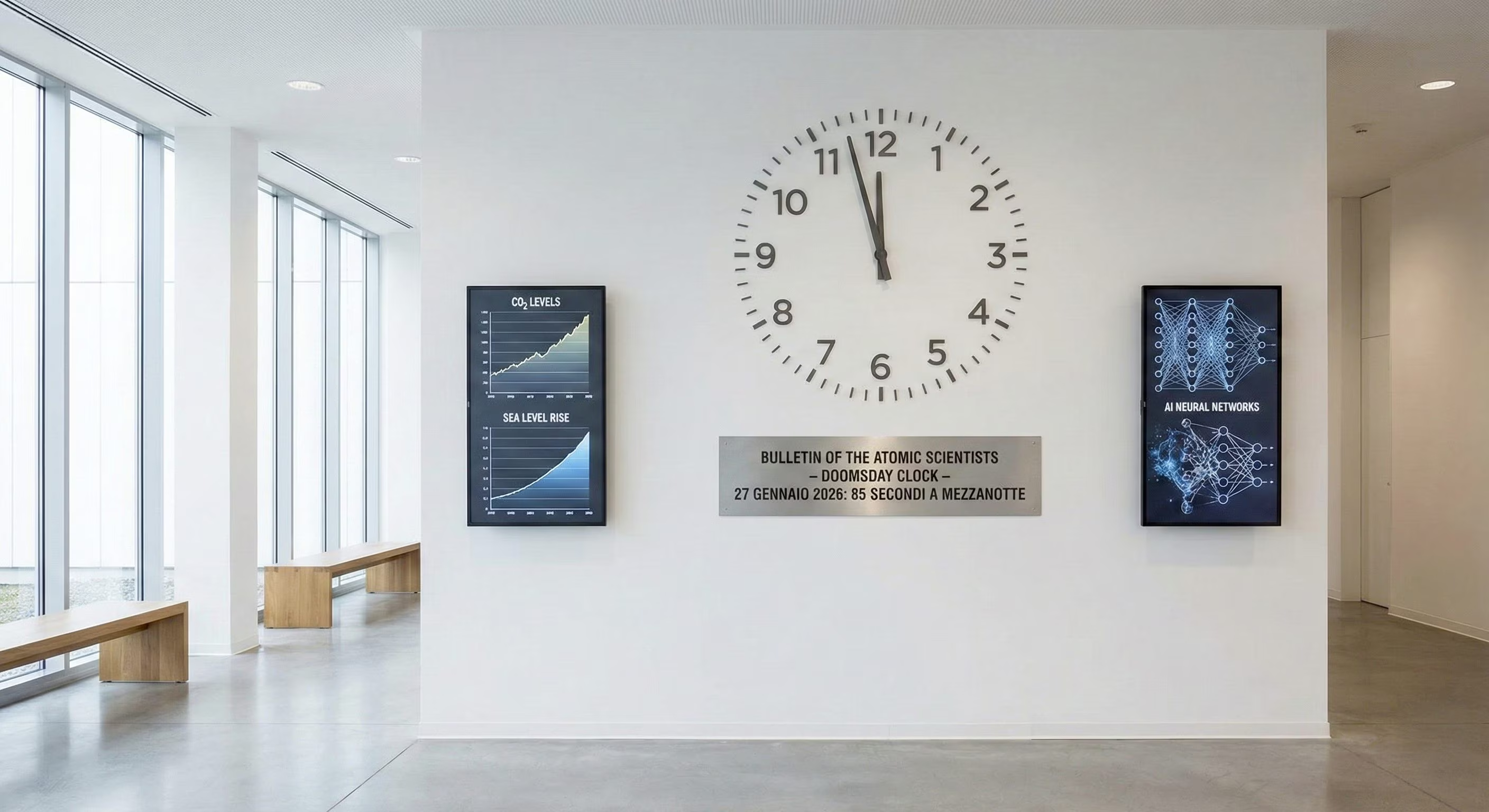
«85 seconds to midnight»: this is the time that the hands of the Doomsday Clock 2026 mark, but what does it mean? The Doomsday Clock is a symbol, a reminder, a metaphor that reminds the public how close we are to destroying our world with technologies of our own invention. This is not a certainty or a prediction about the future.
The clock is updated every year since Bulletin of the Atomic Scientists’ Science and Security Board (SASB) in consultation with its Board of Sponsors, which includes eight Nobel Prize winners. This year’s time has been advanced by 4 seconds compared to 2025, when it was 89 seconds: behind this rapid acceleration there is not only the geopolitical instability of recent years to consider, but also other factors that could represent a threat to human existence. These include rising nuclear risk, the climate emergency and new unregulated technologies such as artificial intelligence and biotechnology.
However, an important clarification must be made: the objective of this initiative is not to spread alarmism, as has been done by the global media in the last few hours. As highlighted by the SASB itself, the clock was conceived as a tool to spur humanity into action and make it clear that, although the seconds are decreasing, there is still time to act.
How the Doomsday Clock works
The Bulletin of the Atomic Scientists was founded in 1945 by Albert Einstein, J. Robert Oppenheimer and scientists from the University of Chicago who contributed to the development of the first atomic weapons as part of the Manhattan Project. Two years later, in 1947, the Bulletin created the Doomsday Clock to assess potential man-made threats to the planet.
The positioning of the hands is based on the study of previous events and current trends. The Committee on Science and Security evaluates both quantitative metrics (numbers, statistics on the number and types of nuclear weapons in the world, the atmospheric concentration of greenhouse gases or the rate of sea level rise) and qualitative factors, such as the effectiveness and timeliness of political and social responses. Through this approach, which combines empirical data and geopolitical analysis, the Bulletin estimates the potential consequences to existing threats.
First set by artist Martyl Langsdorf to 7 minutes, the annual update on January 27 moved the hands to 85 seconds from midnight compared to 89 last year. The farthest point was in 1991, at the end of the Cold War: 17 minutes.
These numbers are not “hourly” but communicate an urgency to the public and world leaders. The closer we are to midnight, which symbolizes the Apocalypse, the less time there is to act and change things. Although an abstract idea, there is a physical clock located in the offices of the Bulletin of the Atomic Scientists at the Keller Center, within the Harris School of Public Policy at the University of Chicago.
What would ideally happen if the clock reached midnight? The hands are moved manually and midnight would symbolize the “global catastrophe” caused by man. However, this is not a prediction of a specific event but a metaphor for a point of no return.
Because the hands of the Doomsday Clock have been moved to 85 seconds
The issues that led the Board to move the clock closer to the hypothetical end concern:
- Nuclear weapons: Jon B. Wolfsthal, director of global risk at the Federation of American Scientists (FAS) and SASB member of the Bulletin of the Atomic Scientists, said as more and more states rely on nuclear weapons, several states openly talk about using them not only for deterrence, but also for coercion. Furthermore, he pointed out that hundreds of billions are being spent to modernize and expand nuclear arsenals around the world, and more and more non-nuclear states are considering whether to acquire their own nuclear weapons or hedge their nuclear bets.
- Artificial intelligence: experts have assessed the expansion of the use of AI without the risks being identified and mitigated as worrying
- Climate change: with an eye to the future and the steps to be taken, the Bulletin of the Atomic Scientists has focused on reducing greenhouse gas emissions from the burning of fossil fuels, the use of renewable energy on a large scale and for the creation of markets and on the reliance on science that monitors efforts to reduce and mitigate emissions.
- Biological threats: For the SASB, this year has been characterized by a reduced capacity to respond to biological events, further development and research of biological weapons, poorly controlled synthetic biology activities and an ever-increasing convergence between artificial intelligence and biology.









