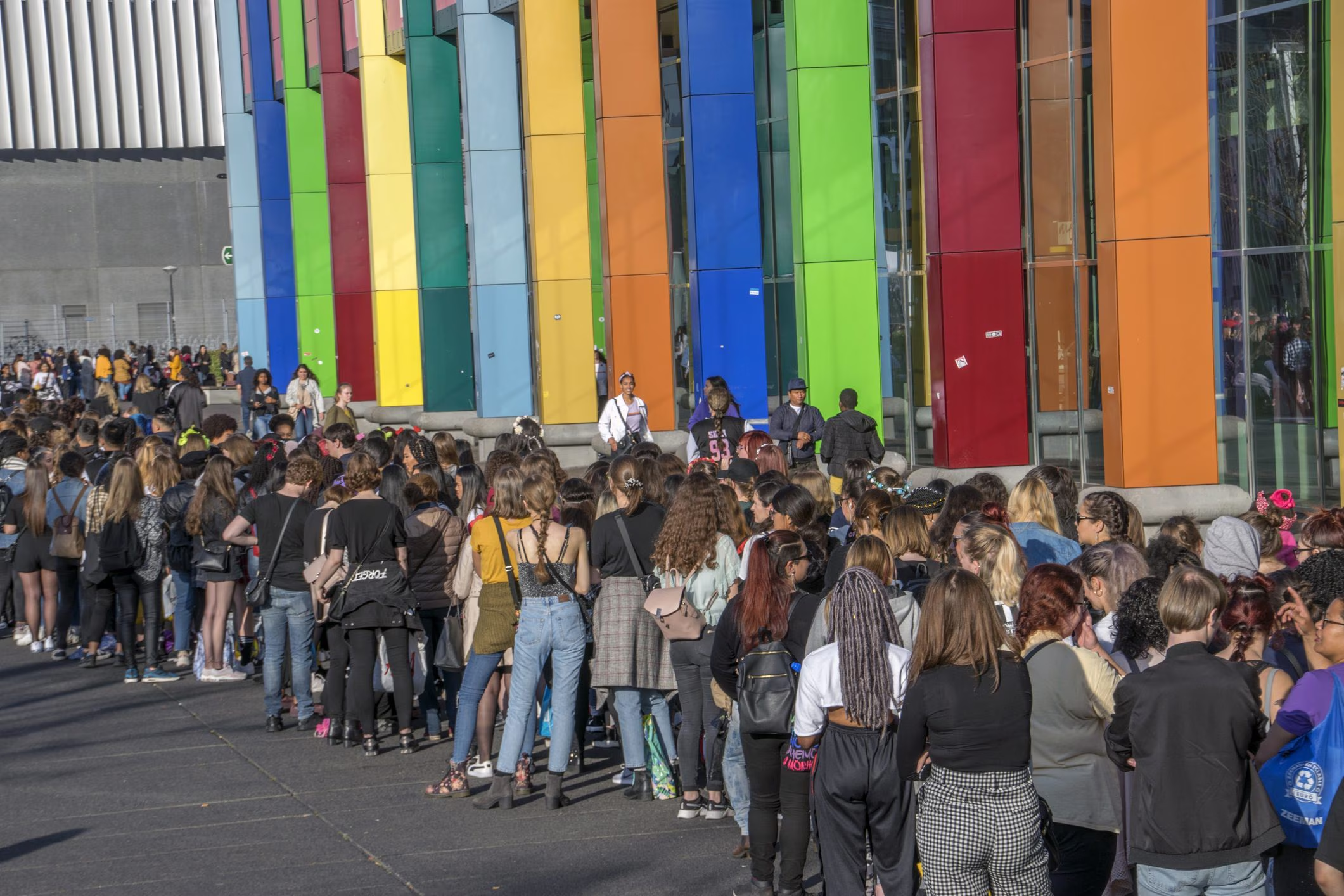
In recent years, thousands of people have increasingly spent entire days outside stadiums to secure a place in the front rows at concerts. Tents, mattresses, folding chairs, blankets and very long waits under the summer sun have become an integral part of the experience. For many it may seem like an incomprehensible sacrifice; for others, two hours of music in front of their favorite artist, leaning against the barrier, is worth days of waiting. From a psychological point of view, attending a concert is a collective and memorable social experience involving emotions, memory, identity, sense of community and belonging.
Long before theaters, arenas and arenas existed, human beings were already gathering to make music together. The oldest musical instruments found so far, such as some flutes made from bird bones and mammoth tusks found in Germany, date back to around 40,000 years ago (there is an even older find but its interpretation is still the subject of scientific debate today). According to numerous theories of evolutionary anthropology, music has had an important social function. Singing together, clapping to the same rhythm or dancing in a group means synchronizing the behavior of multiple individuals, encouraging cooperation and strengthening bonds within the group. Furthermore, music accompanied collective rituals and facilitated the transmission of traditions when writing did not yet exist. Even before being entertainment, it may have been a tool that served as a glue for communities.
From living rooms to stadiums: when concerts became mass events
For much of history, listening to live music meant attending relatively small performances. In Renaissance courts, opera houses or small venues, the audience was limited and the relationship with the musicians was direct. Even the first rock concerts of the fifties and sixties often took place in theaters, clubs or arenas that today we would define as small in size. Everything changes in the second half of the twentieth century. The evolution of audio systems, lights and amplification technologies has made it possible to organize increasingly larger events; thus the concerts have progressively become real mass experiences.
A symbolic moment is the Live Aid of 1985: two benefit concerts organized simultaneously in London and Philadelphia which brought together over 150,000 live spectators and which were followed on television by an audience estimated at close to two billion people. For the first time, music demonstrated the ability to connect millions of individuals at the same time. Since then, the size of the events has continuously grown: today international tours or large festivals bring together tens of thousands of people and generate real migrations of fans, willing to travel, spend large sums and wait days in tents just to live that experience.
Participating live is different from a live broadcast: Kama muta and collective effeverscence
Starting from a general finding, research suggests that listening to music impacts our well-being, reduces stress and trait anxiety, helps regulate and improve mood, and serves as a means to connect with others. While listening to recorded music can offer psychological benefits, some research suggests that the live experience can elicit even greater emotional and physiological involvement.
Research initially published in Scientific Reports compared people who attended the same concert live with others who followed it via livestream. Those who were physically present reported significantly more intense emotions, greater involvement and more marked physiological activation (the measured heart rate was higher on average).
But why does this happen? One of the reasons can be explained by collective effervescence, a term introduced over a century ago by the sociologist Émile Durkheim. It describes that feeling of feeling part of something bigger than oneself; in a concert thousands of people sing the same words, clap their hands in time, scream, get excited and share the same moments. For a few hours the boundary between the individual and the group seems to almost dissolve.
From this profound connection another emotion can arise, studied more recently by psychologists and called kama muta, a Sanskrit term which literally means “to be moved by love” or “to be deeply moved”. It’s when you get goosebumps, shivers down your arms, the lump in your throat and your eyes fill with tears when you sing the same song together with thousands of people. It is not simply happiness, but a strong emotional sense of connection and belonging.
The difference, therefore, is not the quality of the audio or the performance, but the physical presence of the artist, the audience and the context. Consider that a study published in Personality and Social Psychology Bulletin which analyzed almost 800 participants showed that the positive effects on well-being obtained from a concert can even persist until the following week!
Curiously, the concerts also attracted the attention of physics. A study analyzed the behavior of participants at metal concerts during the so-called mosh pits (trivially when you “mosh” near the stage), observing that their movements follow patterns surprisingly similar to those described by particle and fluid physics.
Why some people are willing to wait days in tents: the 4 psychological explanations
At this point the initial question changes perspective. If the concert represents such an intense experience, then even the wait takes on a different meaning. Psychology offers at least four possible explanations.
- Scarcity principle: the more difficult something is to obtain, the greater the value we attribute to it. The front row is not just a better seat: it is an experience perceived as rare and unrepeatable.
- Personal identity. For many fans, an artist represents an important part of their story, accompanies significant moments in life or helps define who they are. Being as close as possible to the stage means experiencing that symbolic relationship in its most intense form.
- Anticipation of the reward. Neuroscience shows that the brain is not only activated when we get what we want, but also during the wait. In other words, part of the pleasure comes from waiting for the event. It’s the same mechanism that makes preparing for a holiday or waiting for a sports final exciting.
- Social dimension. People waiting outside stadiums often end up getting to know each other, sharing time, eating together and sharing experiences. In a certain sense the concert already begins in the queue. The community is born long before the stage lights come on.