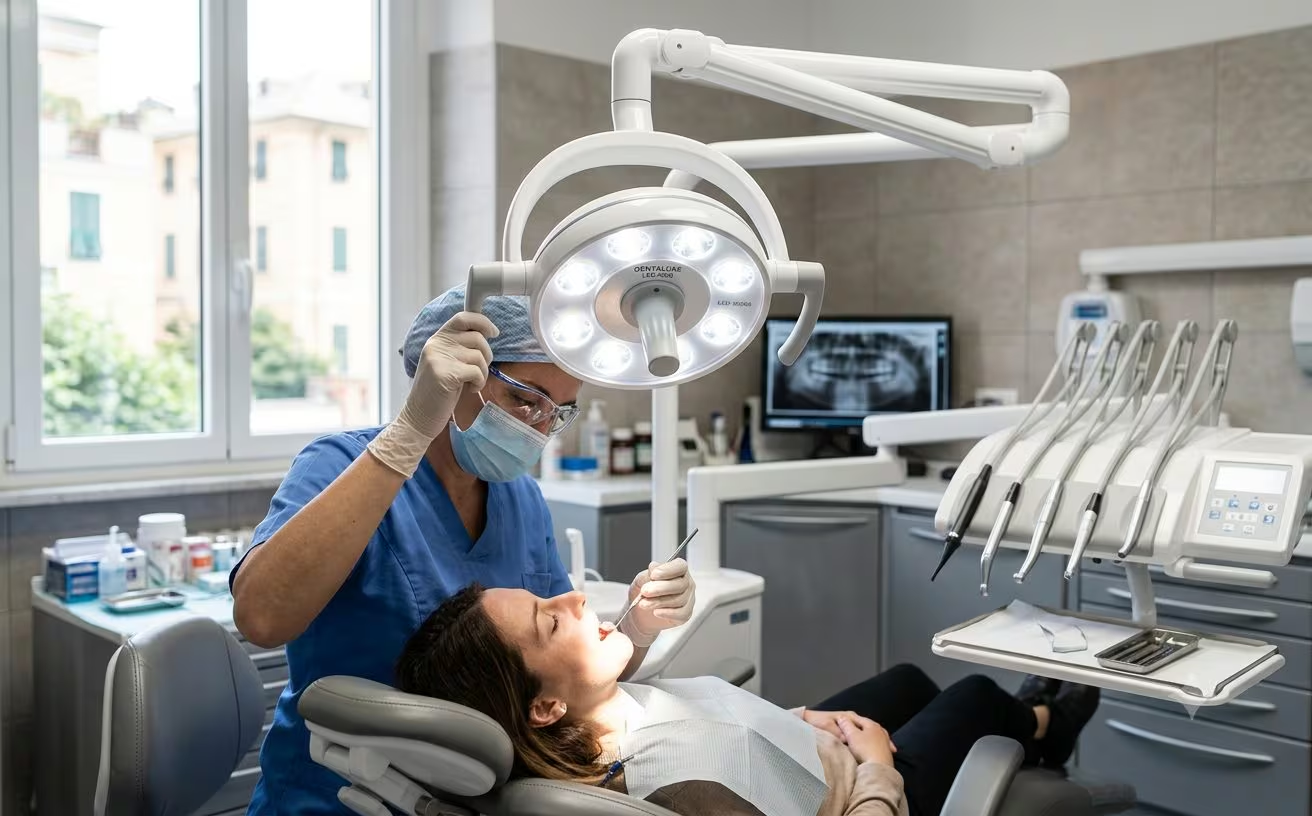
How does the dentist avoid casting a shadow with his hand inside the patient’s mouth? The answer is the special lamp he uses, the surgical lamp, the same one that is also used in operating rooms. It is a lamp capable of neutralizing the shadow of the obstacle placed between the light source and the surgical field.
But how does a lamp not cast a shadow? Let’s see the basic idea behind its operation: it is a geometric question of superposition of light beams and ellipsoids.
The basic principle of the surgical lamp is simple: instead of illuminating the operating field (the area where one must operate) with a single light source, it is illuminated with many beams of light coming from different directions. Let’s explain better, let’s imagine illuminating the affected area with a single lamp, in this case the dentist’s hand (or any other obstacle), which must approach to operate, would create a shadow making the operation difficult.
Now let’s imagine adding other lamps that illuminate the affected area from multiple directions, bypassing, in a certain sense, the obstacle: the shadow area created by the obstacle compared to the first lamp is illuminated by the beams of light produced by the other lamps and the shadow disappears.
In current surgical lamps, the individual light beams are generally made with many small LEDs arranged on a portion of the cap, however in the past, instead of many small light sources, a single lamp (usually halogen) was used which pointed towards a cap which reflected the light towards the operating field. But how can you control the light of a single lamp by concentrating it in a single point and eliminate the shadows?
The secret lies in the use of curved mirrors, generally in the shape of an ellipsoid, a particular geometric figure that allows you to control the direction of the light rays. An ellipsoid is nothing more than an elongated sphere (or flattened depending on your point of view) and is characterized by two points inside it, called foci which enjoy the following special property:
if a mirror has the shape of an ellipsoid, and we light a light bulb placed in one of the two focuses, all the light rays that come out of the bulb end up in the other focus.
We have represented this property in the image below by drawing a section of an ellipsoid: the rays that start from the focus at the top are reflected and all concentrate in the focus at the bottom.
The property also works if you take a portion of an ellipsoid, and this is precisely the idea of the first surgical lamps: if we place a lamp in one focus of an ellipsoid-shaped mirror, the reflected rays of light are all concentrated in the second focus which can be positioned, moving and reorienting the lamp, precisely in the area where the intervention needs to be performed.
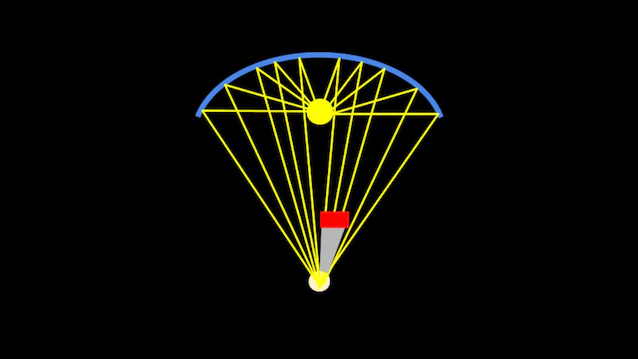
In this way we obtain the same shadow cancellation effect that we saw previously: if an obstacle intercepts some rays of light coming from the mirror, all the other rays will still cancel out the shadow, just as if the mirror were made up of many light sources all directed towards a single point, the focus of the ellipse, which must be placed right in the operating field.