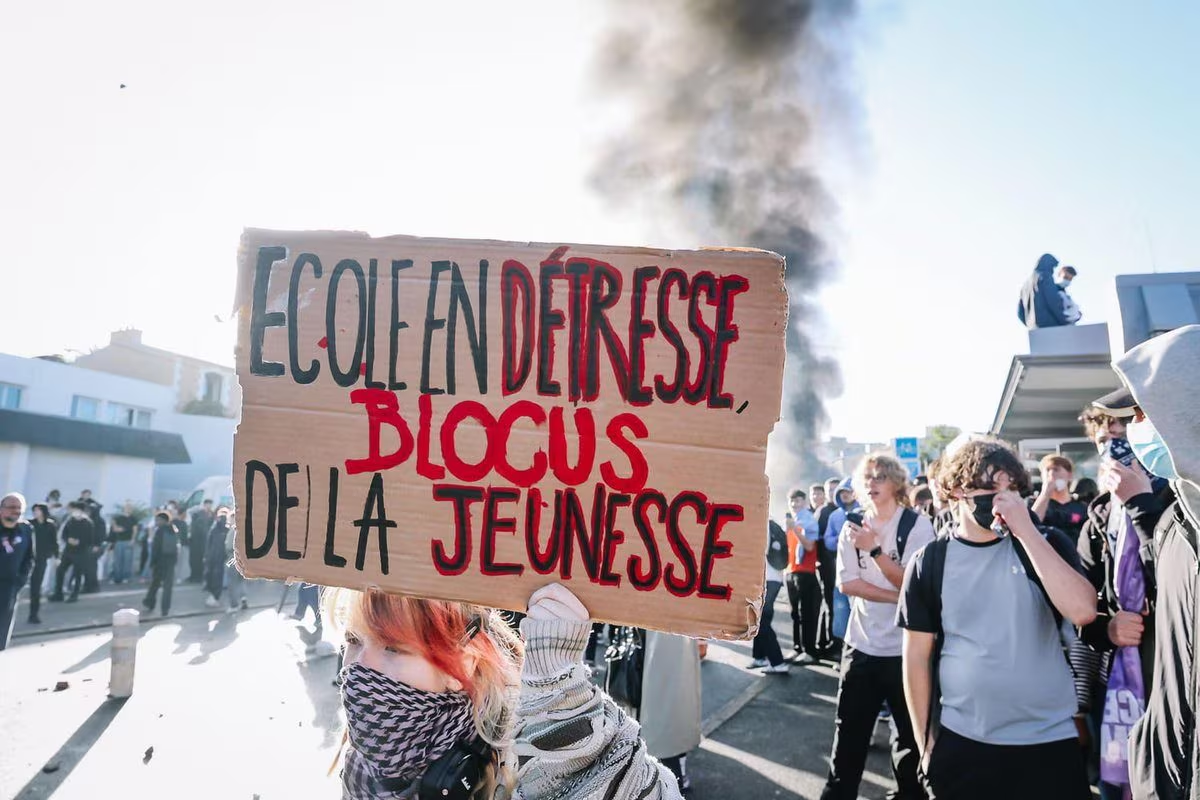
France is experiencing the most intense wave of student protests in recent years, with thousands of high school and university students blocking schools and campuses across the country to denounce study conditions, considered unworthy due to dilapidated structures, overcrowded classes and a shortage of teachers. As already happened last year in Nepal and other Asian countries, the young people of Generation Z are thus the new protagonists of social revolts: the student movement, in reality, was born at the end of September in some high schools in the Paris suburbs, but quickly spread to small and large cities such as Lyon, Marseille, Lille, Bordeaux, Nantes, Strasbourg, Rouen, Toulouse and Le Havre.
According to the Ministry of the Interior, 1,027 out of 3,700 high schools were involved in the protests, with 30 universities and 400 high schools closed today, October 2. In the last few hours, however, the protests have become increasingly violent, with over 2,000 arrests in total (mostly against minors), 170 students and 65 school employees injured, including 40 principals: the demands have in fact been intertwined with the public sector strike against the austerity measures and with the political clash in view of the presidential elections in April 2027. Meanwhile, Prime Minister Sébastien Lecornu has called a meeting emergency between multiple ministries.
Young people are also among the protagonists of the protests in Spain, which broke out after the eviction of an 87-year-old woman reignited clashes against the housing crisis and real estate speculation. In Italy, however, strikes have been called for today, October 2, in the railway, school and healthcare sectors.
The reasons for the student protests
The students’ demands therefore start from concrete elements: in French schools, classes are generally made up of 32 to 35 students, teachers who are absent are often not replaced (with hundreds of hours of lessons lost every year) and school buildings are in critical conditions, lacking adequate thermal insulation, without air conditioning in the summer and with insufficient heating systems for the winter.
The problems, in fact, emerged already during the heat waves in June, when the temperatures in the classrooms made it impossible to follow lessons. Vincent Latour, professor at the University of Toulouse interviewed by Al Jazeeraexplained that discontent began to accumulate precisely from those days, when “the precarious state of the schools, with poor insulation and lack of air conditioning” became impossible to ignore.
Other elements have also added to the material hardship, first of all the management of Parcoursup, the state platform that regulates access to teaching for the first post-diploma year. For many students it is an opaque and discriminatory system, which every year leaves tens of thousands of graduates without a place in their desired faculties, fueling a profound sense of injustice, especially in the most disadvantaged areas.
The student movement then intersected with trade union protests: on 29 September the public sector strike, called against the government’s financial package (a 54 billion euro cut plan for 2027 which includes, among other measures, the freezing of state employees’ salaries for the fourth consecutive year), brought citizens from all over France onto the streets, gathered in over 170 marches.
Why have the clashes become so violent
However, the clashes and claims became increasingly violent following the response of the authorities: the widespread use of tear gas in front of the school gates, baton charges, the use of LBD-40 projectile launchers and the arrest of hundreds of minors transformed a school movement into an open clash with the State. The Interior Ministry has launched three internal investigations after allegations of brutality against three students in Sevran, Saint-Ouen-l’Aumône and Tours.
Yesterday, October 1st, reached a critical point: in Marseille, the principal of the Victor Hugo high school and the vice-principal were attacked, together with a journalist from the M6 broadcaster. In front of the Saint-Exupéry high school, also in Marseille, hundreds of young people surrounded a fire truck, forced the team to abandon the vehicle and set it on fire.
Public transport was therefore suspended in Marseille and Strasbourg, where the prefect ordered the stop of trams to limit the movement of demonstrators. In Nantes, a fire destroyed the entrance to the Nelson Mandela high school, as seen in the video below, causing damage which will force the school to remain closed for a month.
In Toulouse, in Paris, in Caen, the news recorded fires, barricades and clashes. Interior Minister Nunez spoke of “unbridled violence”, reporting the presence of individuals who moved from one school to another to incite children to violence.
The government blamed the far-left party La France Insoumise (LFI) of having encouraged the protests, as several LFI parliamentarians and mayors, including the mayor of the Paris suburb of Saint-Denis, applauded the demonstrations. The French political situation, however, is particularly tense: the presidential elections are less than seven months away, Emmanuel Macron will not be able to run again and the polls indicate Marine Le Pen as the favourite.
Meanwhile, the government is grappling with a high deficit and public debt that could reach 121.7% of GDP in 2027 and is trying to pass a hugely unpopular budget law in an already fragmented parliament. Education Minister Geffray has announced meetings with trade unions, parents’ associations and student representatives, but youth organizations have already called a new day of national mobilization for 6 October.