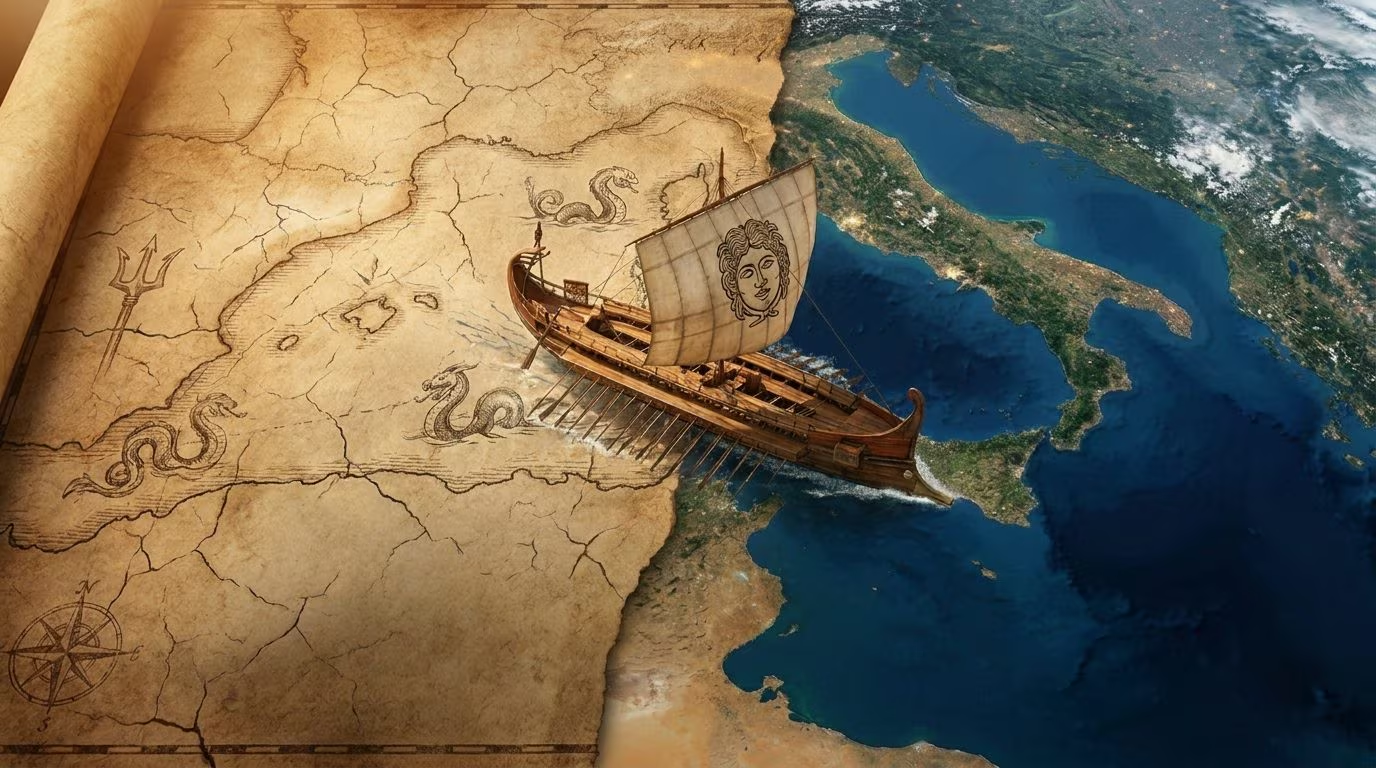
Ulysses – Greek hero whose exploits are narrated inOdyssey – he is a figure who has had great cultural relevance throughout European literature, becoming the subject of reinterpretations, rewritings and, more recently, the protagonist of comics, graphic novels and movies. In July 2026 Ulysses and his adventures will return to the cinema thanks to the film The Odyssey directed by Christopher Nolan: the film was partly shot in Italy, between the Aeolian Islands, Favignana, the Lazio coast in the Ostia area. Other scenes, however, were obviously filmed in Greece, and then in Great Britain and Iceland.
The events narrated in the Odyssey take place between Greece – in the Peloponnese area, in what are now the Ionian Islands, including Ithaca – Italy, and Tunisia. After leaving victorious the city of TroyUlysses sets off towards home, the island of Ithaca with his fleet. According to the reconstructions of scholars and historians of antiquity – such as Strabo, Pliny the Elder and Thucydides – the twelve stages of the journey that brings him back to his wife Penelope and his son Telemachus correspond to real placesmany of which are located in Italy: think for example of Strait of Messinawhere Ulysses faces the monsters Scylla and Charybdis; at mouths of Capriwhere the Sirens are found; The Circeo promontoryonce an island detached from the mainland where the sorceress Circe lived.
The geography of the Odyssey: map and stages of the journey in the Mediterranean
Ulysses’ journey begins in Troyafter the Greeks beat the Trojans thanks to the idea of Ulysses, a hero famous for his ingenuity, to build the Trojan Horse, a gift for the Trojans in the sense of surrender actually full of Greek soldiers ready to attack the city at night once inside the walls.
The ruins of city of Troydiscovered in 1870 by the German archaeologist Heinrich Schliemann, are found today Türkiyein the north-western region of Anatolia, on Hisarlık hill, near the village of Tevfikiye, and can still be visited today.
From here the hero would have moved towards Tunisia, and then reached Sicily and touched various stages in the Tyrrhenian area, until descending again towards Malta, and then moving towards Corfu, a stage from which he would finally reach Ithaca. This is located in the archipelago of the Ionian Islands, 2 km from the eastern coast of Kefalonia and about 25 km from the mainland. Today there are no definitively identifiable ruins of Ulysses’ palace, but only a presumed archaeological site, near the village of Stavros. Another theory identifies Ithaca not with the current island, but with the Greek peninsula of Paliki, in the eastern part of Kefalonia, which may have been an island at the time.
It takes Ulysses ten years to travel this long route that crosses much of the Mediterranean.
12 real places of Ulysses’ journey between Italy, Greece and the coasts of North Africa
1. The land of the Cicones, in Greece
The first stage of Ulysses’ return journey, the land of the Ciconians, corresponds to the coast of south-eastern Thrace, in what is now northern Greece, overlooking the Aegean Sea.
2. The island of the Lotus Eaters, in Tunisia
The land where the Lotus eaters live, a plant which, if ingested, erases all memories, is according to tradition in Tunisia, where the city of Djerba stands today.
3. The Land of the Cyclops and the cave of Polyphemus, in Sicily
There are various hypotheses as to where the cave where Ulysses meets and blinds the Cyclops Polyphemus is located. Generally, tradition places it in Sicily: it is hypothesized that it is on the slopes of Etna, or in the Erice area; but hypotheses have also been put forward, based on texts subsequent to the Homeric poem, about a cavity in the area of Posillipo, in Campania.
4. The Island of Eolo, in the Aeolian Islands
The island of the winds, on which Ulysses receives the waterskin containing all the winds of the world from the god Aeolus, is identified with the Aeolian Islands, in particular Lipari or Stromboli.
5. The Land of the Lestrigoni, in the Tyrrhenian Sea
Tradition places the legendary city of the man-eating giants who destroyed Ulysses’ fleet, along the Tyrrhenian coast, near Formia, in Lazio, or on the other side of the sea, in Sardinia.
6. The Island of the Sorceress Circe, in Lazio or Sicily
The island where Ulysses is held prisoner by the sorceress Circe, infatuated with him, is associated with the Circeo promontory, in Lazio, and which was once an island, before the sea retreated from the strip of land that connects it with the coast. Other hypotheses place the island of Maga in Ponza, also in Lazio, or in Ustica, in Sicily.
7. The descent into hell
After the stop on the island of Circe, Ulysses descends to the underworld where he meets the soothsayer Tiresias: precisely because it is the kingdom of the dead, no real place is associated with this stop.
8. The waters of the Sirens, off the coast of Capri
The place where Ulysses meets the Sirens has been the subject of much debate and various hypotheses have emerged regarding its possible location. One of the most accredited places the Sirens at the mouth of Capri, in the Punta Campanella area, a protected marine area between the gulfs of Naples and Salerno. The mouths are in fact the narrow stretch of sea – about 5 km – between Punta Campanella and the island of Capri itself. Treacherous currents form here, which may have made the ancients think that dangers lay there. The Sirens, in fact, are seductive creatures who hypnotize with their singing and drag sailors with them among the waves.
9. The Strait of Scylla and Charybdis, the Strait of Messina
The place where Ulysses faces the two sea monsters Scylla and Charybdis is the Strait of Messina. Here too, as with the Sirens, the myth arises from the currents that are created in this stretch of sea. According to legend, the monster Scylla lived on the Calabrian coast and guarded the promontory, while Charybdis created a deadly sea vortex near the Sicilian one. Scilla today is a fishing village, while Cariddi does not correspond to a specific location, but is said to have been located between Ganzirri and Torre Faro.
10. The island of the Sun, Sicily
After fighting sea monsters, Ulysses arrives on the land of the sun, namely Sicily. Here Ulysses’ men, elated by the victory they have just achieved, eat the oxen sacred to the god Helios and are punished with death.
11. The island of Calypso, in the Maltese archipelago
Ulysses continues his journey alone and lands on the island where the nymph Calypso, which corresponds to the island of Gozo, in the Maltese archipelago.
12. The Land of the Phaeacians, the island of Corfu
The island where Ulysses is rescued by Princess Nausicaa, who brings him to his father Alcinous, who will help him return to his homeland, corresponds to today’s Corfu, at the time called Corcyra.
From here Ulysses finally reaches Ithaca.