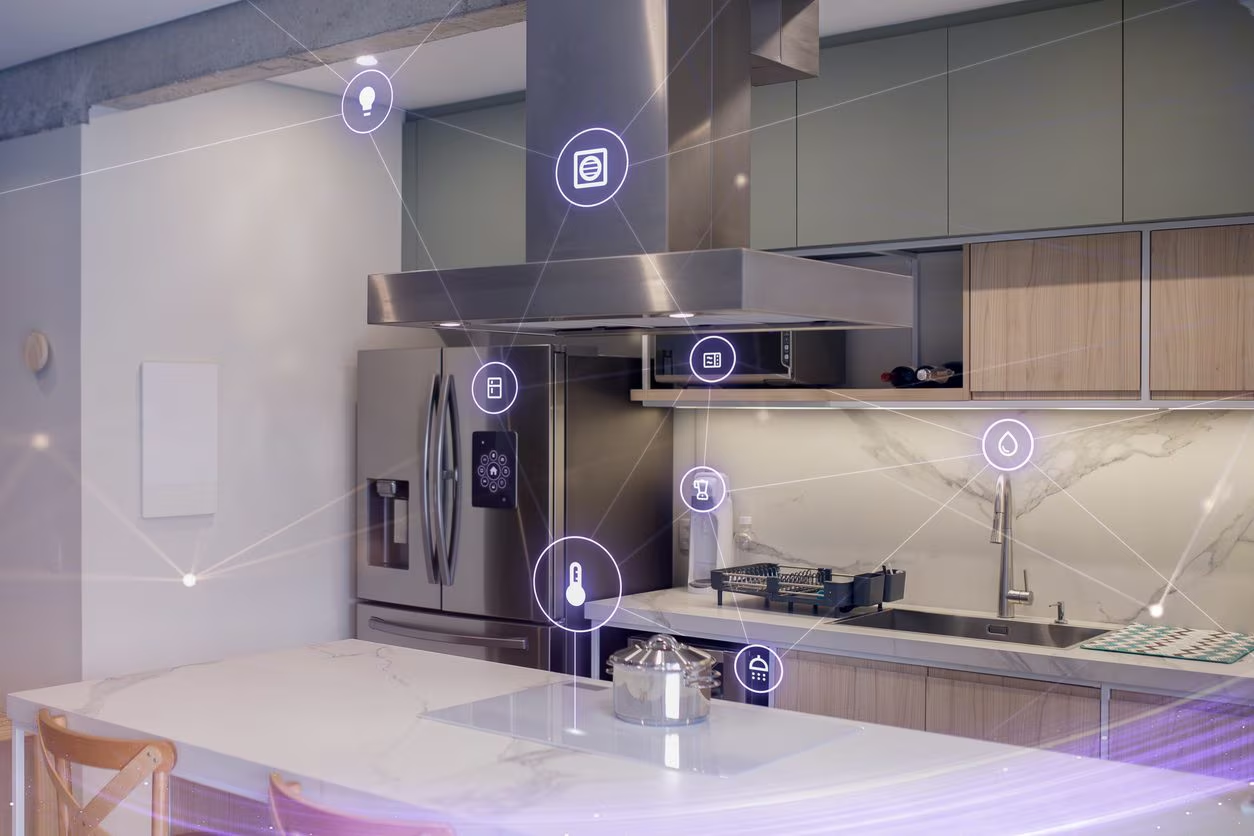
Connected appliances, intelligent sensors, light bulbs controllable from smartphones: everything we call the “Internet of things” (i.e. the set of physical objects connected to the Internet) has transformed our homes into truly integrated systems, capable of collecting data and responding to our commands in real time. But together with the conveniences inherent in home automation, a central question emerges: how safe are these devices and what risks does their daily use entail? In this in-depth analysis we analyze how smart homes work, what vulnerabilities they can present and what strategies we can adopt to reduce exposure to insidious cyber threats that are underestimated by many users. Even if connected appliances are not intrinsically dangerous – this should be made clear from the outset – they expand the potential attack surface of our home network and for this reason it is essential to correctly configure settings, passwords and various updates, as well as separating the more sensitive systems from the less critical ones.
- 1Connected appliances: how to reduce risks
- 1.1Buy safe devices
- 1.2Change the default password of connected devices
- 1.3Configure an ad hoc network for smart devices
- 1.4Install updates promptly
- 1.5Disable unnecessary features
- 2The possible risks of connected household appliances
Connected appliances: how to reduce risks
To reduce risks, you need to take some basic safety measures. We list some of them.
Buy safe devices
Ignoring this point means making all the other efforts you could make to make your smart home safe ineffective. To get more practical, prefer manufacturers that guarantee regular updates and transparency on security policies.
Change the default password of connected devices
Passwords set by manufacturers are often publicly known. It is advisable to use long and unique passwords for each device, avoiding predictable combinations. In addition to doing this, remember to activate two-factor authentication (a system that requires a second verification in addition to the password) whenever it is available.
Set up an ad hoc network for smart devices
Now all Wi-Fi routers allow you to create a “guest network”, which can be dedicated to IoT devices, thus keeping them separate from other personal devices (such as your computer and smartphone). In this way, if a smart device were to be compromised, the attack surface we were talking about earlier would be a little more limited.
Install updates promptly
the best manufacturers of smart accessories and appliances periodically release security patches, i.e. fixes for vulnerabilities discovered over time. An outdated device is more exposed to known attacks. Enabling automatic updates, when available, reduces the risk of forgetfulness.
Disable unnecessary features
Some features, such as UPnP (Universal Plug and Play), or the system that allows devices to automatically connect to each other, can simplify the use of the devices in question but introduce further vulnerabilities. Deactivating them, if not necessary, reduces the possibility of unauthorized access. Similarly, remote access should only be enabled when truly useful.
The possible risks of connected household appliances
Let’s start with the possible risks deriving from the use of connected appliances. The first critical issue concerns the security of individual devices. Many products arrive on the market with short development times and with protection measures that are not always up to date. In some cases, there is a lack of clear information on how users’ personal data is processed. Security is often not the priority in the design of some devices and this is especially true for low-end devices, which generally suffer from the most critical issues.
A second level of risk concerns the home network. When we connect multiple devices to the same router, we create an interconnected ecosystem: if one of these elements is vulnerable, it can become a potential weak link in the chain and, for cybercriminals, it could represent a breach through which to enter our home. An attacker could in fact exploit the flaw to access other systems on the network, including personal computers or online accounts. This type of indirect access is particularly critical because it often goes unnoticed.
A useful concept for understanding these dynamics is that of the “attack surface”, i.e. the set of all points through which a system can be compromised. Each new connected device expands this surface area. The larger the attack surface, the greater the vulnerability of the entire system. This is a serious problem because analyzing the collected data can reveal sensitive information. Just to give an example, the routines for raising and lowering the shutters or for turning smart lights on and off can indicate when you are usually absent from your home: valuable information for thieves.
The smartphone, often used as a home automation control center, also represents a key element. If compromised, it can offer access to your entire home network. The IT security experts at Kasperskyin this regard they warn:
Many users control their connected home through a smartphone, which makes it a very valuable database for anyone wanting to hack into your life. This creates a high risk if your phone is hacked, stolen, or if someone manages to intercept your connection.