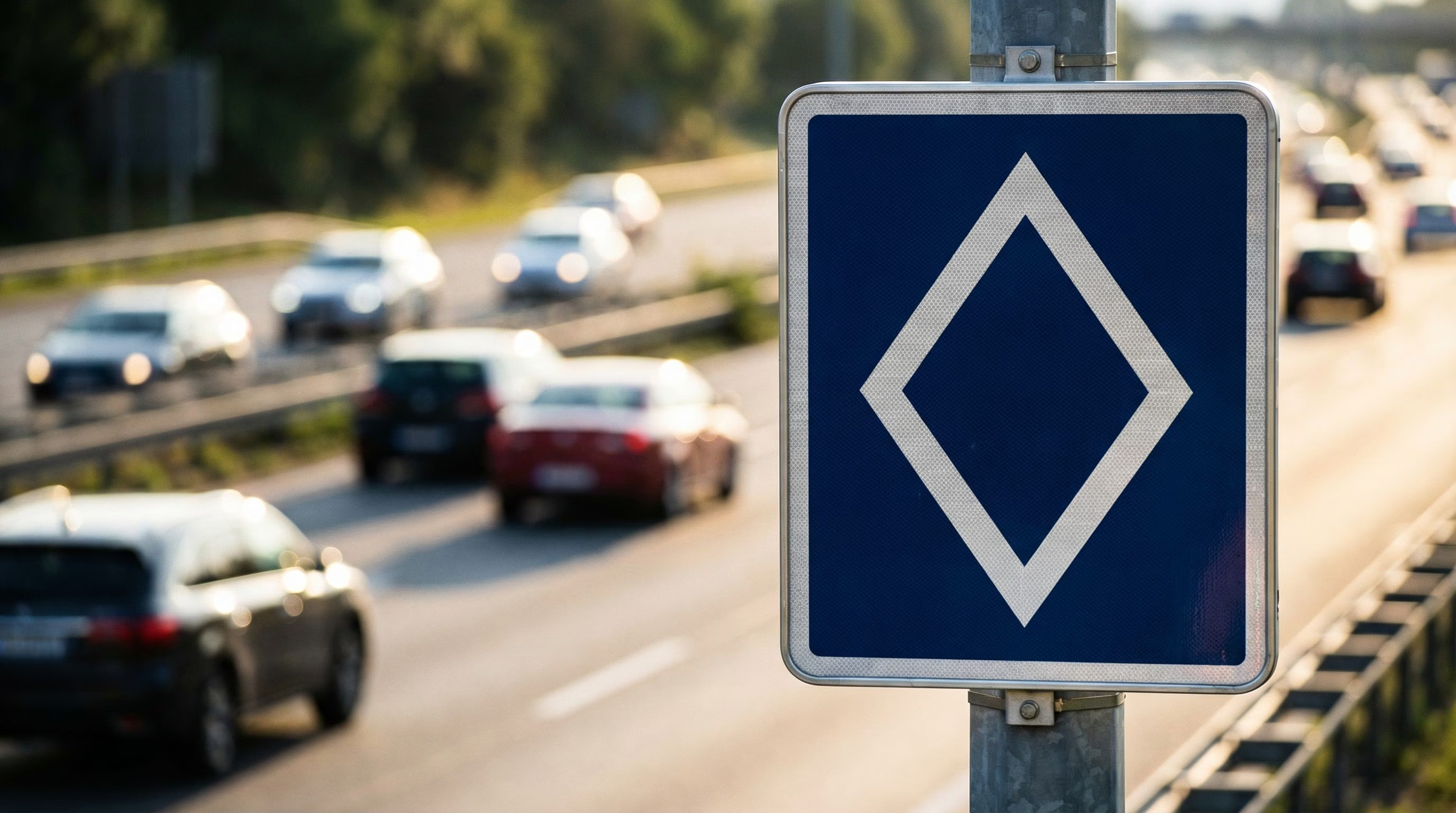
In countries such as Spain, France or the United States there is a new road sign, which has not yet arrived in Italy: it is a white diamond on a blue background, used to indicate the road lanes reserved for so-called HOV vehicles (High-Occupancy Vehicle), i.e. those that carry more passengers or have a reduced environmental impact.
This type of signage, in fact, has already been used for some time in other European countries: in France, for example, since March 2025 the Paris ring road has hosted a lane for “high occupancy” vehicles. The issue, however, has reignited in the last few hours after Spain introduced more restrictive requirements for the use of these carriageways, with fines of up to 200 euros for violators.
In Italy, however, the introduction of these new road signs – and the subsequent creation of preferential lanes – could encourage the carpooling company, which has already recorded a growth of 113% in the last 2 years.
What does the new road sign with a white diamond mean and what is it for
As anticipated, the new road sign consists of a white diamond frequently placed on a blue background, visible in the image below. Its presence along the roads serves to indicate the preferential lanes reserved for “high occupancy” vehicles (High-Occupancy Vehicles) such as, for example, taxis, public transport such as buses, but also private cars carrying multiple people on board (generally at least 2, including the driver).
In Spain these preferential lanes have been introduced in some of the most important road arteries in the country, from the Madrid-Valencia motorway to sections of freeway in Seville, Malaga or Granada. Since 2026, however, the Spanish Government has tightened the requirements for the use of these carriageways – always marked by the appropriate sign – no longer allowing access to electric vehicles, unless they transport more people, and increasing the sanctions in case of improper use, with fines that will now reach up to 200 euros.
In Italy the new cartel could encourage carpooling, which is already growing
At the moment, the Highway Code does not regulate in any way the presence of this new road sign: nevertheless, given the greater diffusion in neighboring countries, it is possible that in the coming years the sign will also be installed along Italian roads, with the consequent formation of lanes reserved exclusively for vehicles carrying multiple passengers.
This initiative, in fact, could further incentivize carpooling (i.e. the sharing of private cars between several people who have to travel the same route, for example to go to work), which allows passengers to drastically reduce the time spent in traffic, but also to split the costs of petrol and any tolls.
Carpooling, among other things, is becoming an increasingly widespread practice among Italian workers, as confirmed by the latest data from the National Observatory on Corporate Carpooling 2026. According to the report, in fact, in 2025, 795,335 car trips shared between colleagues were made: this is an increase of 113% compared to 2023, which made it possible to avoid the issue of 1,623,442 kg of CO2 during the last year and to generate an overall economic saving for passengers of almost 2.5 million euros.
These numbers also have a positive impact on traffic and queues, with 454,819 fewer cars on Italian roads: from this point of view, the most advanced regions are Piedmont, Puglia, Lombardy, Emilia-Romagna and Lazio.