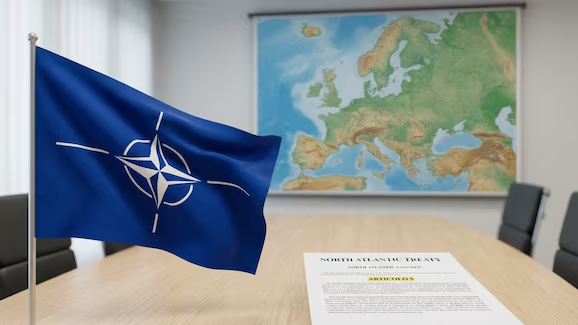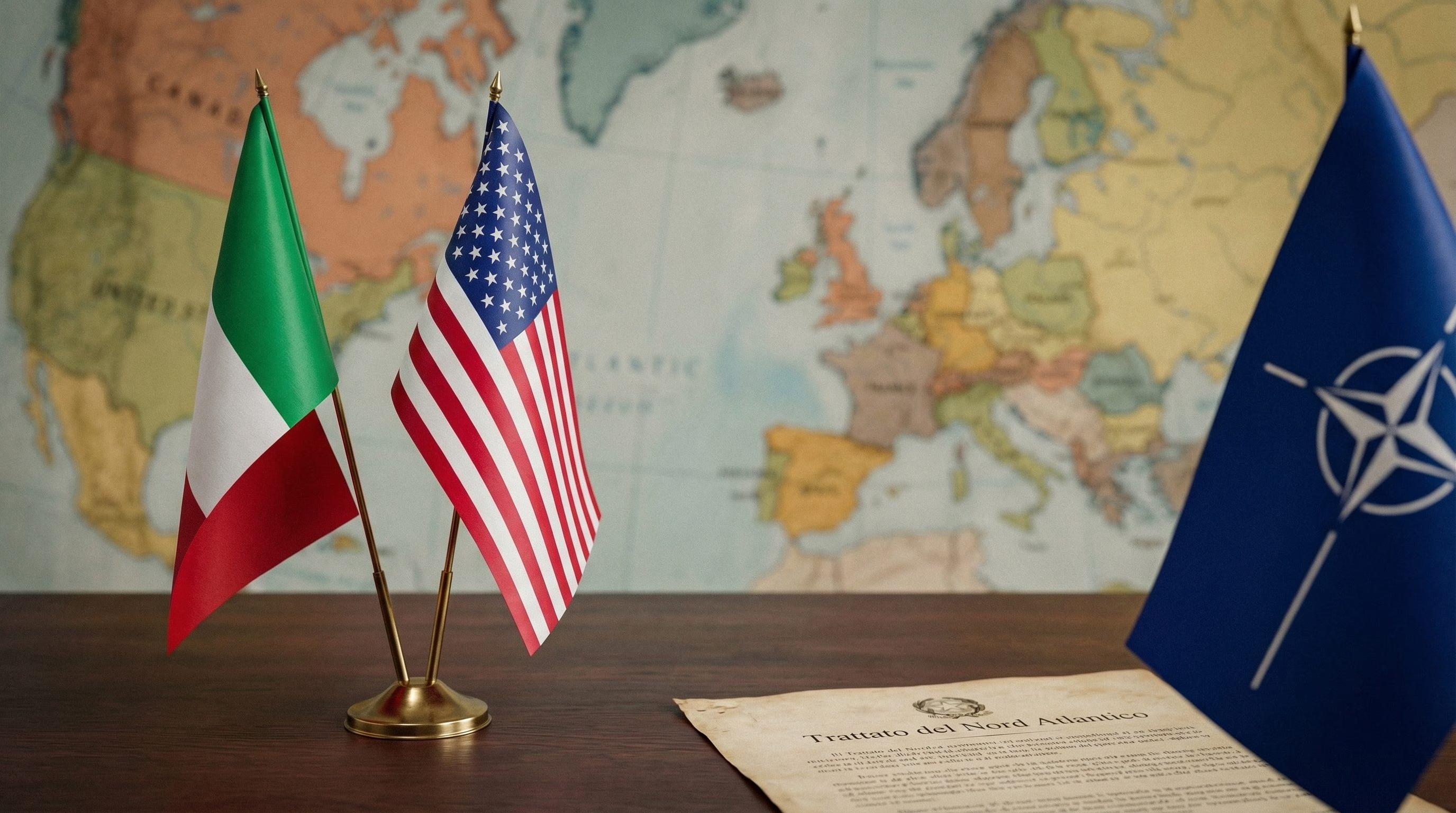
Italy is an ally of the United States and is part of NATO because, during the Second World War, like almost all of Western Europe, it was liberated by Anglo-American troops. During the war, the principle was established according to which the territories liberated from Nazi occupation and its allied regimes would enter the sphere of influence of the power that had made the liberation possible: the Soviet Union in the states of Eastern Europe, the United States in the Western ones. For this reason, Italy was among the founders of NATO in 1949. The Cold War crystallized the alliance.
In short, Italy is an ally of the United States for historical, strategic and geopolitical reasons: the country’s position in the Atlantic bloc still lasts today and, even in the crisis scenario opened with the attack by the USA and Israel against Iran, Italy once again appears closely anchored to Washington’s decisions.
The historical reasons and the relations between Italy and the United States, from the origins to fascism
Italy and the United States had diplomatic relations since 1861. Between the nineteenth and twentieth centuries, millions of Italians emigrated to the North American country, helping to transform it into a great power.
The two countries also fought on the same side during the First World War. During the fascist dictatorship, relations deteriorated due to the aggressive approach of Mussolini, who, especially in the 1930s, made no secret of cultivating “imperial” ambitions. In 1940, President Roosevelt tried to convince the Duce to keep Italy out of the Second World War, started the previous year by Nazi Germany, but he failed. On 10 June 1940 Mussolini made Italy go to war with the United Kingdom and France; in December 1941, after the Japanese attack on Pearl Harbor, he also declared war on the United States.
The Second World War and the Liberation
The war, as we know, proved disastrous for Italy, which in 1943, after the fall of Mussolini, signed the armistice and surrendered to the Allies. As the months passed, it became increasingly clear that Nazi Germany was also destined to succumb and that victory would be for the Allies.
The Anglo-American and Soviet leaders met on several occasions – in Tehran in 1943, in Moscow in 1944 (without the president of the United States), in Yalta and Potsdam in 1945 – and defined the future structure of Europe. In essence, the line passed that after the war the two blocs, the Anglo-American and the Soviet one, would exercise hegemony over the territories they liberated from the Nazis during the hostilities: it was not a principle established in writing in an official document, but accepted, in fact, by the parties.
As we know, the Red Army advanced towards Germany from the East and the Anglo-Americans from the South, through Italy, and from the West, after the Normandy landings. In Italy, the war continued even after the armistice because the Nazis occupied the Central-Northern regions and established a puppet state, the Social Republic, headed by Mussolini. The country was liberated by the Anglo-Americans, who landed in Sicily on 10 July 1943 and in Salerno between 8 and 9 September: with the support of the partisan resistance, the allied troops progressively moved up the peninsula, freeing it from occupation and dictatorship.
The Cold War and Italy’s Atlantic position
The alliance with the United States was defined after the end of the Second World War when, as we know, the Cold War began. The Americans maintained a military presence on Italian territory. In 1947 they included the country in the Marshall Plan, i.e. the provision of financing for reconstruction, which was decisive for the country’s recovery. In Italy the ruling class and public opinion were divided between supporters of the United States, primarily the Christian Democratic Party, and supporters of the Soviet Union, in particular the Communist Party. Everyone, however, knew that the country had been liberated by the Americans and was within their sphere of influence. The Soviet Union also accepted Italy’s “Atlantic” position and never tried to question US hegemony. In 1948 the political elections, influenced by the United States, confirmed belonging to the Atlantic sphere, sanctioning the success of the Christian Democracy. In 1949 the country joined NATO.
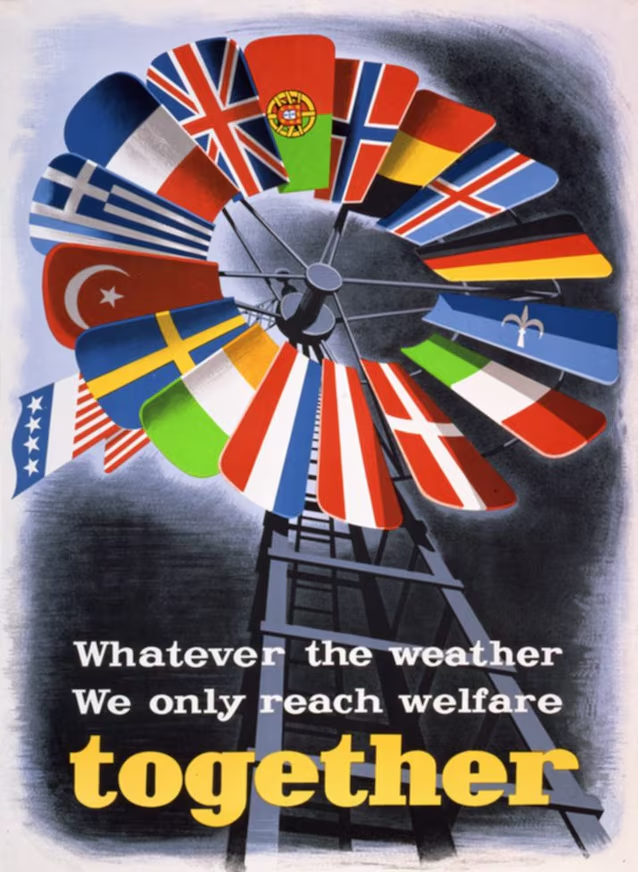
Since then, the alliance with the United States has never been questioned and remained standing even after the collapse of the USSR and the end of the Cold War.
The strategic reasons: the role of US bases in Italy and today’s relations
The alliance, however, is asymmetrical, because the two countries are not on the same level given that the United States exercises an economic, political and cultural hegemony over Italy. Furthermore, the USA manages several military bases in our country, which are essential to make up for their geographical distance from strategic areas, such as the Middle East.
The attitude of the Italian ruling class towards the ally has changed depending on the case: no government has questioned the alliance, but some governments have been able to stand up to the United States without passively submitting to their demands (as in the case of the Craxi government during the Sigonella crisis in 1985) while others have accepted Washington’s requests without question.
The current crisis between the USA and Israel on the one hand and Iran on the other is proof of this: while the war escalation continues, Italy finds itself caught between Atlantic loyalty and the risk of direct involvement in the Gulf. Despite the economic impact of high oil prices and the security risks in the Mediterranean, Rome today seems to align itself with the American maximum pressure strategy, confirming once again the asymmetric nature of the relationship and the difficulty of exercising an autonomous foreign policy in open war scenarios.