Banksy now has an identity: an international agency investigation Reuters has revealed in recent days that the most famous street artist in the world, who remained anonymous for decades, would be Robin Gunningham, a man born in Bristol, England, in 1973, who for years, precisely to deflect the continuous investigations into his identity, has been using another name: David Jones.
How they discovered the identity of the street artist
The journalists analyzed the documents of some activities linked to Banksy, finding the name “David Jones”, but above all followed the trail of a stencil created by the artist on a destroyed building in the Ukrainian city of Horenka, not far from Kiev: the work, dating back to November 2022, depicts a man with a beard washing himself in a bathtub. Going personally to Ukraine, the journalists spoke with the inhabitants, showed them photos of people compared to Banksy in the past. Everyone confirmed that the mural had been created by three people: one could easily be traced back to Giles Duley, an English photographer and documentary maker who was publicly thanked by Banksy for letting him use an ambulance through his association. The other two, they reconstructed, were Robert Del Naja and Banksy himself.
Not only that: the journalists, studying a book written by Lazarides and Instagram accounts, went back to documents relating to an arrest which took place in New York in September 2000, when Banksy was caught by the police while he was modifying an advertising billboard on the roof of a building during fashion week. Reading the files, they found a confession signed by Gunningham.
Confirmed theories about Banksy’s identity
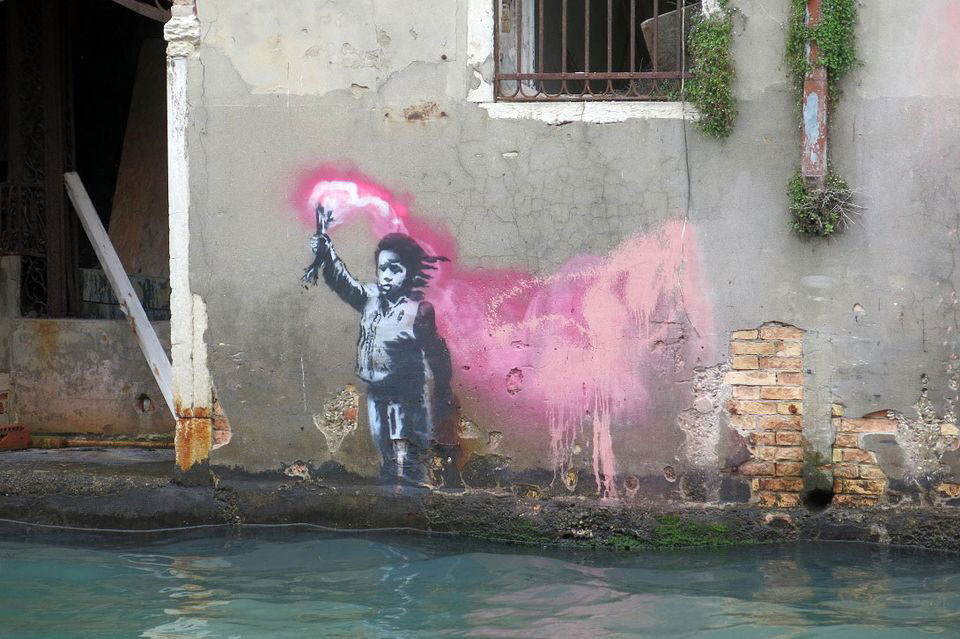
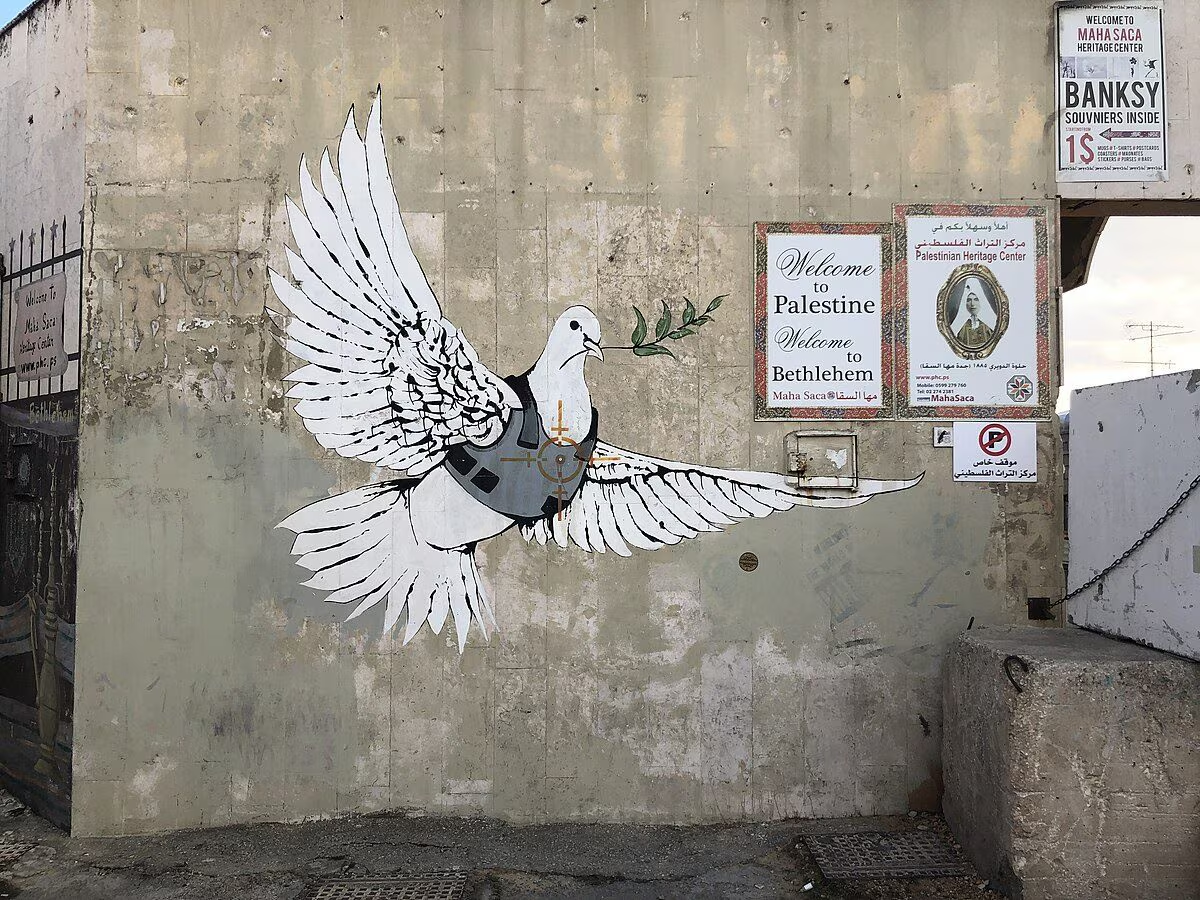
The revelation surprised the world to a certain extent: it was a practically certain fact that it was an English man. Banksy in fact became famous with his stencil graffiti made in Bristol in the early 90s, and almost all theories in circulation wanted him to have been born in the area in the early 70s. The works of the 1990s have a strong political character, which has at times diluted over the years: his first large mural with stencils (The Mild Mild West) depicts a teddy bear throwing a Molotov cocktail at three policemen in riot gear.
The first major investigation into Banksy dates back to 2008, when the British newspaper Mail on Sunday revealed that Banksy was Robin Gunningham, “a former public school student who grew up in a middle-class suburb”. A theory strengthened by the fact that the BBC had unearthed a 2003 interview in which the artist seemed to confirm that his first name was “Robbie”. According to Reuters, after the article was published, Gunningham changed his name to David Jones. Steve Lazarides, the artist’s former manager, confirmed that he had arranged the change of his client’s name, but without revealing what it was.
This had not been the only theory about Banksy’s alleged identity. The singer Robert Del Naja of the Bristol trip hop group Massive Attack had also been linked to the artist, but he always denied it, while admitting that he knew the identity of the real Banksy: now the investigation has linked him to the street artist for the creation of some four-handed murals.
Other less accredited theories linked the artist to public figures such as Neil Buchanan, host of the famous program for children and teenagers Art Attackor the French artist Thierry Guetta, i.e. Mr. Brainwash (who also appears in Banksy’s documentary Exit Though the Gift Shop).Another long-rumored possibility was that which saw in Banksy not a single man, but several people operating as an artistic collective.
Is the Banksy myth at an end?
Now everyone is wondering what will become of Banksy. When his works began to appear, in the early 2000s, first in London and then in big cities around the world, each new piece was a media event and Banksy soon became a celebrity thanks to his status as a “masked artist”. With fame came imitators: this is also why the artist claims his works by publishing at least one photo on his Instagram page.
His personal brand has grown over the last fifteen years, along with the phenomenon of street art exhibitions (for some a contradiction, given the ephemeral and anti-system nature of street art). The exhibitions with his pungent and tragicomic stencils have been sold out around the world, and his works have gone on the market for enormous sums, with clients such as Brad Pitt, Paul Smith and Christina Aguilera. A memorable moment in her rise on the market came in 2018, when the artist made a “performance art” at an auction, smashing her “Girl with Balloon” stencil live at Sotheby’s auction house moments after it sold for a million pounds.
All this, however, has always happened anonymously. And now? The man did not comment personally, nor did he do so through his company, Pest Control Office, which usually mediates relations between him and the outside world. His longtime lawyer, Mark Stephens, has said publicly that he considers Reuters’ reconstruction unrealistic and that in any case disclosing information about his possible identity could threaten the artist’s personal safety, as well as his work. Is this the end of Banksy?