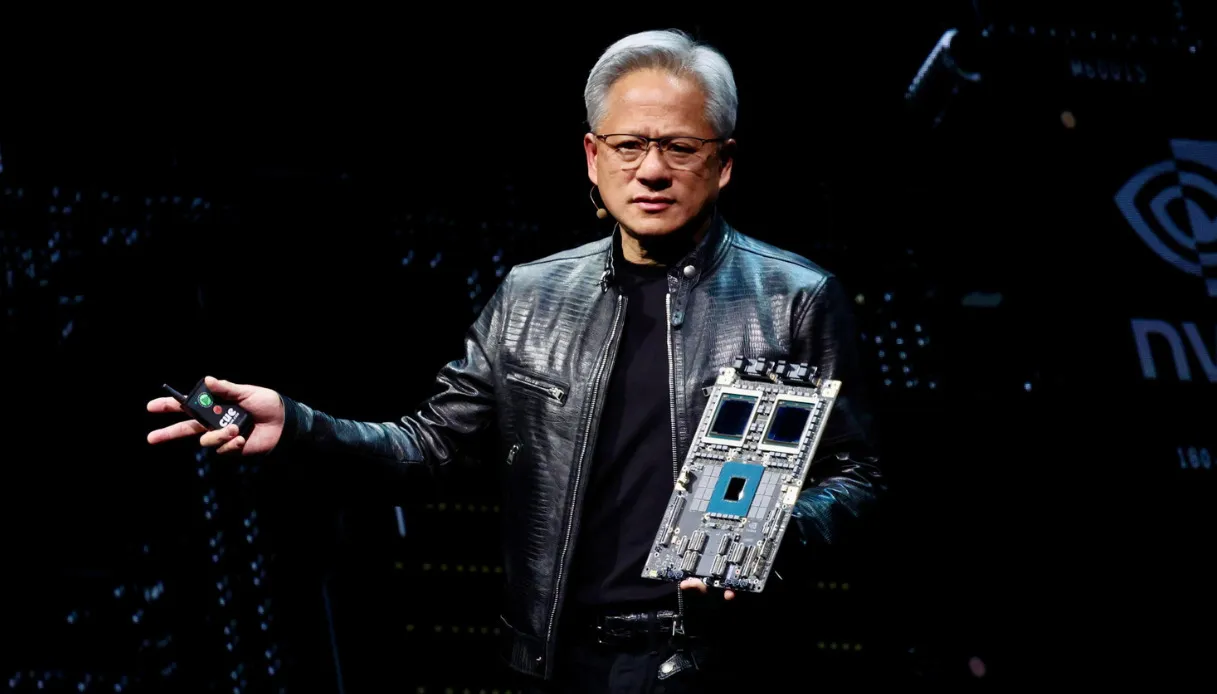
Jensen Huang, CEO of Nvidia, on the occasion of GTC 2026, the company’s biggest event, in front of a packed audience, once again raised the bar on expected orders from its current flagship products, doubling last year’s estimates: between the Blackwell and Vera Rubin platforms, Nvidia expects 1 trillion dollars in cumulative orders by 2027.
On Wall Street, after an initial rise of 4.8%, Nvidia shares failed to exploit the sprint provided by the CEO and quickly reduced their gains, maintaining a more moderate rise of 1.6% to $183.19 at the close.
Nvidia in the right position to take advantage of the boom
Demand, the CEO underlined, is now “inexhaustible”, driven by both emerging startups and technology giants seeking greater capacity to generate more tokens and increase revenues. Huang’s central message is clear: Demand for computing power continues to skyrocket, and Nvidia is ideally positioned to meet this challenge.
Huang announced plans to expand into central processing units (CPUs) and also showcased semiconductors made with technology acquired from startup Groq. Nvidia – he added – is also working on developing chips for data centers in space.
Growth that hasn’t stopped for 11 quarters
With a capitalization of almost $4.5 trillion, Nvidia continues to dominate the artificial intelligence market, supported by revenue growth that has exceeded 55% for 11 quarters. For the current quarter, the company expects a 77% jump to about $78 billion.
Old and new top products
Vera Rubin will arrive in 2026, a system composed of 1.3 million components and capable of offering 10 times more performance per watt than the Grace Blackwell generation. A crucial step in an era where energy consumption is one of the main limits to the expansion of AI.
Huang also unveiled the Groq 3 LPU, the first chip from the $20 billion acquisition of startup Groq.
Looking ahead is Kyber, the next big evolution of Nvidia’s rack architecture, debuting in the Vera Rubin Ultra system, due in 2027.
Huang dedicated part of the keynote to the OpenClaw phenomenon, the open source framework for autonomous agents created by Peter Steinberger and now supported by OpenAI, and presented NemoClaw, a reference stack that allows developers to build enterprise-ready AI agents, leveraging Nvidia hardware.
There is no shortage of autonomous mobility
On the automotive front, Nvidia announced that Uber will launch an autonomous fleet based on Drive AV in 28 cities by 2028. Manufacturers such as Nissan, BYD, Geely, Isuzu and Hyundai are developing Level 4 vehicles with the Drive Hyperion platform, while Isuzu and Tier IV are working on autonomous buses with support for the AGX Thor robotic chip.