Imagine nine hikers, a freezing night with temperatures below -25°C, a tent torn from the inside and bodies found scattered in the snow, half-naked, with inexplicable wounds, without eyes or tongue and with traces of radioactivity. They seem like the perfect elements for a horror film but this, unfortunately, is the true story of the accident Dyatlov Pass occurred on February 2, 1959 in the Ural Mountains, an apparent mystery that for over 60 years has nourished theories of all kinds, from secret military experiments to aliens. The story also inspired the horror film The devil’s step. Recently, however, thanks to modern scientific models and an unexpected “help” from the Disney animated film Frozena scientific study published in Communications Earth & Environment has finally provided a rational answer to this conundrum.
What happened: the Dyatlov Pass case and the expedition into the unknown
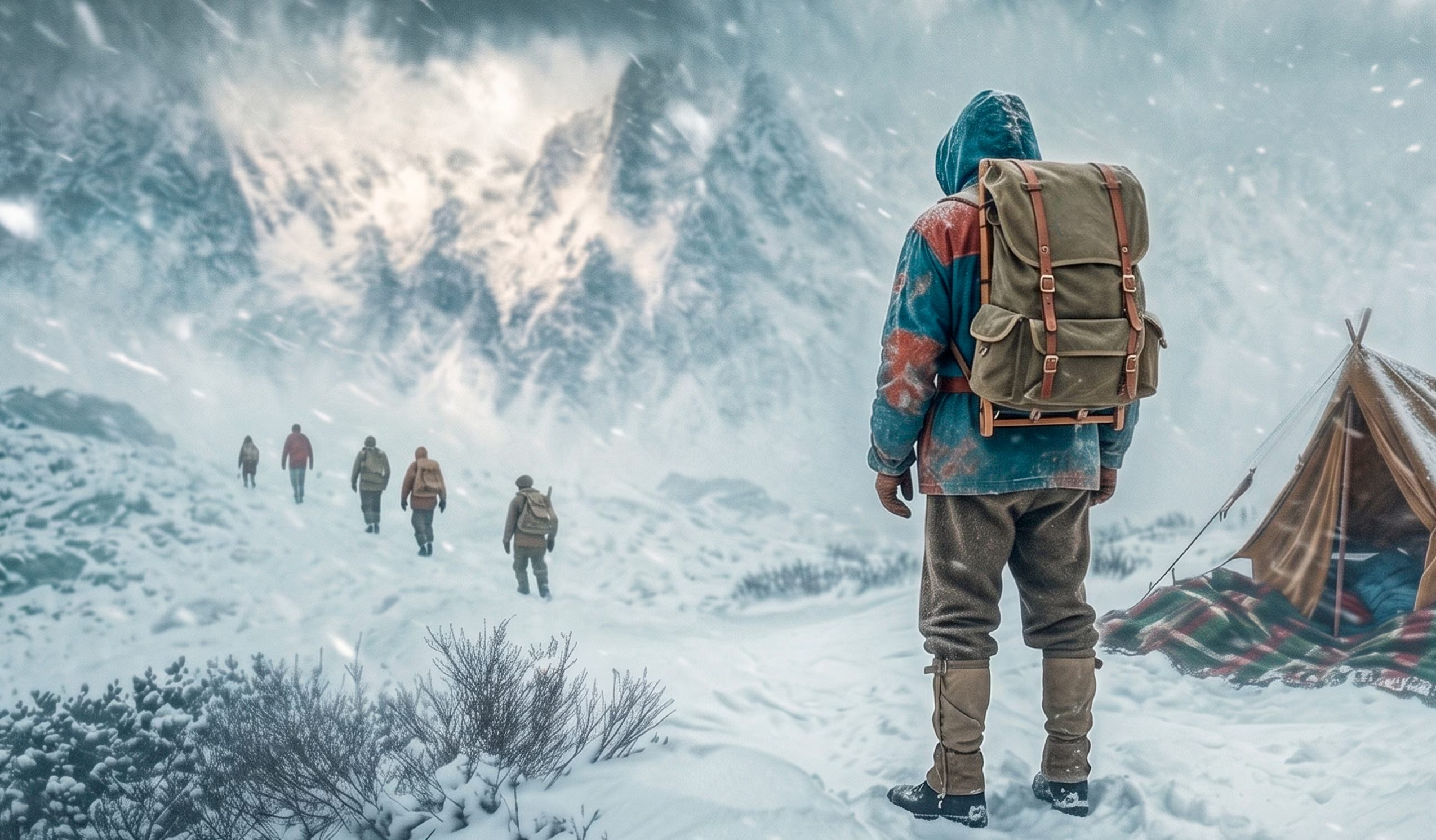
Between the end of January and the beginning of February 1959, ten young and expert ski mountaineers, mostly students or recent graduates of the Ural Polytechnic, undertook an expedition to reach Mount Otorten, under the guidance of twenty-three-year-old Igor Dyatlov. However, one member of the group, Yuri Yudin, fell ill in the first few days and decided to turn back – a choice that, unknowingly, saved his life. The other nine continued but on February 1st a heavy snowstorm inadvertently sent them off the road, causing them to deviate from their route and forcing them to set up base camp on the slopes of Kholat Syakhl, which in the language of the local Mansi tribe means “Death Mountain“.
To set up the tent on a flat surface and protect it from the wind, the guys dig a trench directly into the snowy slope. A few hours after midnight, however, something terrible happened.
Days passed, and there was no news of the young hikers: the alarm was raised on February 20th by their institute and this gave rise to the rescue expeditions.
The discovery of the victims of the 1959 accident
On February 26, the rescuers made the first dramatic discovery: the tent had been abandoned, half buried in snow, cut from the inside and still containing all the equipment and food supplies intact. Following the footprints of bare feet that move away, about a kilometer and a half away near a large pine tree and the remains of a bonfire, the first bodies are found, dead from hypothermia and dressed only in underwear.
But the real horror emerges in May, when the four missing bodies are discovered in a ravine, buried under four meters of snow. These latest corpses present devastating physical injuries: ribs and skulls are shattered, with trauma comparable to those of those who are victims of violent high-speed road accidents. The young Lyudmila Dubinina, for example, is missing her eyes, tongue and soft tissues of her face and even traces of radioactivity are found on the clothes of two victims.
The first hypotheses between conspiracies and the paranormal
Given the surreal nature of the scene, dozens and dozens of different theories have sprung up over the years. The most likely hypotheses suggested an attack by bears or the local Mansi population, or the so-called “avalanche paranoia“, according to which a loud noise at night would have induced the young people to flee needlessly in panic. At the height of the Cold War, explanations linked to military conspiracies took hold: the young people would have inadvertently witnessed tests of secret Soviet weapons, or would have been hit by the accidental explosion of R-7 missiles or killed by the KGB to cover up a failed espionage meeting. Obviously, there was no shortage of more science fiction or borderline absurd leads, such as sudden lethal gravity fluctuations, Yeti attacks, ball lightning, or even alien intervention, a theory fueled by the fact that some residents and rescuers claimed to have seen mysterious bright orange orbs crossing the sky on those nights.
The possible scientific explanation: the study
Today the answer came through a 2021 study published in the prestigious scientific journal Communications Earth & Environment by researchers Johan Gaume of EPFL and Alexander Puzrin of ETH Zurich, confirming the hypothesis of delayed slab avalanche. For a long time this theory had been discarded because the slope did not seem steep enough and because the avalanche did not fall immediately after the trench for the tent had been dug.
The new digital models, however, have highlighted that at that point the slope had an inclination of 28°, a value more than sufficient to generate an avalanche if we consider the pre-existing and unstable layer of “sugar snow” – i.e. of very low cohesion crystals present in that area. The “delay” was instead triggered by very strong gusts of wind which for hours continued to transport and accumulate masses of snow above the tent until, having reached a critical weight, the slab suddenly gave way.
To reconstruct the exact dynamics of the physical injuries to the chest and skull, the researcher Gaume went as far as the Hollywood offices to borrow the algorithmic snow simulator created for the famous cartoon Frozen from the Disney animated studios. By inserting data from General Motors car crash tests from the 1970s into the models, the simulation demonstrated that a heavy and compact block of snow, falling at around 2 meters per second, would be perfectly capable of causing serious fractures to people lying on their backs with their chests crushed between the snow and the rigid floor of the tent (where they had placed their skis for insulation), without killing them outright. This explains why the boys fled in shock and pain, dragging their injured comrades before succumbing to the extreme cold.
And for the more macabre details? The absence of the eyes and tongue of one of the hikers, found face down in a stream under the snow months later, is only the combined effect of prolonged exposure to atmospheric elements and the activity of scavenger animals in the local ecosystem. Even the radioactivity, a very controversial but rationally explainable detail, most likely came from the thorium meshes of old camping lanterns or from residues on the jackets of two of the boys who worked in nuclear plants in the Soviet Union.
In conclusion, even if the incident will continue to fascinate with its sinister and unresolved tones, extraterrestrials or international conspiracies were not needed. It was “just” a brutal and fatal combination of topographical and meteorological elements.