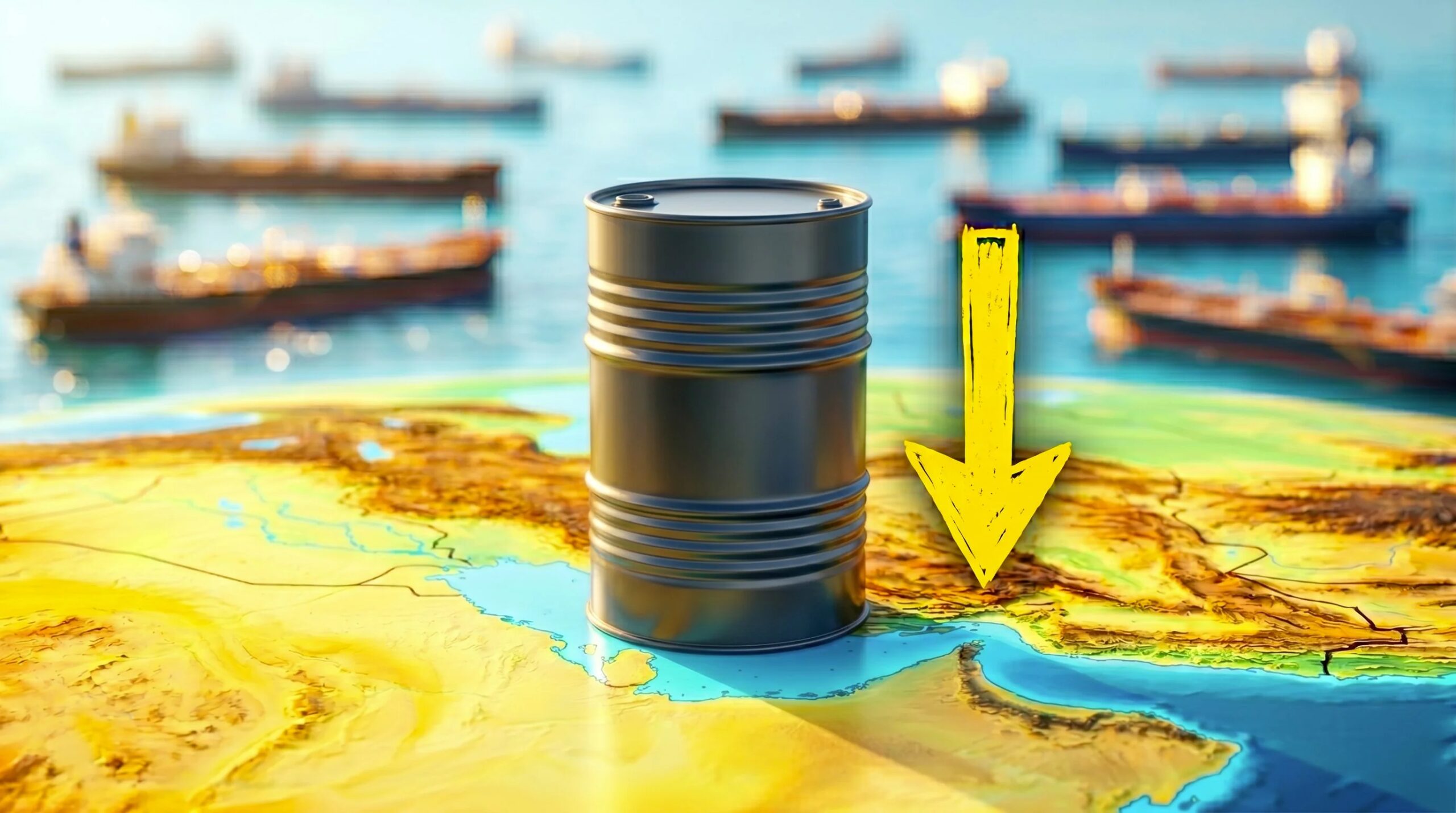
More than ten weeks after the outbreak of war in the Middle East, the global oil market is experiencing one of the most serious crises in its recent history, with oil supplies shrinking “at a record pace”. This is what is highlighted in the new one Oil Market Report of the International Energy Agency (IEA), published on 13 May 2026.
At the center of the crisis, as we all know, is the closure of the Strait of Hormuz, the maritime hub through which until a few months ago a quarter of global oil passed. To compensate, importing countries are drawing on their reserves at a pace never seen before, to the point that in the months of March and April 2026 alone, global stocks were reduced by almost 250 million barrels overall, with OECD countries alone burning almost 5 million barrels per day of their land reserves in April.
The collapse in the global supply of oil is also having repercussions in Italy where, between the end of February and mid-May 2026, the average price of petrol went from 1.67 to 1.93 euros per litre, while diesel rose from 1.72 to around 2.02 euros: an increase which, on a 50-litre tank, translates into 13-16 euros more at each refuelling.
It must be said, however, that at a European level the EU has declared that there are currently no immediate concerns for the energy supply of the member countries of the Union, especially considering that “our supply of both oil, including diesel and aviation fuel, and gas is diversified on world markets”.
How much global oil supplies are: 250 million barrels less
According to estimates released by the IEA, global inventories of crude oil and petroleum products at the beginning of 2026 were around 8.2 billion barrels, the highest level ever recorded since February 2021. In the May 2026 report, the International Energy Agency noted that observed global oil inventories decreased by 129 million barrels in March and by another 117 million barrels in April.
Between March and April, therefore, reserves fell by almost 250 million barrels overall, equal to around 4 million barrels per day: not surprisingly, the Agency underlined how “the growing supply losses from the Strait of Hormuz are depleting global oil supplies at a record pace”. With cross-Strait traffic still closed, cumulative supply losses from Gulf producers already exceed 1 billion barrels, with more than 14 million barrels per day of oil disrupted – this supply disruption is unprecedented in history.
The phenomenon is particularly evident in the case of land-based stocks, i.e. the physical reserves of crude oil and petroleum products stored in land-based warehouses and tanks. In April alone, these reserves fell by 170 million barrels (-5.7 million barrels/day). The ones who bore the brunt were above all the OECD countries, whose onshore stocks collapsed by as much as 146 million barrels (-4.9 million barrels/day) in just one month.
In addition to the issue of inventories and the interruption of supply, there is also the demand for oil to consider: the IEA has in fact predicted that for 2026 global oil demand will reduce by 420,000 barrels per day, reaching 104 million barrels per day. The largest decline is expected to be seen in the second quarter of 2026, with a decrease of 2.45 million barrels per day: the petrochemical and aviation sectors are currently the most affected, but rising prices and a weaker economic context will have an increasingly greater impact on fuel consumption.
The consequence, according to the IEA, is that the oil market will remain in deficit until the last quarter of the year: even if the United States, Israel and Iran were to reach an agreement to end the war in the coming months, in fact, global supply would still need months to return to pre-war levels.
How petrol and diesel prices have increased in Italy
The collapse in global supply, due precisely to the interruption of supplies from the Middle East, caused the surge in oil prices, which reached an average of 120.36 dollars per barrel.
Despite not being in a situation of actual fuel shortage, as highlighted by the European Union, this surge has also had an impact on Italy, in particular on the prices of petrol and diesel.
At the end of February 2026, before the outbreak of the war, average weekly prices on the road network in self-service mode were still moving at relatively low levels: on 27 February (the day before the joint attack by the USA and Israel against Iran), petrol stood at around 1.67 euros per liter and diesel at 1.72 euros, according to data from the MIMIT Price Observatory.
In March 2026, however, the rise in prices began. On 16 March 2026, again according to MIMIT findings, the average self-price of petrol on the road network had risen to 1.82 euros per litre, while diesel had reached 2.03 euros. In just over two weeks, therefore, petrol had earned around 15 cents per liter and diesel 31 cents.
In April, however, the extension of the excise duty cut allowed a slight decrease in average prices on the road network, but only for petrol: on 27 April 2026, the MIMIT reported an average self of 1.73 euros per liter for petrol, but 2.06 euros per liter for diesel.
In May, however, a new surge arrived: on 30 April the Italian government extended the cut in excise duties by 21 days, but with a remodulation. The discount on diesel was kept full at 20 cents per litre, while that on petrol was reduced to 5 cents. The result was seen immediately: according to the latest data released by Osservaprezzi, on 11 May 2026 the average price was 1.93 euros per liter for petrol and 2.02 euros per liter for diesel.
All things considered, in two and a half months self-service petrol went from around 1.67 euros to over 1.93 euros per litre: an increase in prices of around 26 cents, equal to 15% more. Diesel rose from 1.72 to around 2.02 euros, with a jump of around 30 cents (around 17.5%). On an average 50 liter tank, therefore, we are talking about a price that fluctuates between 13 and 16 euros per refueling.
The scenario, however, could change shortly: the extension to the excise duty cut expires around May 22, 2026 and the executive will have to decide whether to renew it, let it drop (with petrol approaching 2 euros per liter and diesel above 2.05) or intervene with structural measures.