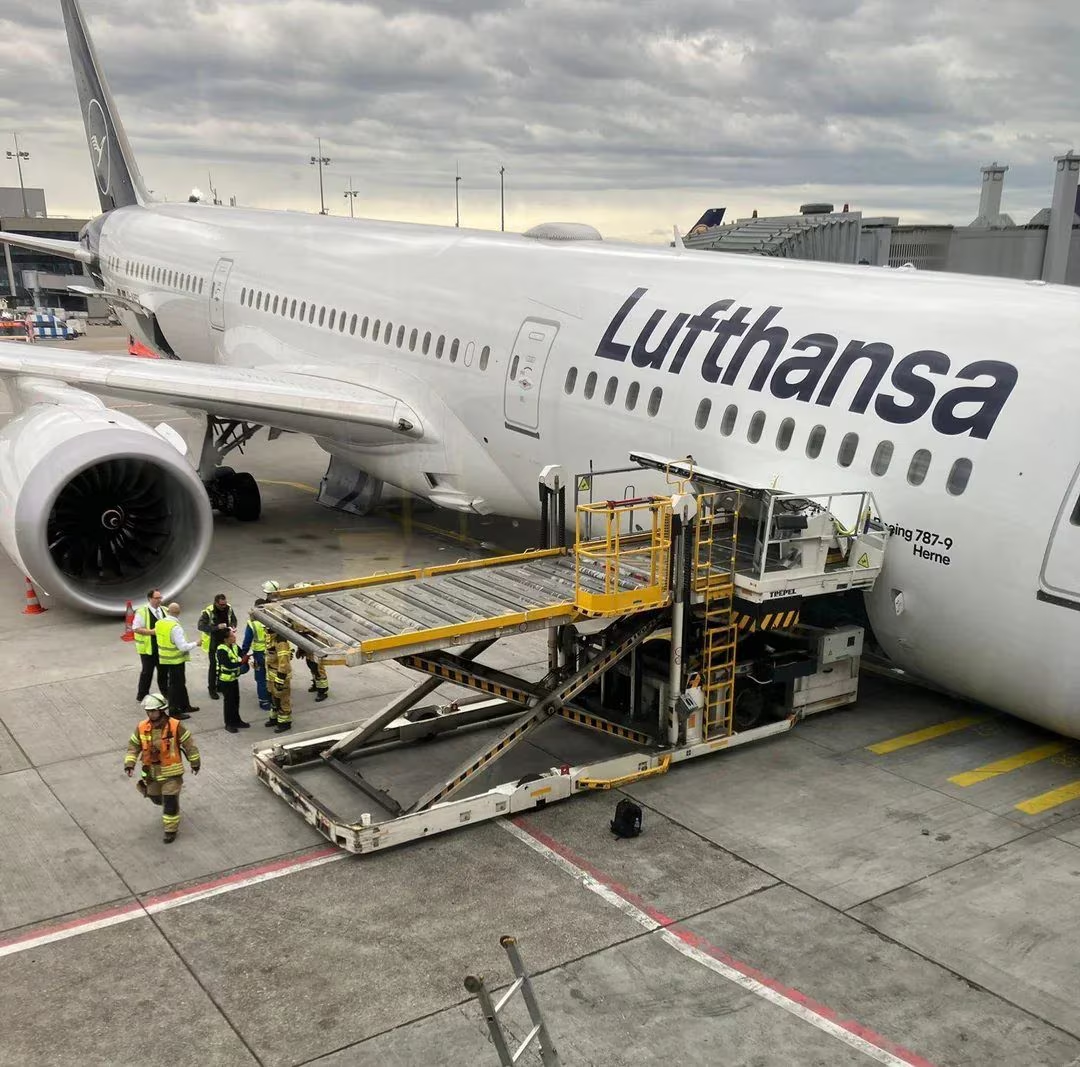
The nose landing gear of a Lufthansa Boeing 787-9 Dreamliner collapsed while the aircraft was still parked at Frankfurt airport, Germany, waiting for passengers to board. The nose of the plane suddenly lowered until it touched the tarmac, tilting the gigantic Dreamliner as the ground crew watched. The accident occurred around 12.45pm on Thursday 4 June: fortunately there were no passengers on board yet, but several crew members and ground technicians were injured and received medical assistance.
The plane suffered extensive damage: Lufthansa activated a crisis unit and flight LH450, which was supposed to take passengers to Los Angeles, was cancelled. From the point of view of possible causes, the German Federal Bureau has not yet released official information: in the last few hours there has been talk of a possible error in the positioning of the downlock pinsmetal bars that would prevent the landing gear from retracting during maintenance procedures, as happened in a previous 2021 incident involving a British Airways aircraft. This hypothesis, however, will have to be confirmed or denied by government investigations.
Possible causes of the plane crash in Frankfurt
The accident occurred during normal flight preparation operations, before the passengers boarded. The impact of the plane also trapped a baggage loading vehicle, which was positioned under the door, and caused some panels of the undercarriage compartment to detach, with the engine nacelles touching the asphalt. The aircraft, identified with the acronym D-ABPQ and renamed by the company after the German city of Herne, suffered significant damage.
From the point of view of possible causes, it must immediately be said that the authorities have not yet released official information. The airline pilot Nicolò Fatai, in a video on his Instagram profile, spoke of the hypothesis (circulated in the last few hours) according to which the landing gear was operated upwards by mistake, causing the nose of the plane to collapse.
In reality, Fatai explains how on a modern airliner there are sensors and safety systems that prevent the landing gear from retracting when the plane is still on the ground. However, during some maintenance procedures there is the possibility of bypassing these protections, thus allowing ground maintenance workers to overcome these blockages.
As the pilot reports, these procedures are carried out according to very specific methods, which involve the use of so-called «downlock pins», some metal safety bars which serve to physically block the trolley in the extended position, so that it cannot re-enter even if the command to bring it upwards is activated.
Among other things, in 2021 a British Airways Boeing 787-8 suffered a very similar accident: at the end of the investigation, it was confirmed that the metal safety bar had been inserted in the wrong position, resulting in the landing gear retracting and the nose of the plane collapsing.
This hypothesis, however, remains only one of the various possibilities that the inspectors of the BFU, the German Federal Bureau for the Investigation of Air Accidents, will have to investigate to establish with certainty whether it was a human error, an accidental activation or a structural failure. Lufthansa has not yet provided any details in this regard.
The Boeing 787-9 Dreamliner: technical characteristics
The Boeing 787-9 Dreamliner is one of the most modern and advanced long-haul aircraft around. It is a stretched variant of the basic 787-8 model, with a length of around 63 meters and a wingspan of almost 60 metres. As also reported on Boeing’s official website, the aircraft can carry up to 296 passengers in a three-class configuration, with a total range of approximately 14,000-15,000 kilometres, which makes it suitable for intercontinental routes such as Frankfurt-Los Angeles.
One of its main features is the heavy use of carbon fiber composite materials, which make up around 50% of the structure: this makes it lighter and more fuel efficient than previous models. The nose gear of the 787 – the one positioned under the nose of the plane and composed of only two wheels – is produced by Safran Landing Systems. And it is precisely this element that failed in Frankfurt, causing the nose of the plane to collapse on the asphalt. The aircraft involved in the accident was built in 2025 and delivered to Lufthansa in January 2026, only entering regular commercial service in mid-February.