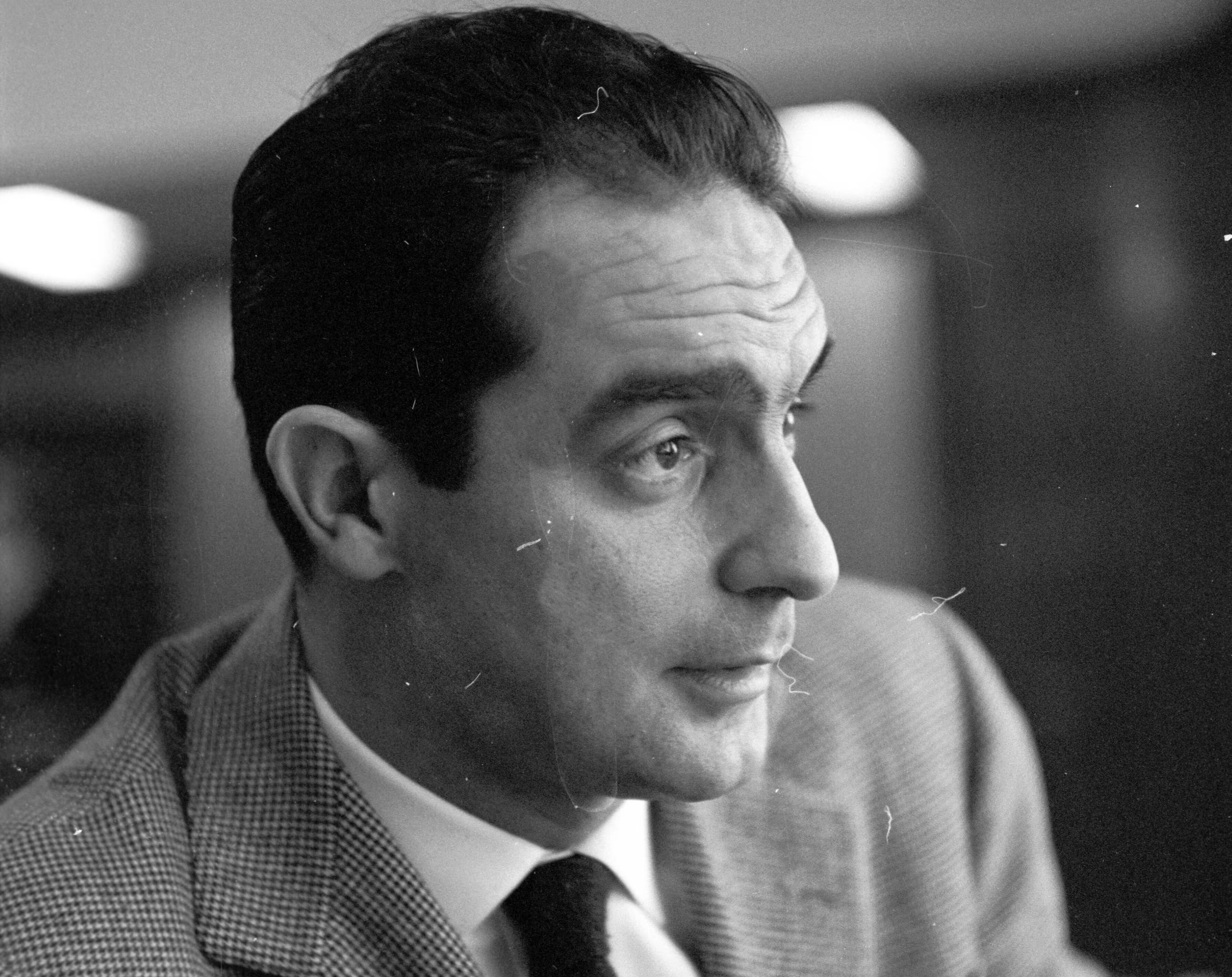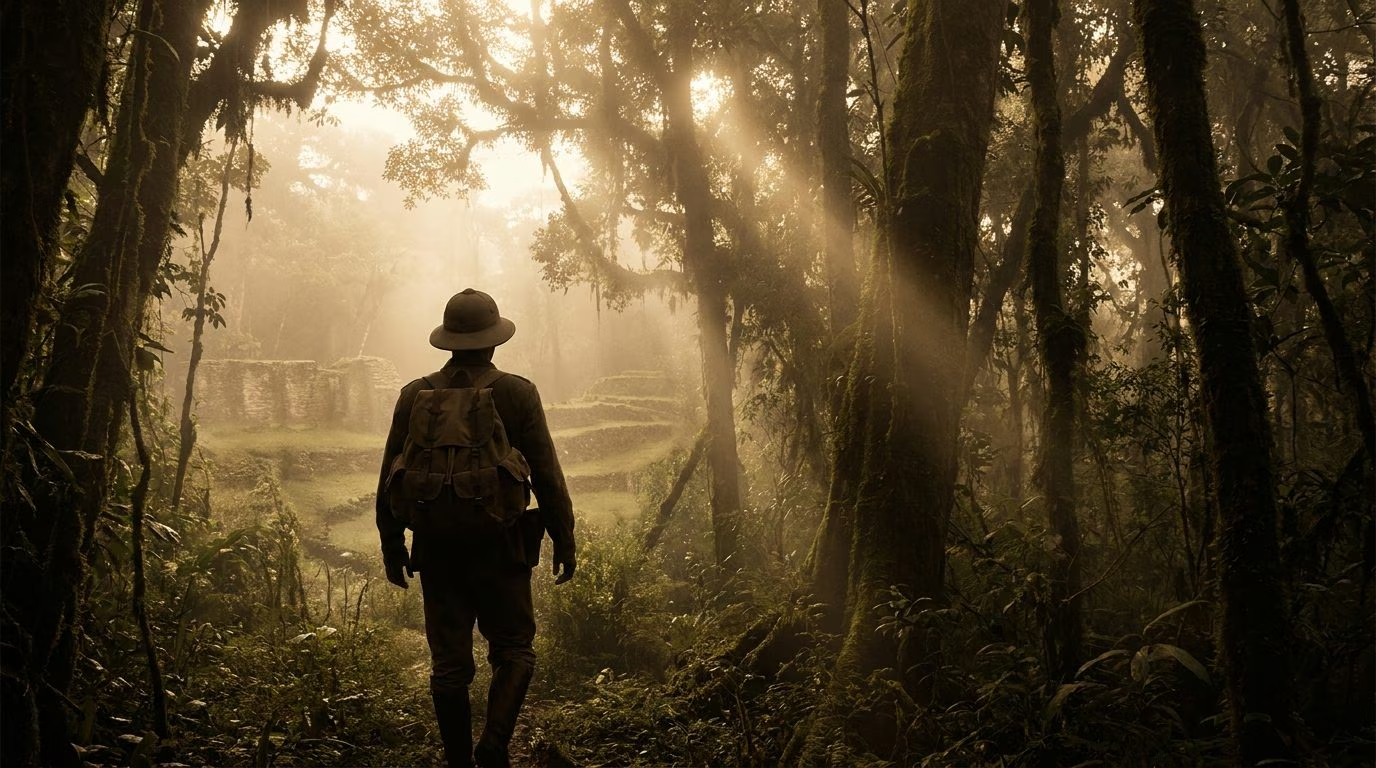
When we imagine an archaeologist-adventurer ready to do anything to snatch a forgotten treasure from the jungle, our mind almost always goes to Indiana Jones, the character created by George Lucas and who arrived at the cinema on 12 June 1981 with the film Raiders of the Lost Ark, directed by Steven Spielberg and winner of 5 Oscars. Behind that icon, however, there are men who actually existed, like the archaeologist Hiram Bingham (who revealed Machu Picchu to the world) and the zoologist Roy Chapman Andrewsbut above all Percy Harrison Fawcett: British topographer, archaeologist and explorer who lived between 1867 and 1925, disappeared into thin air one hundred years ago, during his research in the Amazon in the company of his son, aimed at discovering the remains of an advanced civilization similar to Atlantis, which he christened “Z”. An unexplained disappearance that has fueled many theories and led to one of the greatest discoveries in South American archaeology.
Who was Percy Fawcett, the real Indiana Jones
Born on 18 August 1867 in Torquay in Devon, England, Fawcett joined the Royal Artillery at just 19, serving in Ceylon. In the following years he worked as an intelligence agent in North Africa and as a topographer, a professional specialized in the measurement and representation of the territory on maps, while he deepened his archaeological studies.
By virtue of his skills and resourcefulness, in 1906 the Royal Geographical Society (the most authoritative British geographical society), of which his father of Indian origins Edward Boyd Fawcett was also a member, sent him to Latin America to trace the still unexplored borders between Brazil and Bolivia. After fighting in the First World War, where he enlisted as a volunteer, the explorer returned to his true obsession: the Amazon.
Able to resist tropical diseases and other deadly dangers, especially animals (in his accounts he said he survived a 19 meter anaconda), Fawcett became a small legend in his homeland and the reports of his expeditions, carried out between 1906 and 1925 for zoological and archaeological reasons, also contributed to inspiring his friend Arthur Conan Doyle in the writing of the novel The lost worldpublished in 1912. Professor Challenger is in fact partially inspired by Fawcett.
The obsession with the city of “Z” and Manuscript 512
At the beginning of the twentieth century, the idea dominated that the Amazon was nothing more than a “deceptive paradise”, a wild environment incapable of hosting large advanced populations and inhabited only by small, scattered tribes. Fawcett, however, didn’t believe it: after finding fragments of ancient ceramics on one of his trips to Mato Grosso, he became convinced that the forest held the remains of an advanced civilization.
His “proof” was a document from 1753 preserved in the National Library of Brazil, the so-called Manuscript 512: compiled by Portuguese gold miners (i bandairantesthe explorers-adventurers who explored the interior of Brazil), described the ruins of a monumental city, with streets, squares and stone arches, hidden in the heart of the jungle. From that text Fawcett drew his objective, which he renamed with a single code letter: la lost city of “Z”.
The last expedition of 1925: swallowed up by the forest
In April 1925, at the age of 58, thanks to the financing of a group of wealthy Londoners, Fawcett left for Mato Grosso, Brazil, with a bare minimum of equipment and only two companions: his twenty-two-year-old son Jack and a friend of the latter, Raleigh Rimmell. Being few in number would have helped them in case they had to hide from any hostile tribes and the two young men, strong, loyal and unaccustomed to Western vices, would have been perfect companions for the mission.
On May 29, he sent his last letter to his wife Nina from the Dead Horse Camp (so called by himself because his horse had died here in a previous expedition), after having crossed a river with the help of the indigenous Kalapalo population: the three were about to enter uncharted territory. “Fear not, we will not fail,” he wrote. But no one ever saw them again. Since then his disappearance has continued to cause victims: it is estimated that over one hundred people have died or disappeared looking for him. Fawcett, before leaving, had in fact recommended himself: “If we don’t have to return, I don’t want them to come looking for us with rescue expeditions. It’s too dangerous. If, with all my experience, we can’t make it, what hope can there be for the others? That’s why I don’t want to say exactly where we’re going. Whether we manage to save ourselves and return, or whether we leave our bones there to rot, one thing is certain: the solution to the riddle of ancient South America – and perhaps of the whole world prehistoric – will only be found when the ancient cities are rediscovered and opened to scientific research… That these cities exist, I know with certainty.”
However, the first search expedition was launched in 1928 by the American explorer George Miller Dyott, who reported having found the remains, but the story later turned out to be invented. As late as 1996, an expedition led by businessman and explorer James Lynch, on the trail of Fawcett, was surrounded and taken hostage by the Kalapalo in the Xingu Indigenous Park, and was freed only after having handed over all the equipment and paid a ransom.
Killed, died of starvation or escaped? The theories
Many others, over the years, offered different theories, which were never confirmed. The most widespread version has Fawcett murdered by the natives. But the most solid reconstructions tell something different. Already in 1931 the Italian-American anthropologist Vincenzo Petrullo, in Mato Grosso on behalf of the Penn Museum of the University of Pennsylvania, spoke with the Kalapalo who had ferried Fawcett across the Kuluene River and concluded that the three had simply died of hunger, thirst or disease, having gone too far east, excluding indigenous responsibility. A reading confirmed by the stories handed down by the Kalapalo themselves, who said they had seen the smoke from the three’s camp for a few days, before it went out forever.
Then there is a more recent theory, certainly among the most surprising: in 2004, in the British newspaper The Observer, director Misha Williams, who had obtained access to the family’s private papers, claimed that Fawcett had no intention of returning to his homeland. A fervent follower of theosophy (a nineteenth-century spiritual current that mixes mysticism, esotericism and oriental religions), he would have cultivated a “Great Design”: to found a secret community in the jungle based on the adoration of his son Jack (who believed he was a sort of reincarnated spirit) and inspired by the image of a female “spiritual guide”, a kind of otherworldly mermaid who recurs in the family archive. In short, more than looking for ruins, he wanted to build a new world far from society. It remains a hypothesis, based on private documents and so far not confirmed by independent sources, but it gives the measure of how much this story defies any simple explanation.
He was right: Kuhikugu’s revenge
Leaving aside esoteric theories, Fawcett was right about the existence of ancient Amazonian civilizations. For decades scholars had derided him, but starting from 1993 anthropologist Michael Heckenberger of the University of Florida finally proved him right, combining excavations, satellite images and ground penetrating radar with the collaboration of the Kuikuro people, descendants of those inhabitants.
Today, in fact, we know that it stood precisely in the upper Xingu, in Mato Grosso Kuhikugu: a network of fifteen to twenty settlements connected by roads up to 40 meters wide, with central squares, defensive ditches and log palisades. The regional system extended for approximately 20 thousand km² and could host tens of thousands of people (estimates speak of 30-50 thousand).
This civilization flourished from at least 1,500 years ago until it collapsed after the arrival of Europeans in the 16th century, decimated by disease and then reabsorbed by the forest. It is very likely that Fawcett had intercepted remains and artefacts without being able to recognize them for what they were. The definitive confirmation came with a technology that he couldn’t even imagine: the LIDARa laser remote sensing that digitally “strips” the vegetation from above and reveals what is hidden under the canopy, which in recent years has made it possible to bring to light real urban networks buried in the Bolivian Amazon (the Casarabe culture, described on Nature in 2022) and in Amazonian Ecuador (the Upano valley, reported above Science in 2024), definitively retiring the idea of a “virgin and uninhabited” forest.
Fawcett never found the golden towers of his city of Z, and in all likelihood those towers never existed. But his obstinacy, misunderstood for almost a century and derided for decades by other scientists and archaeologists, sure that the jungle could not host great civilizations, had grasped and defended something a century in advance that turned out to be true: the Amazon was not a green desert, but the cradle of complex and populous societies.