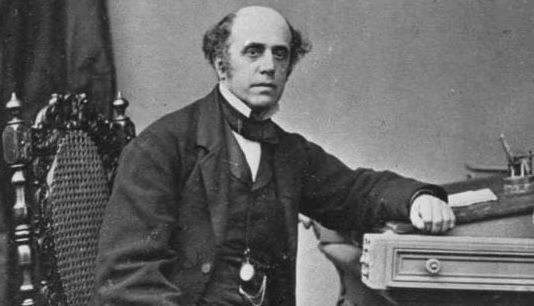
In July of 1841, Thomas Cook (1808-1885) – Protestant pastor and British entrepreneur, coming from a very poor family and very attentive to the problems of society, organized the first collective train journey from Leicester to Loughborough, with the aim of offering a valid, fun and stimulating alternative to people, and distracting the weakest and poorest groups from rampant problem of alcoholism. Founder of Thomas Cook and Son It is therefore officially considered the inventor of modern tourism (and the first package all-inclusive!): from that moment on, Thomas Cook dedicated himself entirely to organizing trips, including summer holidays and beyond, taking people around Europe and the world. The agency that bears his name it is still in business today.
The inventor of the first travel agency Thomas Cook: who he was and how he came up with the idea
Thomas Cook was born in 1808 to a very poor family in Derbyshire, England: at the age of 10 he left school and began working as an apprentice gardener, before completing an apprenticeship as a cabinetmaker and finally choosing to become Baptist preacher. He was a person who was very attentive to the problems that afflicted society: in particular, he was very sensitive to the plague ofalcoholism which in England, at the time, claimed many victims, especially among the poorest and among the lowest-ranking workers. Alcohol was an inexpensive refuge from problems and hunger: Cook joined the Temperance Societya movement that promoted moderation in every aspect and therefore also the complete abstinence from alcoholic beverages.
Cook soon realized that it was not enough to preach to prevent people from choosing alcohol as a “palliative” to the fatigue of work and poverty, but it was necessary to offer them aconcrete alternativesomething that promoted one healthy and pleasant lifestyle.
The story of the first organized steam train journey in July 1841
In 1841, Cook had a truly winning intuition: why not propose afun and interesting activity to do in a groupto divert workers’ attention from what ailed them? In particular, he thought of taking the opportunity of the great novelty of the railways – the first English railway network was inaugurated in 1825 – to organize a journey from Leicester, north-east of Birmingham, to Loughborough, a little further north, for a journey of 35 kilometres. In the modest price of a shilling the organization of everything was included: meals, songs and activities in true “tourist package” mode.
Cook publicized the initiative with advertising flyers, and the success was immediate: the participants found themselves in a real one “trip out of town” for all budgets, fascinated by being able to take a steam train, during which Cook did not spare himself sermons on the importance of refrain from drinking.
As, on July 5, 1841 what is officially started the first organized trip in historygiving life to modern tourism concept.
Thanks to the British entrepreneur, modern tourism was born
Thomas Cook realized he had had a brilliant idea and, following the first voyage, organized many others: officially founded his companywhich still exists today and was refounded in 2019 following bankruptcy. On the occasion of Great Universal Exhibition in LondonCook brought 150,000 people to the city, proving that the trip was in all respects, wholesome entertainment that actually mattered.
He organized a European tour in 1855 and also a 222 day world tour In the 1872called “China via Egypt”, which touched Japan, India and the United States, as well as the Holy Land, considered for the first time as a travel-pilgrimage destination.
The agency, just as it did on the first trip, thought of everything, from promotion with catalogues to the coupons to spend in participating hotelsbut also to exchange of money between different currenciesproviding travelers with “Circular Notes”.
Thomas’ son, John Mason Cook, joined his father, who died in 1892, and then continued the business, making it possible for tour operator “Thomas Cook” to still be in business today, albeit after several changes of ownership.