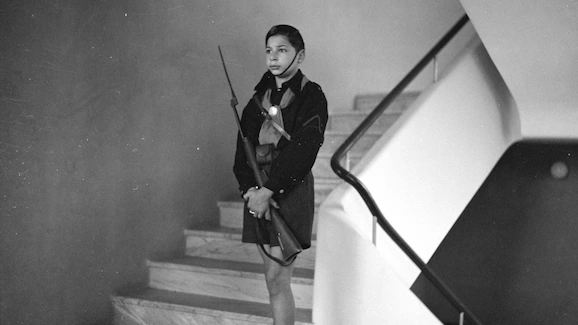
The Italian Social Republic, also known as the Republic of Salò and which existed from September 1943 to April 1945 (in the midst of the Second World War), was a puppet state controlled by Nazi Germany. Power was formally held by Mussolini, who however acted under the control of the Germans.
The RSI was established after the Kingdom of Italy signed the armistice with the Anglo-Americans. Originally it had jurisdiction over the entire central-northern part of the Peninsula but, thanks to the advance of the Allies, its territory progressively reduced. The RSI also had to face the resistance of the partisans, who made an important contribution to its defeat.
The fascists of the RSI collaborated with Nazi Germany in the deportation of Jews and were responsible for serious crimes against Italians.
History of the Social Republic: the puppet state in the hands of the Nazis
The Italian Social Republic was a puppet state established in 1943 in central-northern Italy by the Germans and fascists. After 8 September, when Italy made public the armistice signed with the Anglo-Americans, the German armed forces freed Mussolini, detained on the Gran Sasso, and placed him at the head of a new state, controlled by them, to continue the war against the Allies.
The State took the name of the Italian Social Republic in December 1943 (previously it was called the Italian Republican State) because it aimed to achieve the socialization of businesses, which in reality it would never have implemented.
The RSI was also known as the Republic of Salò, because the Ministry of Foreign Affairs and other institutions were based in the town in the province of Brescia. Mussolini instead resided at Villa Feltrinelli in Gargnano. All institutions were located in northern Italy.
The RSI did not enjoy any international recognition other than that of Germany and other allied countries of the Rome-Berlin Axis.
The territory of the RSI: the advance of the Allies and the Resistance
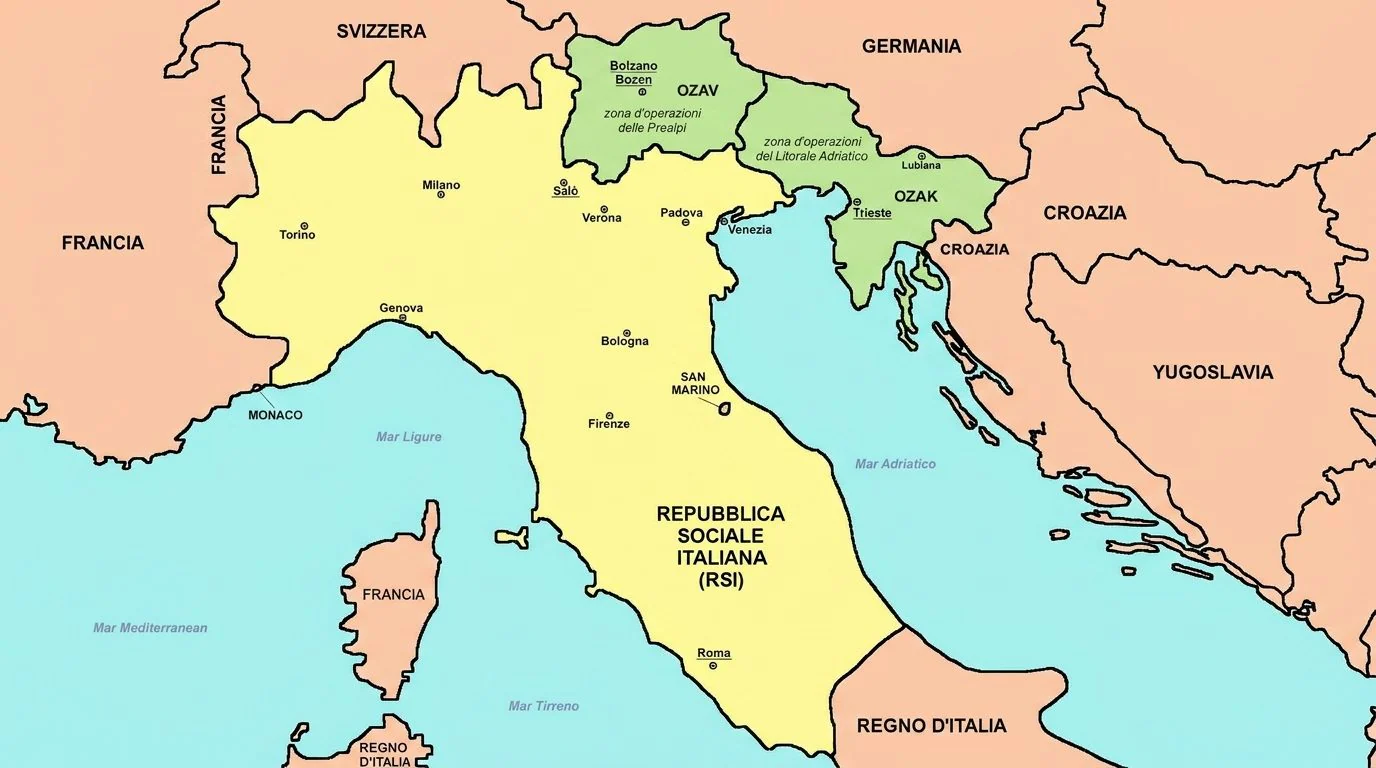
The RSI originally had all of central and northern Italy under its control, with the exception of vast territories ceded to direct control by Germany: Trentino, Alto Adige, Friuli and Istria.
CSR at the time of its establishment. The areas under direct German control are in green. The rest of the territory, however, progressively shrank. The Anglo-Americans landed in Salerno on the night between 8 and 9 September 1943 and began the liberation of Italian territory from Nazi occupation and Mussolini’s dictatorship.
In the autumn of 1943 the Allied advance stalled along the Gustav line, located between Cassino and Ortona. As a result, all territories north of this line, including the city of Rome, remained under RSI control. The Anglo-Americans crossed the Gustav Line in May 1944, liberated Rome at the beginning of June and continued their advance north. The front stabilized again in the autumn of 1944 along the Gothic Line, near the Tuscan-Emilian Apennines.
In the last months of its life, the RSI governed only the territories north of the line, i.e. the Po Valley and the Alps. In April 1945 the Allies crossed the Gothic Line and liberated the regions still occupied: the RSI thus ceased to exist. Mussolini was captured by partisans and shot.
During its existence, the Republic of Salò had to fight not only against the Anglo-Americans, but also against the partisans, who conducted guerrilla actions in the mountains and, in some cases, also in the cities, making an important contribution to the liberation of the country and promoting its moral redemption: while the fascists were aligned alongside the Nazis, other Italians fought to facilitate the liberation of the national territory.
The institutions of the Republic of Salò
In the RSI, power was concentrated in the hands of Mussolini, who held the position of president of the Council of Ministers. Mussolini, however, was under the control of Nazi Germany.
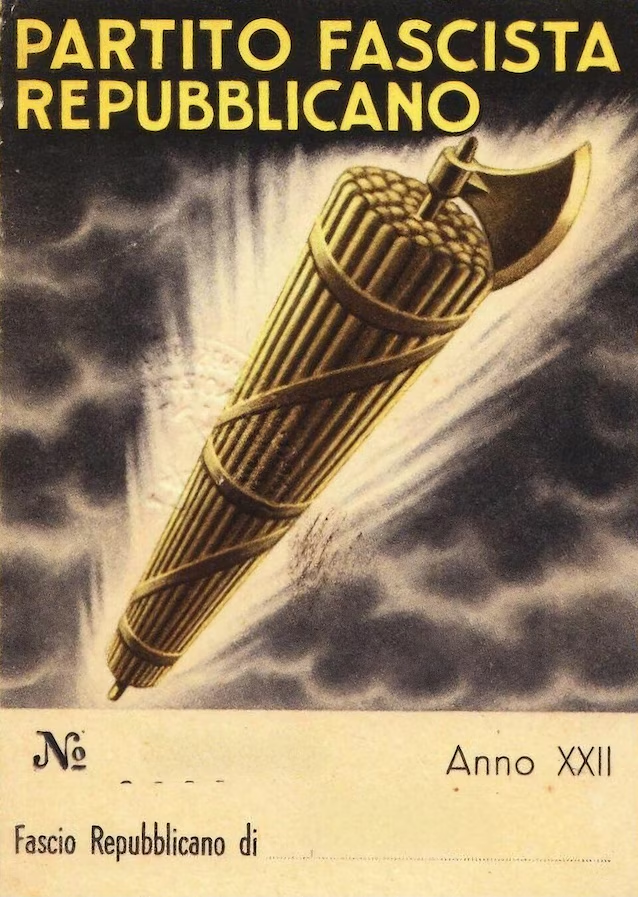
Various institutions were present in the territory of the Republic, derived from those of fascist Italy. The single party was the Republican Fascist Party, which had the task of political education of citizens and control. His secretary was Alessandro Pavolini.
The RSI had a regular army, made up of ordinary citizens called up to arms on orders of the Minister of War, Rodolfo Graziani. However, despite death threats for those who eluded the call, the rate of draft evasion and desertion was very high.
Party militias were also active in the RSI, the Black Brigades, the National Republican Guard and some smaller formations, which fought above all against the Resistance.
Justice was administered by “ordinary” courts subject to the control of the political power and by a special court responsible for judging political opponents. The Special Tribunal conducted the Verona trial against the fascist hierarchs who, in the session of the Grand Council of Fascism on 24-25 July 1943, had sided against Mussolini.
War crimes: the persecution of the Jews and the Nazi massacres
In the RSI, racial legislation against Jews was in force, introduced by fascism in Italy since 1938, which was further tightened. Furthermore, the authorities of Salò collaborated with the Nazi occupation troops in the deportation of the Jews to the extermination camps. The fascists provided support, detaining Jews in transit camps and facilitating German roundups. The best-known roundup is that of the Rome ghetto, from which on 16 October 1943 more than a thousand Jews were captured and deported to Auschwitz.
At the time of the RSI, the Nazis carried out numerous massacres against Italian citizens, without finding opposition from the authorities of Salò: Marzabotto, Sant’Anna di Stazzema, Civitella di Val di Chiana are just the best known. In some cases the Italians actively collaborated in the massacres, for example by providing lists of people to be eliminated, as in the case of the Fosse Ardeatine massacre. The Salò police force was also responsible for torture and summary executions of partisans and opponents.